Homer never called Ithaca an island. Not once. For centuries we assumed the poet described Odysseus’s homeland as an isolated landmass, surrounded by sea. We built entire mental maps around that image. It turns out those maps were wrong. Two scholars, James Diggle from Cambridge and John Underhill from Aberdeen, say the assumption is dead. Long live the peninsula.
Their argument rests on the text itself. Homer consistently uses Greek words like gaia (land) or patris (native land) to describe where Odysseus lives. He also uses dimos, meaning domain or region. If the poet wanted to say island, the word nisos fits the meter just fine. It has the same syllable structure. The spot in the verse was empty real estate for a word he never filled.
“He has many opportunities to call it an island,” Diggle says. “But he never does so.”
Consider the scene where Odysseus finally sees his home after ten years at sea. Most translations say the ship approaches “the island” of Ithaca. But look closer. The Greek says he enters the dimos of Ithaca. The domain. The implication is subtle but sharp. Ithaca isn’t the whole thing. It’s part of the larger land the ship is nearing.
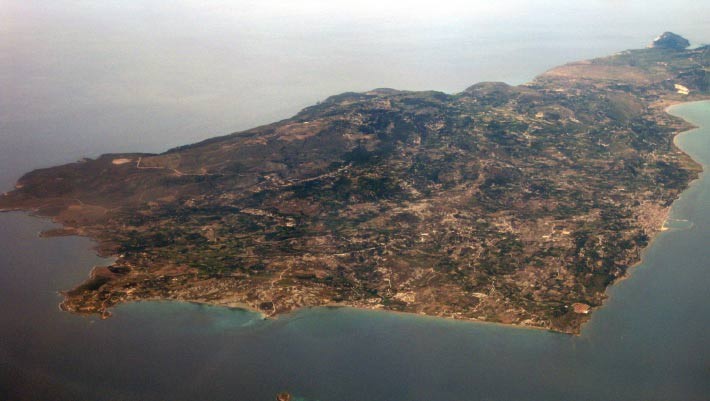
That larger land is Kefalonia. Specifically the Paliki peninsula in the west. This fits better with Odysseus ruling over the Cephallenians. It makes geographic sense too. The modern island of Ithaka is mountainous and faces east. Homer describes his Ithaca as low-lying and west-facing, sitting near three other islands.
A businessman named Robert Bittlestone noticed this mismatch back in 2005. In Odysseus Unbound, he proposed that Ithaca used to be its own island before geological shifts joined it to Kefalonia. The theory was seductive. The catch was physical. A channel of water had to have existed there around 1200 B.C.E.
Underhill spent twenty years digging for proof. He ran geological surveys. He looked for the scar of the strait. Nothing. The channel never existed.
This was supposed to be the end of the Paliki theory. Instead, it strengthened it.
If Ithaca wasn’t an island, the geology supports the philology. The texts point to a peninsula. The ground points to the same place. Recent digs at Livadi Marsh on Paliki are turning up Bronze Age artifacts. It was a significant hub. Odysseus’s harbor? Maybe.
“We are confident an elegant explanation has emerged,” the researchers note. One that unites the dirt under our feet with the words on the page. It aligns with Bittlestone’s founding insight. The mountainous Ithaki is a decoy. Paliki is the prize.
We read these stories as ancient truth. We map them onto reality with arrogant certainty. Maybe we should have listened to the grammar first. Who checks the meter?
The sea is still there. The rocks are the same. Just our perspective shifts, slightly.