Finding proof that life exists somewhere beyond our solar system feels impossible half the time.
But then comes a paper that changes the frame entirely. A study published today in Science details a massive leap forward in identifying a nearby exoplanet with a potentially habitable, Earth-like atmosphere.
It is not a guarantee of aliens. It is not proof of life itself.
It is proof that a rocky planet can hang on to the air we breathe long after its formation. That is enough to keep us looking.
Jason Dittman, an astronomy professor at the University of Florida, put it simply: this is the first time we see a rocky, terrestrial planet that actually seems to hold onto an atmosphere.
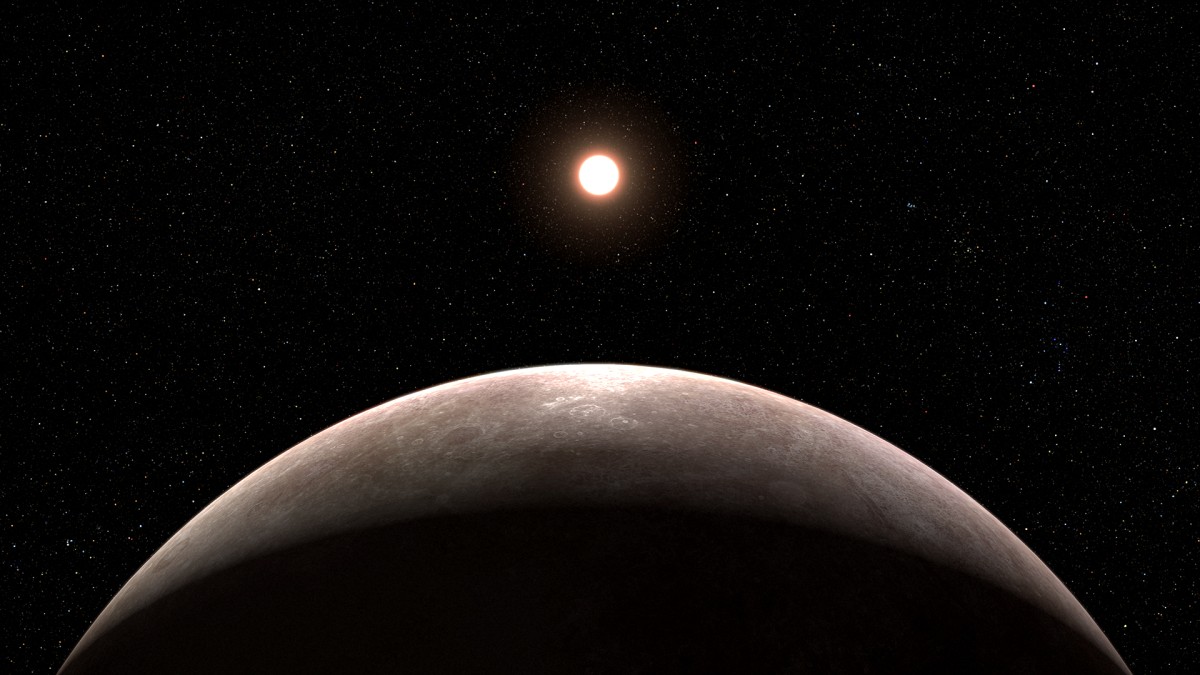
Dittman was there when LHS 1140 c was first spotted back in 2017. He knows the object well. The planet orbits a small red-dwarf star known as LHS 114 c. It sits comfortably within the star’s habitable zone—the “Goldilocks” range where temperatures don’t boil off oceans or freeze them solid instantly.
“This is the first time that we’re seeing a rocky, Earth-like planet with an atmosphere that can sustain itself.”
There is a problem though. LHS 11 40 b is old.
Usually age kills an atmosphere. The wind of space strips gases away. Gravity isn’t always enough to keep them anchored. For older planets we expect bare rocks. Faint echoes of gas maybe. But nothing substantial.
LHS 11 0 40 4 17 should be stripped bare by now.
It is not.
Here’s what actually happened. Scientists pointed Chile’s Magellan Clay telescope at the target. They collected X-ray and extreme UV data across two distinct windows in 24 and early 20 25.
The result? Helium.
They spotted helium escaping. That sounds like a leak. But think about it differently. Where is that helium coming from? It implies a replenishment system. A mechanism keeping the supply steady.
It might look like a burp. Dittman likes to ask: Is this a barren rock occasionally vomiting out trapped gas that immediately escapes?
Or is this a steady-state atmosphere? The kind Earth has. The kind that leaks a little, but mostly stays.
Astronomers have chased this answer for years. Confirmation of dense climates on rocky worlds is the white whale. Without it all previous observations are just guessing. We see faint remnants. We see vacuum. Now we see structure.
Does that mean humans can visit tomorrow? No.
Can you survive without a suit? Not yet.
But it clears a huge hurdle. Life requires two non-negotiable things first.
– A surface solid enough to stand on.
– Air to regulate the temperature and chemistry.
LHS 1 4 b has the surface. It appears to have the air.
What remains missing? The big one. Water. Liquid gold. The final box scientists tick off before they really start getting excited about biology.
How did this data come out of nowhere? Timing. LHS 0 4 c can only be viewed for short windows each year due to how its orbit aligns with our own. If you miss those dates you wait months.
Which means these observations were hard fought. Precise. Rare.
Why does helium matter so much here?
It acts as a tracer. When upper-atmospheric atoms escape, helium tends to rise to the very top. Its escape velocity gives us a clue about the weight and presence of what is underneath. It signals a pressure layer that simply does not exist on bare rock.
If further studies back this up we will have changed the game. Not with a green little guy.
With a sky.
Will the atmosphere stay? That’s the next question. We’ll see when the telescope looks again in 206. For now the signal is loud enough to hear.
Do you think finding an atmosphere is more important than finding water? Or vice versa? The debate isn’t settled.
For today the rock breathes.