We always thought RNA was too simple for the heavy lifting.
That assumption is cracking. A new study suggests RNA can build massive, sophisticated structures. Filaments. Cages. It wasn’t just a humble genetic carrier waiting for proteins to show up and save the day. The “RNA world hypothesis” has long claimed RNA preceded DNA and proteins, but the prevailing wisdom said those early molecules could only manage tiny, basic folds. That view might be completely wrong.
The shift matters because it rewrites the origin story.
Why RNA complexity changes our view of life’s dawn
For decades, the gap was clear. Proteins use twenty different amino acids. That gives them a huge palette. RNA only has four nucleotides. The logic went that RNA lacked the variety needed to fold into anything complex. It couldn’t build structures. It couldn’t catalyze complex reactions without help. Proteins stepped in, took over, and locked the biological system in place.
But this logic assumes limited variety equals limited structure.
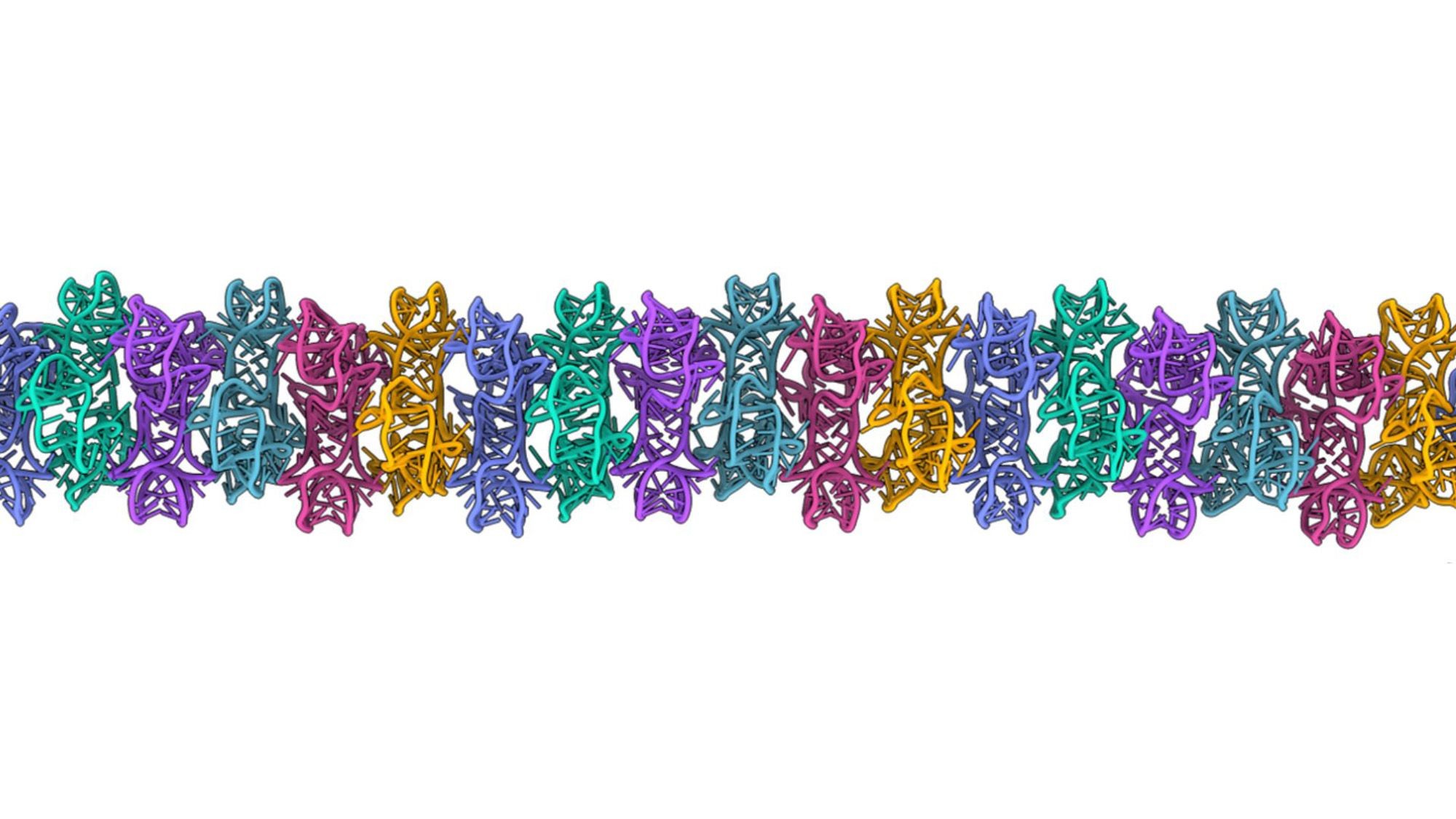
A recent paper posted on bioRxiv by Lin Huang of Sun Yat-Sen University argues otherwise. Huang and his team found RNA can do things we’ve never seen before. The research isn’t peer-reviewed yet, but the cryo-electron microscopy images are startling. They show RNA assembling into large complexes that rival protein-based architectures.
This directly challenges the assumption that only proteins can build elaborate geometries.
“It suggests that at the origin of RNA world could assemble into all kinds of shapes,” Huang told Live Science.
Which mechanisms allow RNA to build large structures
The secret isn’t more ingredients. It’s the way the pieces lock together.
The researchers focused on “kissing stem loops.” Picture a shoelace tied in a loop. If another shoelace loop presses against it, they kiss. Stick together. Link up. The team sifted through RNA sequences and found families from bacteriophages—viruses that infect bacteria—that used this exact mechanism.
Here is what happened when they tested it in the lab:
- They purified the RNA molecules.
- They let them assemble in a dish.
- The short strands (under 200 units each) snapped into place.
The result was immediate and robust.
Some formed filaments that look a lot like the cytoskeleton of modern cells. The cytoskeleton moves things around. It holds cells in shape. If early RNA could do that, life could have been structural very early on.
Others formed icosahedral cages. Think of a soccer ball. Twenty triangles making a sphere. Modern herpesviruses use protein cages (capsids) to hide their DNA. Could ancient RNA have built its own viral-sized boxes? It’s possible. The geometry checks out.
Where do these RNA structures exist in nature
Here is the catch. The structures formed in a dish. They don’t necessarily form inside the bacteria that harbor the viruses.
Huang’s team hasn’t seen this happening in vivo yet. Inside a real cell, proteins everywhere might disrupt these RNA links. Or maybe proteins help them? We don’t know. The lab environment is clean. Cells are chaotic.
Anna Medvegy, an evolutionary biologist not involved in the study, raised a different concern. It’s not just about chemistry. It’s about environment.
“I definitely think that environmental parameters are a Question,” Medvegy wrote. “Can these structures form in the environment where the hypothetical RNA World existed?”
If the dawn of Earth meant scalding heat or low pH, would these kissing loops survive? Maybe. But if you cook the RNA, it falls apart. Recreating those prebiotic conditions to test structural integrity is the next hurdle.
Short RNA strands break easily. That’s a major problem for longevity. Yet, the fact that short pieces built big things is promising. Long chains snap. Short ones snap too. But if short ones link into stable nets or cages, they might have endured the chaos of early Earth better than we thought.
Did RNA actually do this four billion years ago?
We can’t go back to check.
We only have these beautiful, fragile cages sitting in petri dishes. They are proof of capacity, not history. But capacity matters. It means the tools were there. The blueprints exist in viruses we see today. Maybe life wasn’t as slow and clumsy at the start as we imagined. Maybe it was building skeletons and shields from day one.
Or maybe the conditions were just too hot.
Who knows? The lab says yes. The earth says wait and see.