Decades of silence were broken by a whisper.
Astronomers caught it. A faint radio signal. It came from a neutron star we thought was dead.
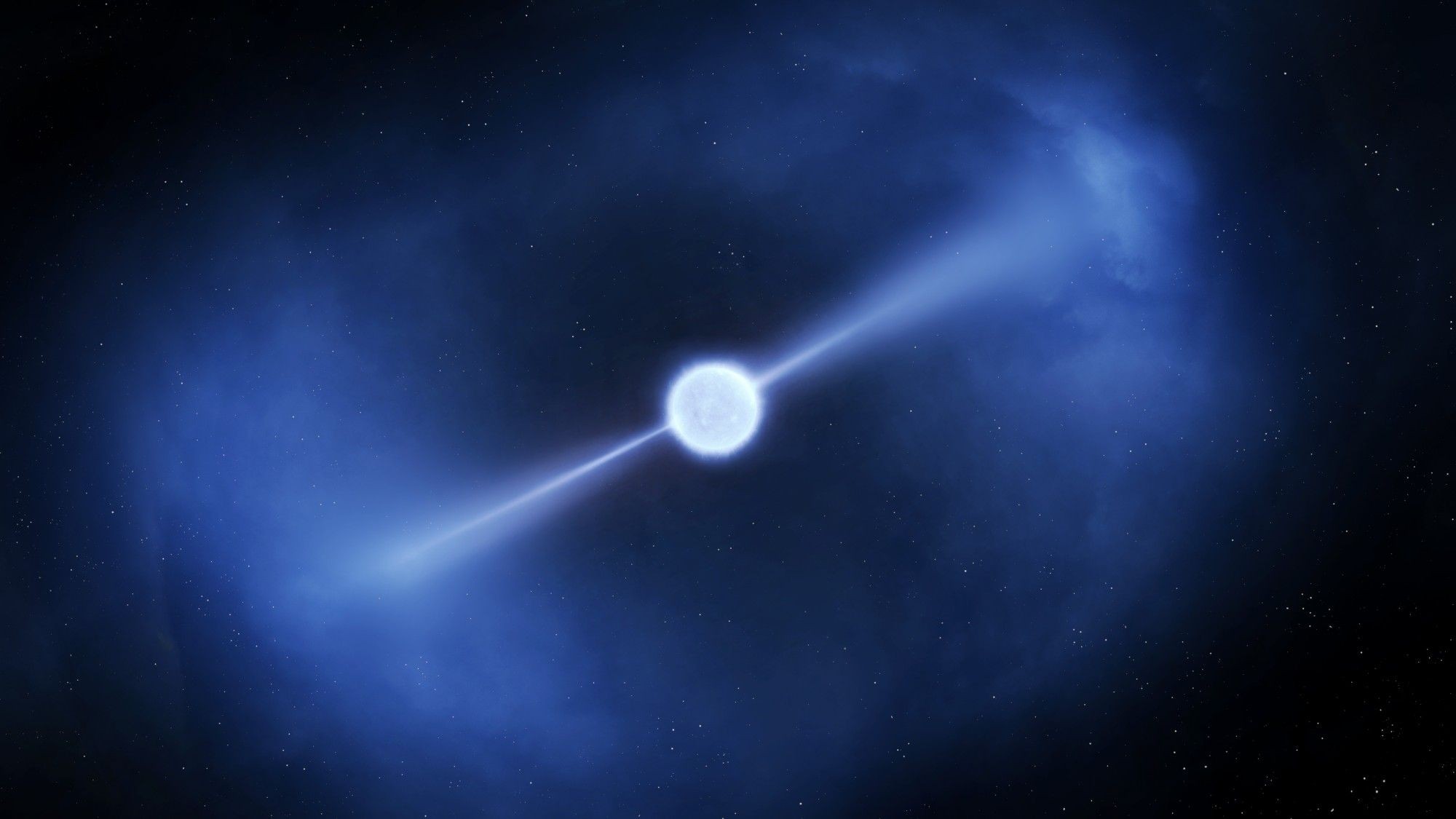
When a massive star blows itself up, the core collapses. Gravity crushes it down. It becomes either a black hole or a neutron star. If it’s the latter, it’s spinning fast. Really fast. Its magnetic field whips charged particles into a beam, shooting them out near the speed of light.
That beam emits radio waves. As the star spins, the beam sweeps past us. Like a lighthouse. Flash. Dark. Flash. Dark. That’s a pulsar. Simple enough.
But not every neutron star behaves this way. About a dozen known objects sit in the middle of supernova craters and say nothing. No radio waves at all. Astronomers call these Central Compact Objects or CCOs. For years, we assumed their magnetic fields were just too weak to make any noise. We listened. We heard static. Or rather, the absence of it.
Until Zhang Lei’s team decided to look harder.
Using the MeerKAT radio telescope in South Africa, they locked onto a specific CCO: 1E 1207.A-5209. It’s in our own galaxy, ten thousand light years away. And guess what? It was talking.
Faintly. Yes. But definitely pulsing. Every 424 milliseconds, a weak radio burst fires. It matches the star’s known spin. It’s not silent. It was just hiding.
Li Di, a professor at Tsinghua University, has a nickname for this object. The Blue Eye Pulsar. Not for the light alone, but because when you overlay the faint radio data onto bright X-ray images, it resembles a blue eye. 👁️
Here’s the kicker.
This thing has history. The supernova that made it exploded 4,100 years before it happened to you. Back in 2015, we saw it stutter. A “glitch.” The star spun up slightly, faster than physics said it should be allowed. Maybe internal material shifted. Maybe the core twisted.
Lei’s team thinks that glitch did the heavy lifting. It might have reoriented the magnetic field. Or strengthened it. Enough to turn on the radio transmitter. Or perhaps the signal was always there, just too feeble to catch until the angle changed.
What happens now? The glitch settles. The star slows back to its normal crawl. The radio waves might stop. If they do, it proves these stars are shy emitters, switching on and off.
And that changes everything.
We may have missed them. All along.
If this Blue Eye is a prototype for other quiet neighbors, the Milky Way is swimming in undetected pulsars. We might have classified old, slow-spinning pulsars incorrectly. Or we might be missing young ones entirely, mistaking their quietness for age when they are actually just… quiet.
Look at Supernova 1987A. That’s the bright one in the Large Magellanic Cloud everyone loves. We’re pretty sure a neutron star lives inside that debris cloud. Indirect evidence says yes. But no radio signal has ever been confirmed.
Maybe it’s a Blue Eye too. Whispering softly in the dark.
Or maybe we’re still looking in the wrong frequency band.
It leaves you wondering what else is out there, silent but present. We tune the dials, hoping to catch another whisper. But sometimes the silence just feels louder.