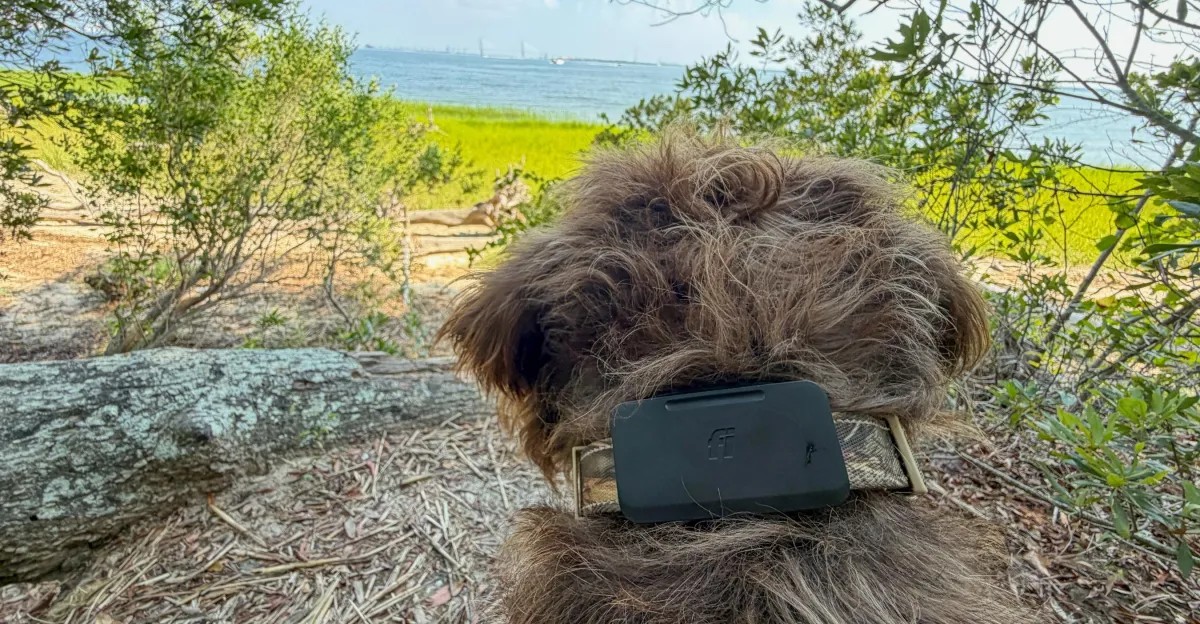
GPS has limits. LTE networks drop out the second you hit a tree line or a canyon. Then there’s Starlink. Fi Ultra claims to bridge the gap using SpaceX’s low-earth orbit constellation through T-Mobile’s direct-to-cell service. It tracks pets anywhere in the US when cellular coverage fails. It sounds like magic until you check the battery indicator.
The Hardware
$199 gets the device. Add a $20 activation fee and an $189 annual subscription because hardware alone is never enough. It fits most collars or harnesses, according to the marketing. It is heavy, 68 grams of dense electronics housed in a 75x40x25mm box.
Waterproof to IP68 and salt-resistant. Durable? Sure. It has a vibration motor and a speaker for a new “Callback” training feature. Shock-free correction for puppies.
Is it built for “adventure dogs of any size”? Let’s be real. It looks massive on my 80-pound Griffon, Gus. For a Chihuahua, it is essentially a yoke. Toy breeds rarely vanish into national forests, so the fit issue is minor if your dog stays close to the couch.
Testing the Signal
I drove to the edge of Francis Marion National Forest. Alligators. Silence. No bars. I hit Lost Mode in the app to simulate a panic scenario. The tracker switches to high-frequency GPS polling instead of its usual power-saving check-ins.
The connection held. It jumped onto T-Satellite via Starlink.
How long between updates? Two to three minutes.
In a frantic search, that is an eternity. Gus could have gone miles. But it was identical to the performance on weak LTE in my suburban neighborhood. Sometimes three minutes is all you get when the infrastructure thins out. Better than nothing, definitely. But there were glitches. The app stalled on “reconnecting” twice. Five minutes of radio silence. Fi blames the satellite handoffs. The device hunts for terrestrial towers even when locked on orbit. It creates lag as coverage patches in and out.
The Cost of Connection
Those radios burn energy like wild things. I didn’t hit two days on a charge. Barely. One long walk and the battery tanked. Every thirty minutes of live tracking shaved 20% off the remaining juice. USB-C charging takes two hours. That’s decent. It just happens often.
Most pet owners want set-and-forget. The older Fi collars, like the Mini or 3 Plus, last weeks. They track sleep. They monitor behavior. The Ultra does none of that efficiently because it is too busy shouting at satellites.
Is there a workaround? Yes. If you already pay for Fi, add the Ultra for $299 flat. You clip it to an existing collar. The apps merge. You keep the health metrics and get the satellite safety net. A clever hack if you camp often.
I lived in rural Idaho once. My dog, Stanley, chased deer down valleys for hours. I knew that feeling of staring at a blank map screen.
For urban apartments, skip it. For backcountry trails where cell towers are a myth, the Ultra offers a specific kind of peace of mind. The trade-off is obvious. You carry the signal everywhere else goes dark. You also carry a power bank. Or you learn to live with the anxiety of a dying battery icon blinking red on a Tuesday afternoon.
Photos by Jennifer Pattison Tuoy