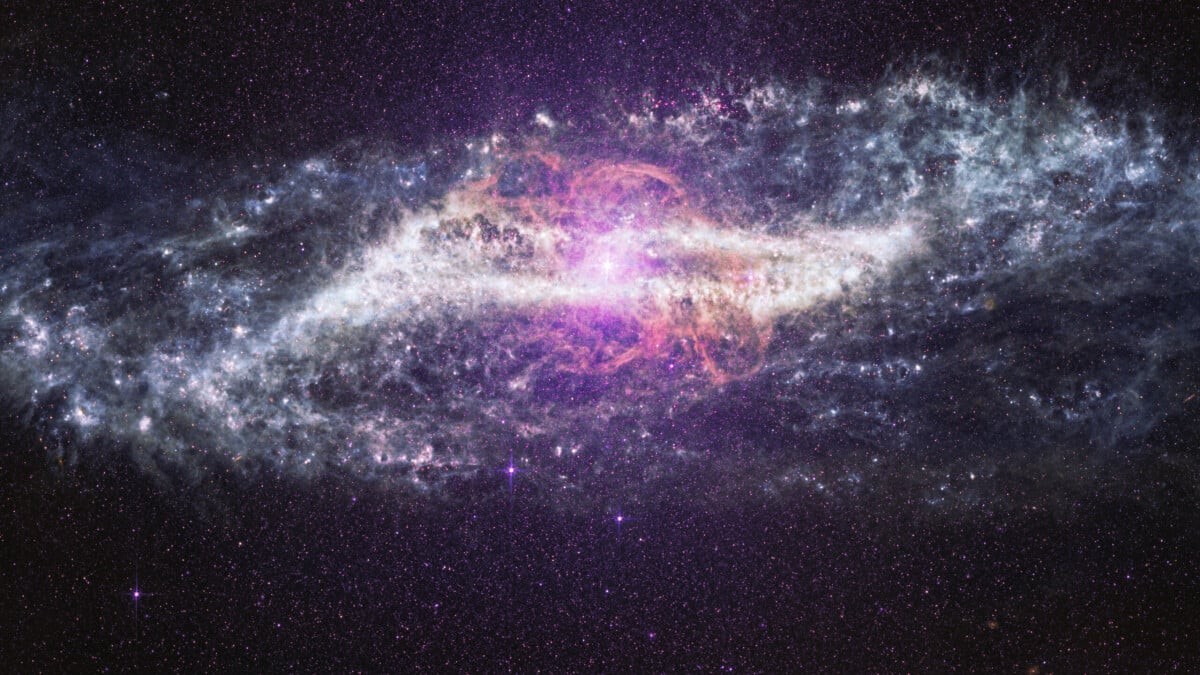
Dust clears. The curtain falls.
NASA’s James Webb Space Telescope has just published fresh eyes on Centaurus A. Thick clouds that used to hide the galaxy’s guts are now pulled back. What sits underneath? Millions of stars. All of them. Cramped into a core that refuses to be ignored.
We’re seeing spaghetti bowls of glowing debris. We see a warped strip of gas, shaped suspiciously like Tennessee, cutting straight through the middle. And we see the hungry black hole at the bottom, chewing on whatever it can grab.
It makes for great desktop art, sure. But look closer. It’s a laboratory. A chaotic one.
Centaurus A tells us how galaxies collide, how black holes eat, and how stars are born in the mess.
Distance matters here. It is only about 11 million light years away. That is close. Close enough for Webb’s infrared eyes to pick out details that blur into smudges for more distant objects. Every star counts. Every speck of gas tells a story about billions of years of cosmic history.
What story is this?
Violence. About 2 billion years ago, this galaxy rammed into another one. The impact left the disk twisted. A warped band of dust still stretches across the center like a bruise. But it didn’t kill the galaxy. It just made things weird.
Hubble couldn’t see this well. Dust blocks visible light. Spitzer could look in infrared, sure, but the vision wasn’t sharp enough. It saw the glow. It didn’t see the stars. Webb sees both. It separates the ancient light from the new. Astronomers can now tell which stars were there before the crash and which ones screamed into existence because of it.
Then there’s the S-curve near the middle.
Nobody knows what it is exactly. Maybe it’s debris from the ancient crash. Maybe the black hole twisted it into place. Maybe both. We wait. We watch.
Webb splits the light too. It measures speed. Warm hydrogen spins near the black hole’s maw while other gas flees outward in panic. It shows the dual nature of these monsters. They compress gas to make new stars, yes. They also blow gas away to stop new stars from forming.
Creation and destruction in the same breath.
Your screensaver can’t do that.
Can it?
Not really.