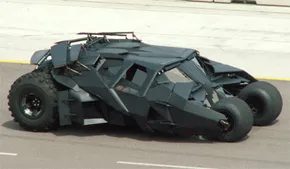
You might have skipped Batman Begins. You probably didn’t care for Christopher Nolan’s gritty reboot. It happens. But you’ve seen the car. That jagged, military-grade tank that looks like a spaceship someone forgot to finish building. It’s not sleek. It’s not cool in the traditional sense. It’s a rolling billboard for the film, an icon of heavy metal and shadow.
Here’s the trick.
Every time you see that Batmobile tear through Gotham, landing in the cave, or speeding down a street, it’s real. No CGI. No wireframes. Just a 5,000-pound beast of steel and rubber. It even pulled double duty as the pace car for a NASCAR race in June 2005. Real engine. Real tires. Real speed.
So why do I say it doesn’t exist?
Because the Batmobile you see on screen is a ghost. A composite. An illusion built from pieces of cars that never drove together. It’s a Hollywood trick so good it fools your eyes every time.
Nathan Crowley designed it. He brought it to life. To understand how something can be physically real yet technically non-existent, you have to look at how it was made.
How the Batman Begins Batmobile was actually built
The question isn’t just “what is the Batmobile?” It’s “how do you make a fictional car feel tangible?”
Crowley didn’t just sketch a cool car and hand it to a builder. He had to engineer a vehicle that could survive stunts while looking like a prototype of the future. The result was a mess of practical effects.
The Batmobile is real. Every single time you see the Batmobile in the movie, you are seeing a real, physical object.
But here’s the catch. The car that lands through the waterfall? That’s one chassis. The car that drives through the streets? That’s another. The car that sits in the garage? A third. They all look identical. They all share the same design language. But they are never the same object.
This is where the magic happens. Or the deception, depending on how you look at it.
Which specific cars were used to create the Batmobile?
If you’re wondering which car brands were modified to create the Tumbler, the answer is messy. There isn’t one donor vehicle. There are many.
The base structure was essentially a custom fabrication, but it borrowed DNA from several sources. Think rugged utility vehicles. Think armored transports. The design team needed something that looked capable of crossing desert terrain and urban rubble alike.
They didn’t use a Ferrari. They didn’t use a standard Ford. They used parts. They used frames. They used whatever could hold up under the stress of a 30-foot drop.
The illusion relies on consistency. If the headlights flicker differently in shot A than in shot B, you know it’s fake. If the door hinge moves differently, you spot the error. The crew had to ensure that every variant of the Batmobile looked exactly like the others, even if their internal mechanics were wildly different.
One was built for speed. One was built to crash. One was built to sit still while cameras circled it.
You can’t have one car do all three. Physics says no. Insurance
The Logic Behind the Batmobile’s Design
Let’s rewind. Why does Batman even need a car?
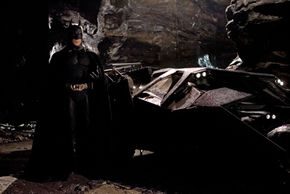
Because he’s human. Unlike Superman, who can just shout “Up, up and away!” and blast off into the stratosphere, Bruce Wayne is stuck on the ground. He relies on ingenuity. Technology. A mix of both. He needs wheels. No flying.
Then there’s Gotham. In this film, the city isn’t just dark. It’s a dysfunctional, steroid-fueled version of New York. Obstacles are everywhere. Surprises lurk in every alley. A normal sedan won’t cut it. You need something rugged.
But here’s the catch. Batman can’t exactly build this thing in his basement.
Imagine the noise. The orders for industrial machine tools. The delivery trucks. It would blow his cover faster than a Joker joke. So the script solves the problem with a neat workaround: Wayne Enterprises builds a mothballed military vehicle. Batman requisitions it. Paints it black. Done.
The result is a machine with some serious tricks.
- It moves fast. Very fast.
- A jet engine lets it jump or fly through the air, distances normal cars can’t touch.
- Two driving positions. One for the road. One for the air.
- Stealth mode. Silent. Electric-motor drive.
- No doors. The car opens like a flower. Unusual entry. Unusual exit.
Now, someone had to make this cinematic vision real. Enter Nathan Crowley.
He’s a physical guy. Really physical.
How Nathan Crowley Built the Batmobile
Why Nathan Crowley Rejected CGI for Batman Begins
Hollywood’s default setting for complex vehicles is digital. You spin up a computer model, simulate the physics, and call it a day. Even creatures like Yoda or Gollum get this treatment. A car? It’s supposed to be easier.
Nathan Crowley didn’t buy that logic. For Batman Begins, he insisted on a physical Batmobile in every frame. No shortcuts. He started with model bashing.
It sounds messy. It is. You raid hobby shops, toy stores, and hardware stores. Buy plastic kits, metal tubing, RC parts. Cut them up. Glue them back together until they look right. Crowley found a P-38 model kit nose cone that perfectly mimicked a jet engine. He hollowed it out, added bits, and glued it to his prototype.
He built six 1:12 scale models. It took four months. Only then did he move to full size.
Sculpting the Batmobile from Foam
Next came the giant block of Styrofoam. A crew of about 30 people, including engineers Chris Culvert and Annie Smith, carved it by hand. Every detail. Even the rubber ties.
Why foam? Two reasons.
- Proportions. The car is 9 feet 4 inches wide. That’s 8 inches wider than an 18-wheeler. Getting the scale right matters when it’s that big.
- Molds. The car has 65 separate body panels. Each needed a custom wooden mold, hand-made from the foam sculpture.
They cut the foam to size the steel frame and mark panel mounts. This sculpting phase lasted two months.
The Batmobile Test Frame
The movie Batmobile isn’t a prop. It’s a real car. It had to meet insane specs:
- Hit 100+ mph.
- Go 0 to 60 in 5 seconds.
- Turn sharply at speed. Most movie cars can’t. This one had to navigate Chicago streets.
- Jump 30 feet and land intact.
To test this, they built a steel “test frame.” They tuned the engine, suspension, and brakes. The brakes were weird. Extra brakes on each rear wheel, controlled by hand levers. Pull the left lever, the left rear wheel locks. It works like a tractor turning in a field.
They tried a jump. The front end collapsed. They rebuilt it.
The Actual Components
Once the test frame worked, the specs were locked in.
- Engine: A tuned 5.7-liter Chevy V-8. It pushes the 5,000-pound car from 0 to 60 in 5 seconds.
- Rear Axle: A truck axle. Heavy. They wanted light for jumping. The weight strained the front end in early tests.
- Rear Tires: 37-inch Interco Super Swampers. Off-the-shelf 4×4 mud tires.
- Front Tires: Hoosier racing tires.
- Front Suspension: Inspired by Baja trucks. Long travel. The wheels pop out 30 inches in the air to absorb the shock of a 30-foot drop.
Nine months. Several million dollars.
Now, they could start the assembly line.
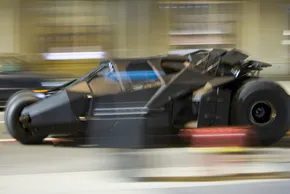
Street-Ready Batmobiles Built for Chaos
They didn’t just build a shell. The team cranked out four fully functional, street-ready race cars. Steel frames first. Then the drive trains. After that, the body shop spent weeks crafting 65 carbon-fiber panels for each vehicle.
These were the machines tearing up Chicago streets. From the curb? They look like the Batmobile. Inside? Pure NASCAR.
Nathan puts it bluntly. You climb in and see bare steel. Sheet metal covers spots where it needs to. Gauges hang exposed. A Halon fire-suppression system sits ready. Safety first, style second.
Visibility is basically non-existent. The front window works. Everything else is blind. Side mirrors? Rear view? Gone. The drivers rely on video cameras and monitors to see anything behind or beside them.
So why build four?
Two reasons. First, accidents happen. These beasts hit 100 mph. They jump 30 feet. Turning requires manual levers. Wrecking seemed inevitable. The team planned for it. Good thing they did. No major crashes occurred during filming. One minor bump happened while moving cars between locations. That’s it. Six months of training paid off.
Second, two cars had special jobs.
- The flap version handled the flying shots. Hydraulics and flaps made it look airborne.
- The jet version brought real fire. Nathan refused CGI flames. He wanted heat. An actual jet engine, fed by six propane tanks inside the car, provided the thrust. They could mount and remove it for specific shots.
Each car cost roughly $250,000. Worth it for the street scenes.
But here’s the catch. When Batman slides into the driver’s seat in the movie, he doesn’t look like he’s entering a stripped-down race rig with exposed rivets and fire suppressants. The movie interior is sleek. Cool. Designed.
Those shots required different builds. Two other teams handled that part of the puzzle.
Inside the Batmobile
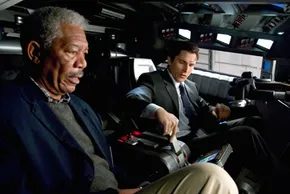
How the Batmobile’s “Flower” Entry Actually Works
Watch the cockpit open. It looks like a blooming flower. The roof unhinges, the windshield slides back, the seats rise up. It’s mesmerizing. But that specific car? It’s not the one doing the heavy lifting in high-speed chases.
To get that origami fold and unfold right, the production team built a separate, dedicated Batmobile cockpit entry sequence car. This vehicle exists solely for the moments Batman pulls up.
Here is what makes it different:
- Hydraulics everywhere. They needed the opening and closing to look realistic, not jerky.
- No V-8 muscle. A small electric motor handles forward motion. There is no need for massive power when the car is just rolling into a driveway.
- A hidden driver. Someone is actually inside the vehicle, making it stop and start for each shot.
When you see Batman sitting in the driver’s seat, that is yet another layer of the trick. The interior is a stationary studio set. It’s oversized to fit cameras, complete with moving seats and functional controls. It doesn’t move. It just pretends to.
Why Miniatures Still Rule the Stunt Game
And then there is the fourth version. The miniature Batmobile.
It is a 6-foot-long, 1:5 scale model. It has its own electric motor drive. When you see the Batmobile flying through the air—across ravines or between buildings—that is the mini.
Not the 5,000-pound race car. That big beast flies through the waterfall to land in the Batcave. But the aerial stunts? The mini handles the flying.
So there it is. The complete illusion. Four cars. One legend. Which one do you think was the hardest to build?
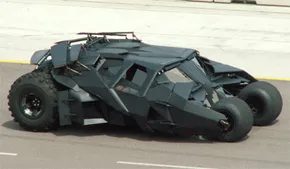
How the Batmobile Illusion Actually Works
It’s not one car. It’s a fleet.
When you see the Batmobile tearing down Gotham’s streets, you’re watching one of four “race” builds. They’ve got real engines and drivetrains, sure, but strip out the interior and it’s basically a NASCAR chassis. Pure speed. No comfort.
Then there’s the jet burst. That’s a whole different beast. The “jet version” hides six extra propane tanks inside its frame just to fuel that momentary thrust. It’s heavy. It’s dangerous. It’s expensive.
Flying? That’s magic. Or at least, model magic. Most aerial shots use a 1:5 scale miniature. Sometimes they cut it with the “flap version” of the full-sized car, but mostly it’s the tiny replica doing the heavy lifting.
Getting in and out? That’s the “opening” version. It’s built for access, not speed. A separate driver sits hidden inside while Batman climbs into a more realistic-looking cockpit. And when he’s actually in the seat, staring out at the city? That’s a static set. A cardboard box with good lighting.
Here’s how they stitch it together. Let’s say Batman is driving home to the Cave after a long night.
The race version hits the road.
The jet version ignites.
The miniature flies across the ravine.
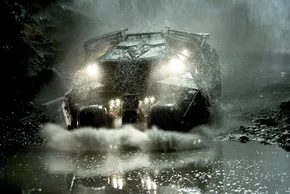
Then comes the stunt. One of the full-sized race cars hits the Batcave entrance. It drives straight through a real, full-size waterfall. This isn’t CGI. It’s physics. A 5,000-pound machine launches off a ramp, flies through the downdraft of falling water, and lands on reinforced concrete. It travels 30 feet. It hits the pad with a thud that shakes the cameras. A sand berm slows it down. An arresting cable holds it back, just in case.
Cut to the static cockpit. We see Batman’s face.
Cut to the “opening” version. It pulls into the Cave set, stops, unfolds. Batman steps out.
Eight different cars. Dozens of crew members. Millions of dollars in R&D and fabrication.
That’s why modern blockbusters cost what they cost. You aren’t just paying for the actors. You’re paying for the mechanical army that makes the illusion hold together.
Understanding this process gives you an appreciation for why a modern film can cost so much to make.
It’s not just a movie. It’s an engineering project.