It took 20 years. Two decades of staring into the dense heart of Omega Centauri.
Until now, the cluster’s dark secrets stayed put.
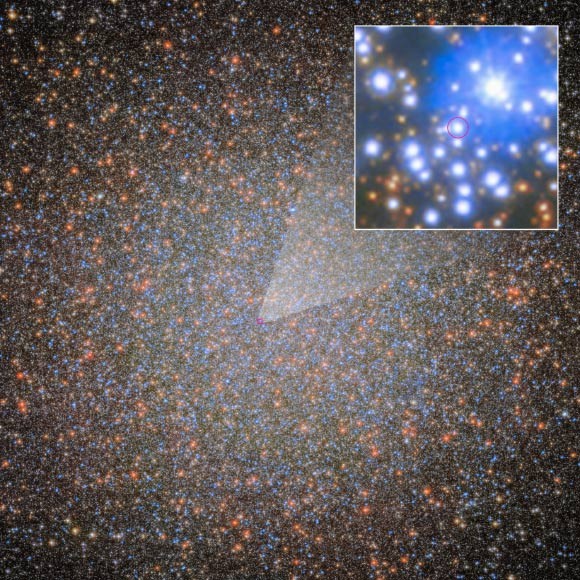
Astronomers finally found something nobody expected: the first confirmed stellar-mass black hole in the galaxy’s most massive globular cluster.
The object, named oMEGACat BH-2, hides in plain sight. It is the tip of the iceberg. Estimates suggest roughly 10,000 of these objects lurk in the cluster, waiting to be found.
Why Omega Centauri Matters
Omega Centauri isn’t just another star cluster. It’s the king.
Located 18,000 lightyears from Earth in Centaurus, this beast packs 3.6 million solar masses of starlight. That makes it the most massive stellar system ever cataloged in the Milky Way.
It is old. Really old. Twelve billion years.
At 150 lightyears wide, it holds over 10 million stars. They are tightly packed, gravitationally bound, and crowded. If you lived there, the night sky wouldn’t look like ours. It would be blindingly bright. Visible to the naked eye in the southern hemisphere, it glows at magnitude 3.9.
But the light isn’t the point. The darkness is.
We already knew an intermediate-mass black hole sat at its center. We’ve suspected it for years using Hubble data. But the smaller stuff? The stellar-mass black holes? They remained invisible ghosts.
The Astrometry Breakthrough
Why did we miss them?
Standard detection methods failed. The radial velocity method? Too noisy in such a crowded field. Radio emissions? None detected. X-ray flares from accreting material? Nothing.
So the team tried astrometry.
It sounds technical. It’s really just precise tracking. You watch where stars move over time. If a star wobbles—jerks slightly against its neighbors—it’s tugging on something massive and invisible.
Dr. Matthew Whitaker and his team at the University of Utah didn’t just look at a few years of data. They mined archives.
They pulled more than 20 years of Hubble Space Telescope imagery. Then they sharpened the focus using fresh data from the James Webb Space Telescope (a collaboration between NASA, ESA, and CSA).
The precision required was staggering. They were measuring stellar motion down to fractions of a pixel.
“It would not have been possible to find this black holes without these two space telescopes.”
Without Hubble’s long baseline and Webb’s sharp eye, the signal would have vanished into the noise.
oMEGACat BH-2: The Slowest Dance in the Universe
Here is where the story gets weird.
Most black hole binaries are tight, frantic dancers. They spiral inward. They merge. They shout in gravitational waves.
This one? It’s a slow roller.
The star companion orbits oMEGACat BH2 once every 94 years.
That is the longest orbital period ever recorded for a black hole binary system. The system probably formed dynamically. The star and the black hole didn’t start together as a pair. They collided and captured each other in the cluster’s chaotic environment.
But here’s the catch.
This setup is unstable.
The team calculated that encounters with passing stars will eventually tear this system apart. It will last less than a billion years. That’s a blink compared to the cluster’s 12-billion-year age. We found it during its brief, slow-moving window.
Why does this matter?
Beyond the novelty, this discovery helps calibrate our understanding of black hole physics. Globular clusters are factories for mergers. They are the primary sources for the gravitational wave events we detect on Earth.
“Understanding the process of forming black holes and then dynamically form binaries is vital, because it affects our able to interpret and understand gravitational wave events.”
Said Dr. Anil Seth, another author from the University of Utah. If we don’t understand the population here, we don’t understand the waves out there.
The black hole itself was also lighter than expected. A reminder that nature doesn’t always follow our models.
The paper describing this discovery appeared in the Astrophysical Journal Letters.
There are likely 9,999 more of these out there in Omega Centauri.
And they are all just waiting for us to get better at looking.