Kirchhoff’s law of thermal radiation has been around for 160 years. It states, quite simply, that a surface’s ability to absorb heat must match its ability to emit it at the same wavelength and angle. Reciprocity. It’s a rule that makes controlling thermal energy feel like trying to hold onto smoke. We’ve found workarounds before. They were inefficient. They were volatile.
Now, we have a way out.
An international team of researchers has published a study in Laser & Photonics Reviews demonstrating that you can break this decades-old law. By decoupling absorption from emission, they’ve created the conditions for programmable heat.
The Magnet Trick
The breakthrough doesn’t come from chemistry. It comes from manipulating light with a magnetic field.
This changes everything about how heat behaves. The direction of emission can now be controlled. The switch can be toggled on or off. And perhaps most surprisingly, the system remembers its state even after the power is cut.
“We made heat radiation behave in a smarter way,” says Shunsuke Murai, physicist at Osaka Metropolitan University.
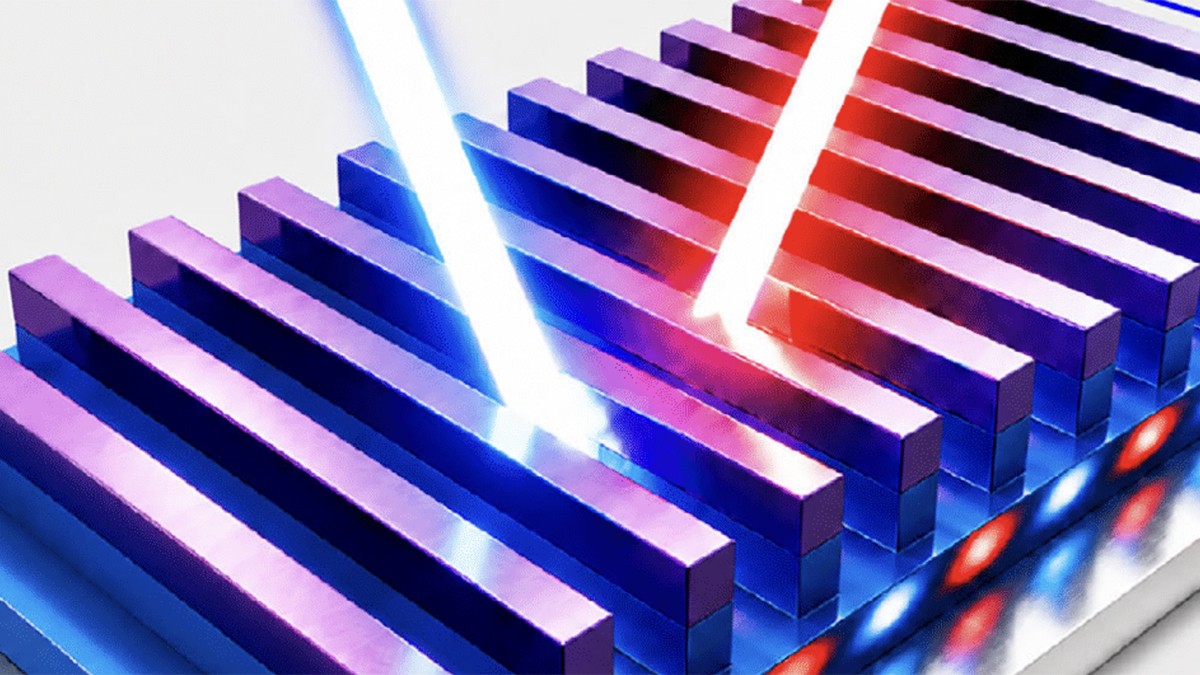
The device making this possible is a metagrating. It’s a hybrid beast. It combines a magneto-optical substance with a phase-change material.
Think of the phase-change component as a memory bank. If you’re into physical media, this part might look familiar. The alloy used here is Ge₂Sb₂Te₅. That’s germanium, antimony, and tellerium. It’s the exact material used in rewritable CDs and DVDs to store data. It switches between disordered (amorphous) and ordered (crystalline) states.
The “grating” part is the other half of the equation. Tiny, precision-engineered ridges trap and channel incoming light. This makes the interaction manageable in a way previous systems weren’t.
Tuning the Temperature
How does programmable heat actually work in practice? You don’t just guess. You adjust.
By tweaking three things, researchers can program the desired absorption behavior:
– The angle of the incident light.
– The strength of the applied magnetic field.
– The physical dimensions of the grating ridges.
Do that, and you get absorption without reciprocal emission. The nonreciprocal absorber’s operating wavelength shifts across a broad spectral range just by changing the angle.
That flexibility suggests applications far beyond the lab. Smart infrared sensors. More efficient thermal energy devices. Photonic memory tech that stores info using light and heat rather than electrical charges.
“Our ultimate goal is to develop compact devices that active control heat radiation, much like electronic circuits controls the flow of electricity.” – Koichi Okamoto, Osaka Metropolitan University
The Catch
It’s theoretical right now.
The physics and math are solid. The models are rigorous. But there is no physical prototype yet. We are in the “paving the way” phase.
And it’s not without friction. The researchers note in their paper that the study focused heavily on absorption. Emission was assumed rather than explored in granular detail. Also, you need an external magnetic field to make this happen. That’s a wrinkle. An extra component. A potential hurdle.
But given that the laws of physics were built to be challenged, it’s hard to argue that’s a dealbreaker.
This work establishes a framework for active, non-reciprocal thermal control. Chip-scale thermal photonics is on the horizon. The question isn’t if this works on paper. It’s whether we can build it.