If you’ve ever felt a pull toward the red dust of Mars, you’re not alone. “Strange New Worlds” season 4 kicked off with an opener that couldn’t have timed itself better.
Viking 1 just celebrated its 50th anniversary on the Martian surface. Oxford researchers recently suggested Mars once had active magma beneath the crust. That means the Red Planet might have been far more habitable than we thought.
Sci-fi has loved this idea forever. From HG Wells to Doom, the obsession is real. Usually, Star Trek handles Martians by making them humans living there. By the 24th century, Utopia Planitia Fleet Yards handled repairs for the Borg and the Dominion. It’s a busy spaceport. But homegrown Martians? They’ve been rare. Until now.
A 65 Million Year Trip Back in Time
“Valles Marineris,” the season 4 premiere, changes the game.
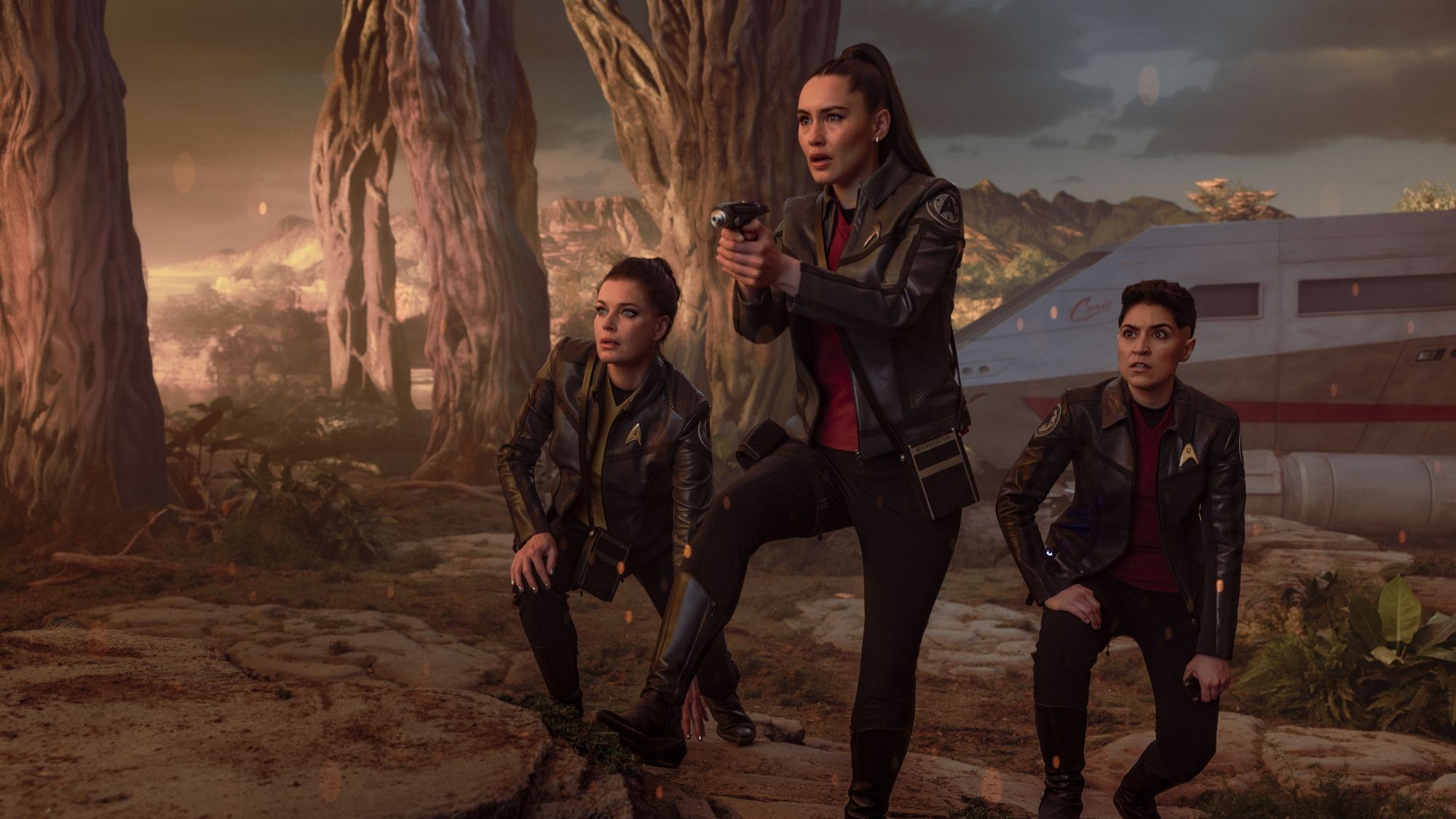
Captain Pike and the crew of the USS Enterprise jump back 65 million years. The goal is simple on paper: recover iridium to fix the ship after it slipped through a quantum anomaly. The execution? Less simple.
Una Chin-Riley (Rebecca Romijn). La’an Noonien-Singh (Christina Chang). Erica Ortegas (Melissa Navia). They land on what we know as Earth. The away team finds dinosaurs. And a puppet from the original Jurassic Park.
La’an gets to punch a reptile. It’s the kind of moment that sounds absurd until it happens. You step on a bug, unleash a butterfly effect, and suddenly humanity never exists. Standard Starfleet warning stuff. But they do the job.
The Truth Behind the Red Planet
It turns out this world was Earth all along. But in orbit? That’s where the real story lives.
Pike has Edgar Rice Burroughs’ A Princess of Mars on his shelf. You can guess what follows.
Battle Commander Cassell (Saffron Burrow’s crew looks human. They’re Martians, evolved millions of years before Vulcans or Klingons rose to power. Spock notes Martian DNA is everywhere. It complicates the Star Trek: TNG theory about the Progenitors.
But Cassell doesn’t care about ancient origins. She cares about the Dol’Drm.
These arachnid invaders live on the fifth planet in our system. Yes, the fifth planet. Science purists know this doesn’t match our Solar System. Jupiter is gaseous. There’s no solid fifth rock here. Unless… the Asteroid Belt is where the planet used to be.
Cassell sees a future where her homeworld is a dead wasteland. Diplomacy is off the table. She steals antimatter from the Enterprise. She builds a weapon. One that wipes out the Dol’Drm homeworld completely.
The Origin of the Asteroid Belt
The explosion doesn’t just end a war. It changes history.
Spock confirms the debris forms the Asteroid Belt. It’s a direct nod to the “Disruption Hypothesis.” German astronomer Heinrich Olbers proposed this in the early 1800s. He thought a Moon-sized planet exploded between Mars and Jupiter. The wreckage became the belt we see today.
Scientists now say that’s unlikely. Gravity likely pulled the dust and rocks together. But in Trek logic? It fits.
The shockwaves ripple through time. Mars loses heat. It becomes cold. Life struggles. And then?
The Chicxulub asteroid gets knocked off course. It heads for Earth. It wipes out the dinosaurs. It kicks off the Cenozoic Era. It paves the way for humans.
The Heaviest Decision in Trek History
This isn’t Star Trek IV passing a formula for transparent aluminum. This is bigger. Even the Borg messing with history in First Contact seems minor by comparison.
Pike holds the fate of 65 million years in his hands.
Federation protocol says intervene. Don’t let technology destroy a civilization. Don’t break the Prime Directive. But Pike sees the bigger picture.
What if the Enterprise was always meant to go there? What if humanity only exists because the crew answered a distress call that happened 65 million years ago?
“In our future there is no fifth planet,” Pike says.
He lets Cassell fire. He accepts the timeline.
It’s a beautiful, terrifying paradox. You could tie your brain in knots trying to trace the causality. But the episode moves too fast to care about the logic holes. It’s pulpy. It’s fun. It has dinosaurs, Martians, and the origin story of us all.
What more could you want from a Tuesday night?
Probably less existential dread. But that’s a trade-off we’ll take.