It happens in a blink. Actually, faster.
Synapses are the bridge. They are the specific mechanism by which neurons communicate within the nervous system. Without them, the brain is just a silent mass of tissue. With them, it is the engine of human experience.
These connections span the entire body. Impulses travel from the extremities to the brain via synaptic transmission. The brain, in turn, uses these same pathways to send commands back out. You move. You feel. You think. It all relies on this microscopic handoff.
Central vs. Peripheral: Where the Handoff Happens
The location changes the destination, but not the method.
In the central nervous system, the synapse is a meeting of minds—neurons talking to neurons. It is a complex network of data exchange.
In the peripheral nervous system, the rules shift slightly. Here, information moves from a neuron to an effector cell. This could be a muscle fiber contracting. It could be a gland releasing hormones. The signal leaves the nervous system proper to act on the body.
The Filter and the Speed
Information does not just pass through unchanged. It is processed.
Each synapse acts as a gatekeeper. It filters incoming data. It integrates multiple signals. If the combined input is strong enough, the neuron fires. If not, nothing happens. This integration is what allows for nuance. It prevents your body from reacting to every stray noise or itch.
The speed is the real marvel.
Nervous impulses take mere milliseconds to traverse these gaps. The delay is almost imperceptible to human consciousness. Yet, it is where the magic of coordination lives.
“Synapses allow nervous information received by one neuron to be filtered, integrated, and transmitted to others.”
This filtration process is why you can catch a ball. Or why you pull your hand away from a hot stove before you even realize it hurts. The synapse makes the split-second decision.
It is a chemical relay race. Neurotransmitters cross the gap. Receptors catch them. The signal continues.
Why does this matter? Because without this precise, instantaneous filtering, the nervous system would be overwhelmed. Noise would drown out signal. Thought would be impossible.
The brain is not a solitary processor. It is a chorus of billions of tiny conversations, each lasting less than a heartbeat. We are only beginning to understand how many of these conversations go wrong.
The Chemistry of Thought: How Neurons Talk
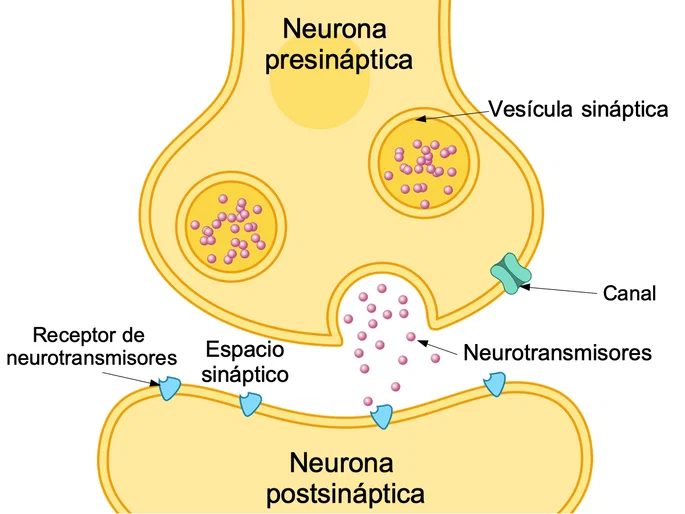
When a signal needs to travel from one neuron to another, the sender is the presynaptic neuron and the receiver is the postsynaptic neuron. But how exactly does that handoff happen? It depends on whether the connection is chemical or electrical. In chemical synapses, neurotransmitters act as messengers, converting electrical impulses into chemical signals. These chemicals sit waiting in membrane-bound spheres called synaptic vesicles. In contrast, electrical synapses rely on physical bridges known as connexons, allowing direct current to flow between cells.
Understanding how synaptic transmission works reveals the intricate machinery behind everything from reflexes to complex thought. Let’s look at the two main types.
Chemical Synapses: The Slow but Precise Communicators
Chemical synapses are the most common form of neuronal communication. Unlike electrical connections, there is no physical touch between the neurons. Instead, they are separated by a tiny gap called the synaptic cleft or synaptic space.
This setup makes the process unidirectional. Information flows only one way: from the sender to the receiver. To cross the gap, the neuron uses neurotransmitters, biomolecules that switch an electrical signal into a chemical one. There are dozens of these messengers, each with a specific job. Serotonin, for instance, helps regulate sleep, hunger, and thirst. Adrenaline prepares the body for rapid response during danger.
Once the neurotransmitter crosses the cleft and hits a receptor on the postsynaptic cell, that cell converts the chemical signal back into an electrical impulse. The effect can be either excitatory or inhibitory:
- Excitatory synapses make the target cell more likely to fire an action potential. This amplification is essential for learning, memory, and improving bodily efficiency.
- Inhibitory synapses make it harder for the target cell to fire. This acts as a brake, preventing overexcitation and helping the brain focus energy on more critical tasks.
The balance between these two forces creates synaptic plasticity, the brain’s ability to strengthen or weaken connections as it adapts to its environment.
Electrical Synapses: Speed and Synchronization
Electrical synapses offer three distinct advantages over their chemical counterparts. First, because they involve direct physical contact, the transmission is nearly instantaneous. Second, they allow for synchronization, enabling large groups of neurons and nerve fibers to fire in unison. Third, the flow of information is bidirectional. In these connections, either cell can act as the sender or receiver.
This direct communication happens through gap junctions (or communicating junctions). These protein channels, made of structures called connexins, allow ions to flow freely between cells. This facilitates the direct spread of electrical signals without the need for chemical messengers.
While chemical synapses dominate the peripheral nervous system, electrical synapses are far more common in the central nervous system.
Where Do Neurons Connect?
Neurons can also be classified by where they make contact. The connections typically occur at the axon, the dendrites, or the cell body (soma). Based on these points of connection, there are three primary types:
- Axodendritic : The most common type, where an axon connects to the dendrites of the receiving neuron.
- Axoaxonic : A connection from one axon to another, often used for modulation.
- Axosomatic : A connection from an axon directly to the soma or cell body of the neuron.
Each type plays a unique role in the complex network that defines our nervous system, shaping how we perceive and react to the world. The interplay between these structures and their chemical or electrical nature continues to define the boundaries of modern neuroscience.