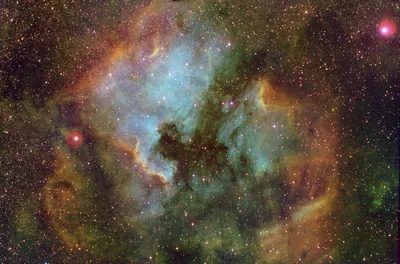
The sky is full of gas clouds, but few look quite like our own continent. That is what makes NGC 7000 so distinct. Astronomers call it the North American Nebula because its silhouette mirrors the shape of the continent. It sits in the constellation Cygnus, roughly 1,700 light-years away from Earth.
This is not just a pretty picture. It is a massive, glowing region of ionized hydrogen. The gas glows because young, hot stars buried inside it are blasting out intense ultraviolet radiation. This energy strips electrons from hydrogen atoms, creating a plasma that shines brightly. But the nebula is not uniform. Patches of interstellar dust within the cloud block this light. This creates contrast. The darker areas, particularly the one shaped like the Gulf of Mexico, are dense with dust particles. These particles absorb the recombining light, carving out the recognizable map-like features we see in images.
How Distance and Size Define Its Structure
Understanding the North American Nebula requires more than just visual recognition. You have to look at the scale. The entire structure spans about 30 parsecs, which equals 100 light-years across. To put that in perspective, if you could travel at the speed of light, it would take you a century to cross it.
The mass is equally staggering. The nebula contains roughly 4,000 times the mass of our Sun. This is a lot of material compressed into a relatively small volume compared to the vastness of space. The combination of mass and proximity to our solar system (in astronomical terms) makes it a prime target for studying how interstellar clouds behave.
Where Do Young Stars Form in Nebulae?
The presence of these young, hot stars is key. They are the engine of the nebula’s glow. But they are also agents of destruction. Their radiation pushes back against the surrounding gas and dust. This process, known as photoevaporation, can eventually disperse the cloud entirely. It is a cycle. Stars are born from these clouds, and their own life forces kill the nursery they came from.
The dust plays a dual role. It creates the dark “Gulf of Mexico” shape by blocking light. But it also acts as a shield. In denser regions, dust protects molecules from being torn apart by UV radiation. This protection allows new stars to continue forming in the shadows. Without that dust, the process would be chaotic and short-lived.
Why Study NGC 7000 Specifically?
Researchers are interested in NGC 7000 not just for its shape, but for its mass and distance. At 520 parsecs away, it is close enough to study in detail with current telescopes. It is far enough that we aren’t affected by its glare. This makes it an ideal laboratory. Scientists can measure how ionization fronts move through gas. They can analyze how dust grains are distributed in space.
The data helps us understand star formation in general. If we can track how energy transfers from young stars to the surrounding cloud, we can predict how long a stellar nursery lasts. We can also learn how much material is left over to form planets. The North American Nebula is a snapshot of this violent, creative process.