Isaac Newton didn’t just write a physics equation. He wired the cosmos together. In 1687, he proposed a simple rule that changed how we see the universe. Any two objects with mass pull toward each other. The strength of that pull follows a strict mathematical pattern.
The formula looks intimidating at first glance.
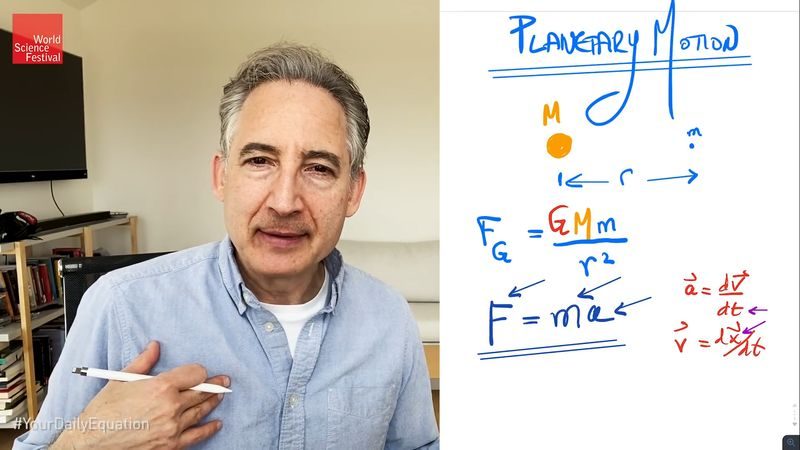
F = G (m 1m 2)/R 2
But it breaks down into three clear ideas. The force, F, gets bigger if the masses (m 1 and m 2) get bigger. It gets weaker as the distance (R ) between them grows. Specifically, it drops off with the square of that distance. Double the distance, and the pull becomes one-fourth as strong. The G in the middle is the gravitational constant. Its exact numerical value shifts depending on your unit system, but the physical reality it represents doesn’t change. It is a universal constant.
Why does this matter?
Before Newton, Johannes Kepler had spent decades mapping the orbits of planets in the early 17th century. He found the shapes. Ellipses. Specific speeds. But he didn’t fully explain why they moved that way. Newton took Kepler’s mathematical observations and gave them a physical cause. Gravity. The same force that pulls an apple to the ground keeps the Moon in orbit. It keeps planets circling the Sun.
This unified the sky and the earth. No more separate rules for celestial bodies. One law governs all matter in the universe.
Newton’s law of gravitation states that any particle of matter in the universe attracts any other with a force varying directly as the product of the masses and inversely as the square of the distance between them.
This isn’t just historical trivia. It is the foundation of space travel. Satellite orbits. Rocket trajectories. Understanding tides. All of it relies on this 1687 insight. When you calculate where a probe will land on Mars, you are using Newton. When you predict an eclipse, you are using Newton.
The elegance is in the simplicity. Mass pulls mass. Distance weakens the pull. Square law. It works from apples to galaxies.
Did Newton get it all right?
Not entirely. Einstein later refined the picture with general relativity, showing that gravity is actually curvature in spacetime. But for most practical purposes, Newton still holds. It is accurate enough for engineering, navigation, and everyday physics. The square-law relationship remains a cornerstone of classical mechanics.
Next time you watch a satellite pass overhead, remember. That tiny dot is falling around the Earth, guided by a formula written over three centuries ago.