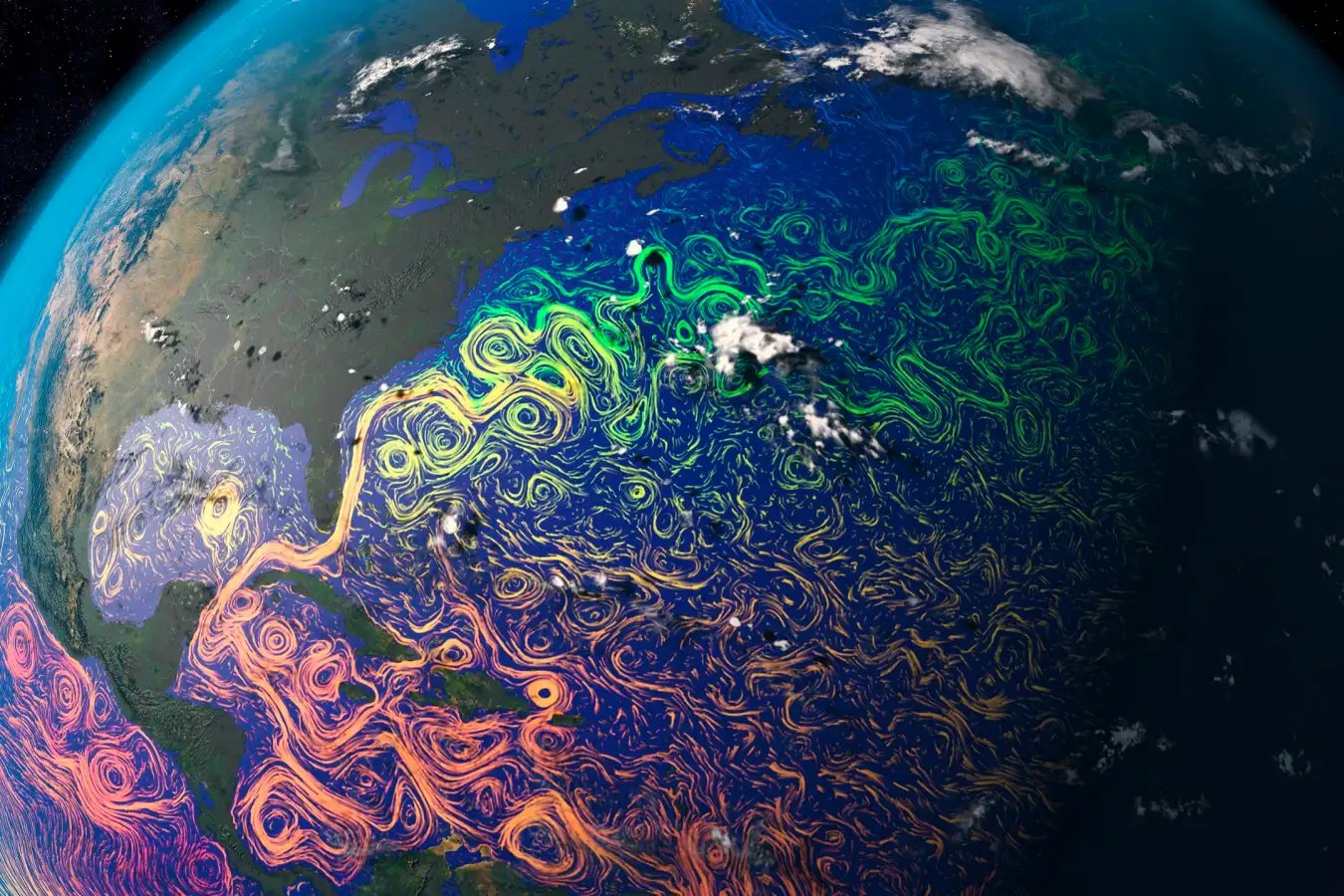
The Atlantic Meridional Overtowning Circulation might get weak. Slowly. It’s not going to snap like a dry twig, though. Not according to a brand-new climate model anyway.
The Melting Myth
Greenland is bleeding ice. Fast. Like 30 million tonnes an hour fast. That fresh water mixes into the salty, dense soup of the North Atlantic. It dilutes it. Less density means the water doesn’t sink. The AMOC stalls.
Scary picture right?
Europe freezes. Crops die. Monsoons go weird. The fear was that hitting a tipping point was inevitable, irreversible. An abrupt plunge into near-Arctic hell.
Oliver Mehling from Utrecht University thinks that’s nonsense. Or at least, too simple.
“The conventional wisdom that the melting of the Greenwich ice sheet could trigger an irreversible collapse… is definitely too simplistic,” Mehling says.
Turns out, Greenland melt alone can’t push the button. It helps, sure. But it isn’t the master switch.
The Real Villain
Heat is the main culprit. Warmer air means the salty North Atlantic water stays warmer. It stays floatier. Less sinking. The atmosphere holds more moisture too, which falls as rain. Freshwater on top. Ocean mixing goes down. Simple physics, messy consequences.
Mehling’s team ran the numbers. They looked at what happens when you add that Greenland slush to the existing atmospheric warming mess.
Here is the breakdown:
- Atmospheric warming alone cuts AMOC strength by 60% by the year 2300
- Adding Greenland melt shaves off another 20%
- Total weakening, significant, sure. But gradual
Is it a disaster? Absolutely. An 80% drop means the North Sea ices over. Western European agriculture takes a brutal hit. It is not a picnic. But it’s predictable. It’s linear. It doesn’t cliff-drop.
Hope for Reversal
What if we stop?
If CO2 emissions start dropping by 1% a year starting in 2258 — okay, maybe not tomorrow, but in the long arc of time — the system snaps back. The AMOC recovers. Fully. By about the year 2400.
It’s not magic. It’s just not a one-way trip.
Louise Sime from the British Antarctic Survey puts it plainly: the AMOC tracks our CO2. Strongly. Linearly. If we quit burning fossils, the current returns. The “falling off a cliff” scenario? That’s a movie plot. Not this model.
Not Settled Yet
But wait. Don’t celebrate. Yet.
Other models say different things. René van Westen, also at Uthrecht, found a tipping point in a previous study. Massive Greenland melt led to collapse there. His model assumed melt happened at a steady rate though, not increasing like it is in the real world. Different assumptions. Different results.
“The results are model-dependent,” van Westen admits.
Plus, we aren’t just watching Greenland. Antarctica is melting too. Its fresh water could disrupt the whole global conveyor belt. Or, weirdly enough, help stabilize it, depending on the timing. It is chaotic. Messy.
Jonathan Baker from the UK’s Met Office doesn’t want you to think this case is closed. It’s one more piece of evidence. Not a gavel bang.
The AMOC might be fragile. But maybe, just maybe, it isn’t doomed to a sudden end.
Unless we keep warming it up. Which, honestly? That seems like the obvious move we’re still making.