Everyone held their breath.
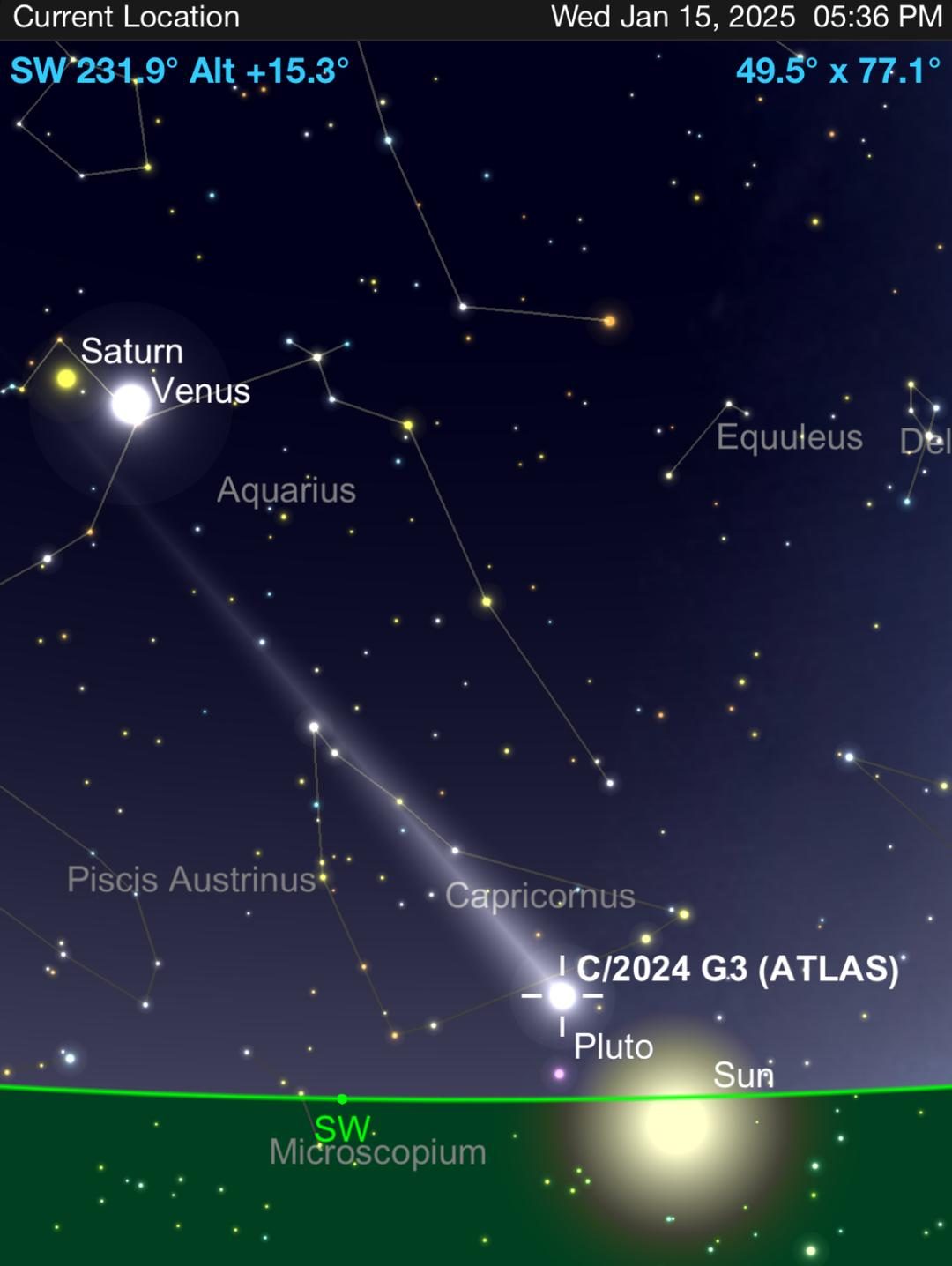
Comet C/2024 G3 Atlas made its closest approach to the Sun on Monday, January 13, 2025. This is more than just a flyby. Because it is dangerously close to our star, it is heating up, expanding and contracting, and is in danger of collapsing completely. Astronomers had hoped that the encounter as the sun passed would cause a spectacular brightening. They were right, sort of.
But the real question facing the scientific community isn’t just how bright it will be. The question is whether the comet will still exist tomorrow.
Photographed from the International Space Station, American astronaut Don Pettit captured an amazing image of the debris cloud before the peak of this encounter. It also looks beautiful. It also looks fragile.
Did it survive the incursion?
Yes.
How bright is Comet Atlas now?
The comet didn’t just survive. Now it shines brightly in our night sky.
The magnitude was -2.5. For context, this is brighter than any natural star visible to the naked eye (except the Sun). It’s not as bright as Venus, the day-star’s usual rival, but it’s definitely noticeable.
This is an important achievement for sun-grazing comet. Many such objects evaporate completely when passing within a few million kilometers of the Sun’s surface. Atlas remains intact. At least for now.
Will Comet Atlas get brighter or dimmer?
Things are uncertain here.
Astronomers are currently unsure of the comet’s future brightness. There is little data. The immediate consensus was that the brightness will decrease significantly over the next seven days. A comet’s tail is unstable. They react to solar wind and radiation pressure in unpredictable ways.
However, the possibility that it will become even brighter is not zero.
“The only way to find out is to keep looking.”
There is no formula that can accurately predict this behavior in real time. We have to wait. You have to look up.
Where can you see Comet C/2024 G3 Atlas?
Observing conditions vary greatly depending on location.
Observations are difficult in many areas of the northern hemisphere. Clear sightings are rare due to atmospheric disturbances and the angle of the sun. Many observers missed this window.
But not everyone missed out.
European observers reported that there was a “surprise” in the sky. They managed to capture the comet at sunset. Time is running out. Lighting is difficult. But they get it.
If you live in Europe, check your horizon tonight. If you live in North America or Asia, you’ll have to wait.
Why is this important?
We don’t see sun-grazers often. If the comet survives, we may get a rare glimpse of the outer layers of the comet’s nucleus. These objects are time capsules of the formation of our solar system. They contain ice and dust that has not been exposed to sunlight for billions of years.
Studying their response to extreme heat can help understand the physical limits of these ancient objects. This will help refine models of other ephemeral objects in the solar system.
More importantly, it gives the public something to look at.
Real skywatching. It’s not a simulation. This is not a processed image taken from a telescope.

The hidden costs of digital convenience
The way we consume information right now is a silent friction. It’s not just the content itself. It’s about the surrounding ecosystem. When you check your phone, you’re not just reading the news. You often exchange information indirectly.
This brings us to the core tension of modern technology. We have been promised contact. It is delivered in parts.
The algorithms that control the feed don’t care about the truth. They focus on retention rates. This is a structural fact, not a moral error. But it shapes the way we understand complex subjects. Like space exploration. Or medical advances. Or climate science.
Think about how we talk about innovation. We celebrate the launch. We skip the maintenance. We ignore the supply chain.
This blindness has consequences. It’s not just about feeling alienated. It means you’re not ready.
Why the background is more important than the title
Most people want to know “what happened”. They rarely ask “how” it works.
Let’s take quantum computing as an example. The title screams speed. They talk about breaking the encryption. What they miss is the cooling requirement. The isolation needed. This process is very fragile.
Without this background, the technology feels like magic. And magic is easily promoted. And easy to dismiss when it fails.
A different approach is needed. An approach that emphasizes slow disclosure rather than immediate reaction.
“The real innovation is not in the chips, but in understanding what the chips actually do.”
This shift in perspective changes everything. It transforms us from passive consumers to active participants. From scrollers to thinkers.
Human factors in the digital world
Technology is a tool. It does not replace human judgement.
When we let algorithms rule our reality, we outsource our curiosity. We also accept simple answers. Quick fix. A cursory summary.
But the best discoveries are rarely simple. They are messy. They require patience. They ask us to remain uncertain.
This is where the divide widens. On one side, those who skim. On the other, those who dive deep. The gap between them is not a difference in intelligence. It’s time. It is attention.
We must choose where we focus our attention.
What does this mean in your daily life?
This may seem abstract. it is not. Each click reinforces the pattern. Every share amplifies a signal.
If you always want the latest information, you have to be careful. You have to dig beyond the first level. You have to ask the harder questions.
Which source is prioritizing engagement over accuracy?
How does this algorithm serve its advertisers?
Why is this story being pushed to your feed now?
These are not trivial questions. They are the basis of digital literacy.
Things are changing. Platforms change. However, the responsibility rests with the user.
We are not powerless. But we are vulnerable.
Future direction
There is no single solution. No app can save us. No update resets intuition.
It requires daily practice. Be prepared to get bored with the complexity. Reject simplistic narratives.
Think about the last time you encountered a scientific breakthrough. Did you read the paper? Or did you read the tweet about the paper?
That difference is important. Depth is important.