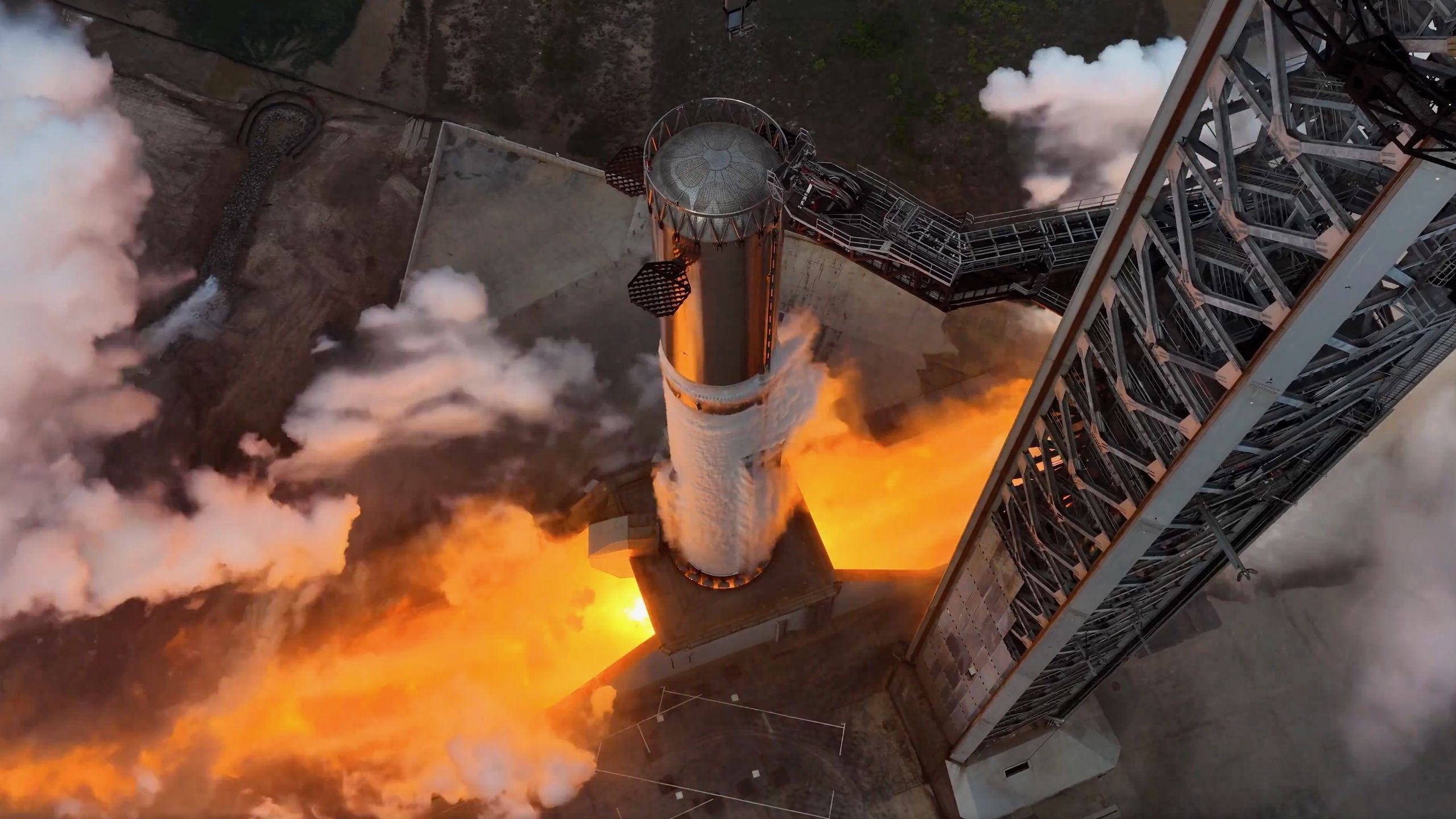
SpaceX has successfully completed a critical milestone for its next-generation Starship rocket, bringing the company closer to launching its most powerful version yet. On Thursday, May 7, the company conducted a full-duration, full-thrust static fire test of the Super Heavy V3 booster at its Starbase facility in Texas.
All 33 Raptor engines ignited simultaneously, firing for 14 seconds while the booster remained anchored to the launch pad. The test proceeded without incident, marking the first successful full-up static fire for the upgraded V3 hardware. This achievement clears a major technical hurdle and keeps SpaceX on track for its 12th integrated flight test, currently targeted for May 15.
Why This Upgrade Matters
This is not just another routine test; it represents a significant evolution in the Starship program. The “Version 3” (V3) of Super Heavy is more powerful and refined than its predecessors, designed to improve reliability and performance.
Previous attempts to test this specific booster faced setbacks. In March, a 10-engine test ended prematurely due to ground equipment issues, followed by a 33-engine test in mid-April that also cut short for similar reasons. Thursday’s success demonstrates that SpaceX has resolved those ground-side challenges, validating the readiness of the new hardware for actual flight.
“Full duration and full thrust 33-engine static fire with Super Heavy V3,” SpaceX confirmed in a post on X, sharing video footage of the fiery test.
The Path to Flight 12
While the Super Heavy booster has now passed its final major pre-launch check, the upper stage—known as “Ship”—is already prepared. It successfully completed its own six-engine static fire on April 14. With both stages now verified, the focus shifts entirely to final integration and launch preparations.
Flight 12 will be a suborbital test, meaning the rocket will not enter orbit. However, it serves as a crucial stepping stone. The delay between Flight 11 (in October 2024) and this upcoming test was largely due to the loss of the original Flight 12 Super Heavy booster, which was destroyed during a pressure test in November. The current V3 booster is the replacement, and its successful static fire confirms it is ready to take its place.
Beyond the Test: The Artemis Connection
The stakes for Starship extend far beyond technical demonstrations. SpaceX is developing this massive vehicle—standing over 400 feet (122 meters) tall and capable of lifting more than 100 tons to low Earth orbit—to enable human settlement on the Moon and Mars.
Crucially, Starship is integral to NASA’s Artemis program. The agency has selected Starship’s upper stage as a crewed lunar lander for future missions. If development continues on schedule, a Starship-derived lander could support the Artemis 3 mission in late 2027. That mission would involve rendezvous and docking operations in lunar orbit, paving the way for the first moon landing in decades.
However, before Starship can carry astronauts to the Moon, it must prove its capabilities in orbit. Future tests will need to demonstrate:
– Orbital insertion: Successfully reaching and sustaining orbit.
– In-orbit refueling: Demonstrating the ability to transfer propellant in space, a requirement for long-distance missions.
– Life support systems: Equipping the vehicle for human habitation.
Conclusion
The successful static fire of the Super Heavy V3 booster removes a significant obstacle from SpaceX’s path. With the May 15 launch window approaching, the aerospace industry watches closely to see if this upgraded megaproject can finally achieve its next major milestone. While Flight 12 will remain a suborbital test, it is a vital proof point for the vehicle that aims to carry humanity back to the Moon and onward to Mars.