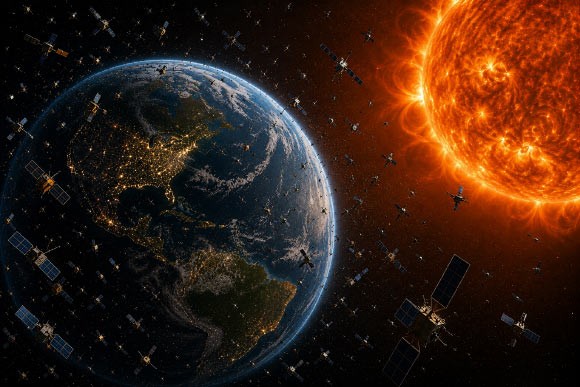
The cluttered highway of Low Earth Orbit (LEO) is getting a surprising assist from the Sun. As solar activity surges, space debris is falling out of orbit significantly faster than previously anticipated. This discovery, rooted in decades of historical data, offers a crucial new variable for satellite operators: solar cycles don’t just disrupt communications—they act as a natural, albeit unpredictable, cleanup mechanism.
For mission planners, this means the lifespan of satellites and the risk of collisions are intimately tied to the Sun’s 11-year heartbeat. Understanding this relationship is no longer just academic; it is essential for the sustainability of the booming commercial space industry.
The Sun’s Grip on Orbit
Low Earth Orbit, sitting between 400 and 2,000 kilometers above the planet, is the prime real estate for modern space infrastructure. It hosts everything from Earth-imaging satellites to massive internet constellations like Starlink. However, this crowded zone is also filled with defunct satellites, spent rocket stages, and collision fragments.
The primary force pulling this debris toward Earth is atmospheric drag. Even at these altitudes, the Earth’s atmosphere hasn’t ended; it has merely thinned into the thermosphere. When a satellite or piece of junk moves through this tenuous gas, it experiences friction that slows it down, causing its orbit to decay until it re-enters the atmosphere and burns up.
But the density of this upper atmosphere is not static. It is highly sensitive to solar activity.
How Solar Cycles Accelerate Decay
The Sun operates on an approximately 11-year cycle, moving between quiet phases and periods of intense activity marked by sunspots, solar flares, and coronal mass ejections.
During peak activity, the Sun emits higher levels of Extreme Ultraviolet (EUV) radiation and charged particles. When this energy strikes Earth’s upper atmosphere, it heats the thermosphere, causing it to expand upward. This expansion increases the atmospheric density at altitudes where satellites orbit.
Think of it like this: If you are driving a car through a foggy tunnel, the fog is thin air. If the fog suddenly becomes dense steam, your car encounters more resistance and slows down faster. Similarly, when the Sun heats the upper atmosphere, the “steam” becomes denser, increasing drag on orbiting objects and accelerating their fall.
The “Transition Boundary” Discovery
A new study led by Dr. Ayisha Ashruf of the Vikram Sarabhai Space Centre in India has quantified this effect with unprecedented clarity. By analyzing the trajectories of 17 specific pieces of space debris over a 36-year period (spanning solar cycles 22 through 24), the researchers identified a critical threshold.
The study found that debris does not fall at a linear rate relative to solar activity. Instead, there is a non-linear “transition boundary.”
- Below the threshold: Orbital decay proceeds at a predictable, slower pace.
- Above the threshold: Once solar activity exceeds roughly two-thirds of its maximum intensity (measured by sunspot numbers), the rate of altitude loss spikes noticeably.
This threshold is not defined by a fixed amount of radiation, but by how close the Sun is to its peak activity. Near the solar maximum, complex solar processes generate intense EUV radiation that disproportionately heats the atmosphere, creating a “fast lane” for orbital decay.
Why This Matters for the Future of Space
This finding has immediate practical implications for the space industry, particularly as we approach the next solar maximum.
- Fuel and Lifespan Planning: Satellites must perform “station-keeping” maneuvers to counteract drag and maintain their orbit. If operators underestimate the drag during solar peaks, satellites may run out of fuel sooner than expected, shortening their operational life.
- Collision Avoidance: Accurate prediction of debris trajectories is vital for avoiding collisions. A domino effect from a single crash can create thousands of new fragments. Knowing that debris falls faster during solar peaks helps refine these risk models.
- Launch Timing: Missions launched near a solar maximum may require more fuel reserves for orbit correction or different trajectory strategies to account for the higher atmospheric density.
Old Junk, New Science
Remarkably, this insight comes from objects launched in the 1960s. These dormant pieces of hardware, which lack the active propulsion systems of modern satellites, serve as perfect passive sensors. Because they do not adjust their own orbits, their decay rates are purely a reflection of atmospheric conditions.
By treating this historic debris as scientific instruments, researchers have unlocked a long-term record of how solar activity shapes our orbital environment. As the paper notes in Frontiers in Astronomy and Space Sciences, these 60-year-old objects are still contributing to cutting-edge science, helping us navigate the growing congestion of space.
In short, the Sun is not just a source of light and heat; it is a dynamic force that actively reshapes the orbital landscape, demanding that we adapt our space operations to its rhythmic pulses.