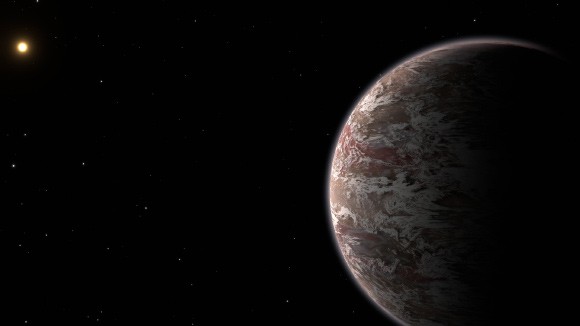
Astronomers using the James Webb Space Telescope (JWST) have made a surprising discovery in the atmosphere of a distant gas giant. The planet, known as Epsilon Indi Ab, appears to be covered in thick, patchy water-ice clouds—a finding that challenges previous scientific models of how such massive, cold worlds should behave.
A Cold Giant in Our Neighborhood
Epsilon Indi Ab is a “super-Jupiter” located just 12 light-years away from Earth, orbiting the star Epsilon Indi A in the constellation Indus. While 12 light-years is a vast distance, in cosmic terms, this planet is practically in our backyard.
The planet possesses several unique characteristics:
– Massive Scale: It is approximately 7.6 times more massive than Jupiter, yet its physical diameter is roughly the same size as our solar system’s gas giant.
– Residual Heat: With surface temperatures ranging between -70°C and 20°C, it is significantly warmer than Jupiter (-133°C). This warmth isn’t from its star, but rather “leftover” heat from the planet’s intense formation process billions of years ago.
– A Cooling Future: Over the next several billion years, the planet will continue to lose this internal heat, eventually becoming even colder than Jupiter.
The Ammonia Mystery
Before this new study, scientists operated under a specific assumption: because of the planet’s temperature and composition, its atmosphere should be dominated by ammonia gas and ammonia clouds, much like Jupiter.
However, using Webb’s Mid-Infrared Instrument (MIRI), researchers led by Bhavesh Rajpoot of the Max Planck Institute for Astronomy found something unexpected. When they analyzed the light from the planet, they detected significantly less ammonia than the models had predicted.
The Discovery of Water-Ice Clouds
The team concluded that the “missing” ammonia wasn’t actually gone; rather, it was being obscured. The most likely explanation is the presence of thick, patchy water-ice clouds swirling through the upper atmosphere.
These clouds are described as being similar to the high-altitude cirrus clouds found on Earth. By masking the expected chemical signatures, these icy layers create a “deficit” in the data, revealing a much more complex atmospheric structure than previously imagined.
“What once seemed impossible to detect is now within reach, allowing us to probe the structure of these atmospheres, including the presence of clouds.”
— Dr. James Mang, University of Texas at Austin
Why This Matters
This discovery is a milestone for exoplanetary science for two main reasons:
1. Refining Models: It proves that our current mathematical models for gas giants are incomplete. We cannot simply “copy and paste” the characteristics of Jupiter onto larger planets; mass and temperature create unique atmospheric behaviors.
2. The Power of Webb: The ability to directly image and perform photometry (measuring light intensity) on such a distant, cold object demonstrates that the JWST is fundamentally changing our ability to characterize “cold” worlds that were previously invisible to us.
Conclusion
By detecting unexpected water-ice clouds on Epsilon Indi Ab, astronomers have moved one step closer to understanding the complex weather patterns of super-Jupiters, proving that even the most distant worlds hold surprises that defy our current theories.