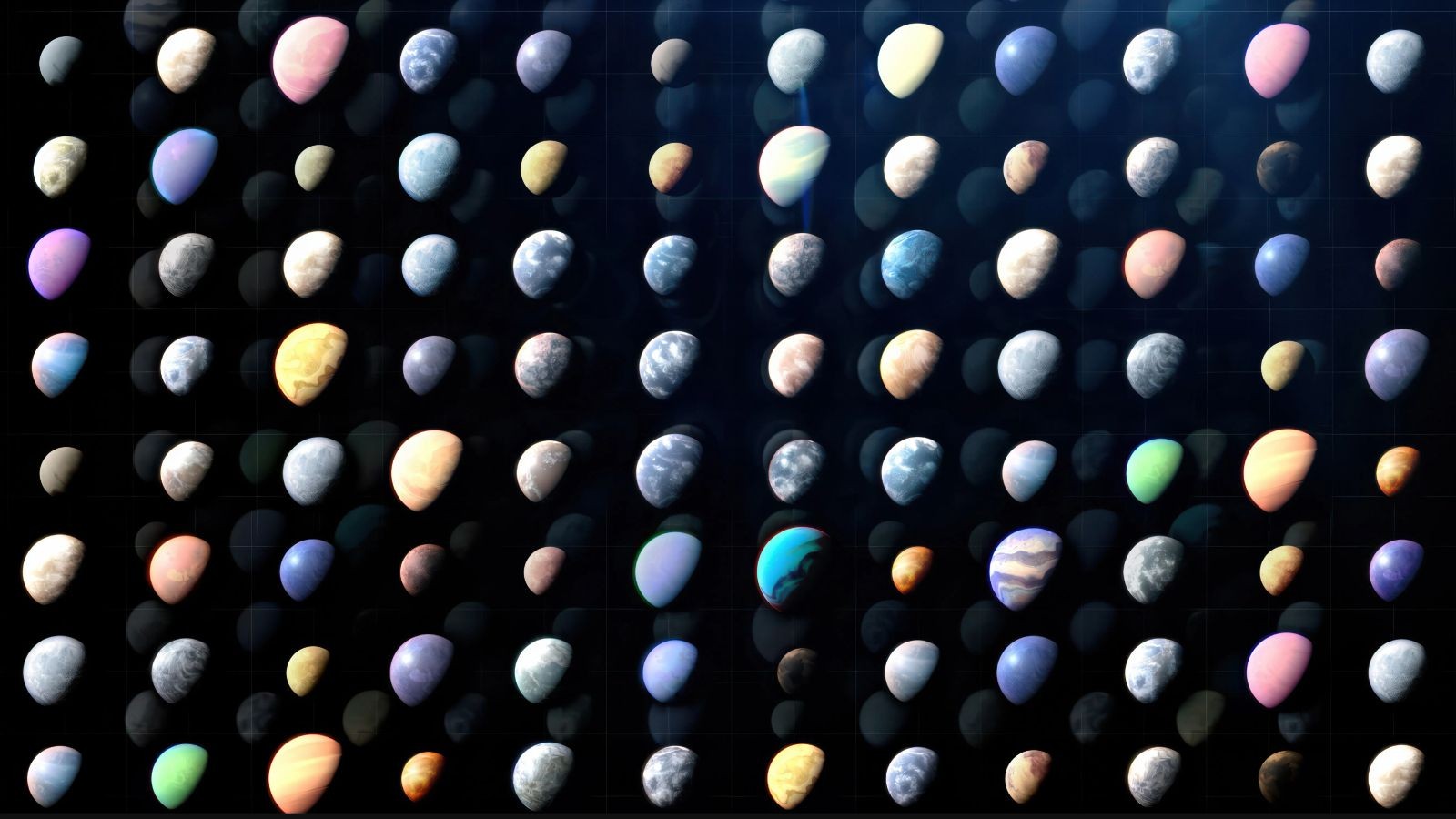
A breakthrough in astronomical data analysis has revealed a staggering number of potential alien worlds, challenging our understanding of how many planets exist in the Milky Way. By applying advanced machine learning to data from NASA’s Transiting Exoplanet Survey Satellite (TESS), researchers have identified 10,052 previously unknown exoplanet candidates.
If confirmed, these discoveries would nearly triple the current catalog of known exoplanets, pushing the total count from approximately 6,000 to nearly 18,000. This finding suggests that for years, astronomers have been overlooking a vast population of planets orbiting faint, distant stars simply because the signals were too subtle for traditional detection methods.
The Power of Machine Learning in Astronomy
The study, published on the preprint server arXiv in April 2025, details how a team of scientists analyzed light curves from 83.7 million stars. The core challenge was not a lack of data, but the sheer volume and noise within it.
Traditionally, astronomers prioritize bright stars because planetary transits—when a planet passes in front of its host star, causing a dip in brightness—are easier to spot against a strong background light. However, the TESS telescope captures a wide field of view, including millions of faint stars that are often ignored due to the difficulty of filtering out noise.
To solve this, the researchers developed a specialized machine learning algorithm. Unlike traditional software that relies on explicit programming rules, this AI learned to recognize the subtle, faint dips in brightness indicative of a planetary transit, even in stars up to 16 magnitudes dimmer than the standard threshold for such studies.
“This work shows that large-scale, machine-learning-assisted transit searches can significantly expand the census of transiting planet candidates, particularly around faint stars,” the researchers noted.
Validating the ‘Impossible’ Findings
The identification of 11,554 total candidates (including some previously flagged but unconfirmed) is impressive, but scientific rigor requires verification. To test the reliability of their AI model, the team selected one candidate, TIC 183374187 b, for follow-up observation.
Using the 21-foot Magellan telescope in Chile’s Atacama Desert, astronomers successfully confirmed TIC 183374187 b as a “hot Jupiter” orbiting a star 3,950 light-years away. The planet’s orbital characteristics matched the algorithm’s predictions precisely.
This confirmation is critical. It proves that the AI is not merely generating false positives from noise but is accurately identifying real planetary bodies. With about 87% of the new candidates showing two or more transits, researchers can calculate their orbital periods, which range from 0.5 to 27 days.
Why This Matters: A New Census of the Cosmos
This discovery highlights a significant shift in how we map the universe. For nearly three decades, since the first exoplanet was detected in 1995, our knowledge has grown steadily but incrementally. The recent surge to over 6,000 confirmed planets was driven by powerful telescopes like the James Webb Space Telescope and TESS.
However, this new study suggests that technology alone is not enough ; we also need smarter ways to process the data these tools generate.
- Hidden Populations: The majority of these new candidates orbit faint stars, suggesting that the galaxy is filled with planetary systems that were previously invisible to human analysis.
- Efficiency: Manual analysis of 83 million stars is impossible. AI allows astronomers to sift through “impossible” datasets, turning raw data into scientific discovery at an unprecedented scale.
- Future Confirmation: While the potential for 10,000 new planets is exciting, each candidate must undergo independent verification. This process can take months or years, meaning the official count will rise gradually rather than overnight.
Conclusion
The identification of 10,000 potential exoplanets marks a pivotal moment in astronomy, demonstrating that artificial intelligence can unlock hidden secrets within existing data. By looking where others did not—at the faintest stars—scientists have expanded the horizon of our galactic neighborhood, promising a future where the census of alien worlds grows not just by hundreds, but by thousands.