Eighty years have passed since ENIAC booted up. It was the first general-purpose computer. Built by Penn researchers J. Presper Weckert and John Mauchly. It ran on electrons. That is still the foundation of your laptop right now.
But electrons are hitting a wall.
As AI models balloon, the hardware groans. Electrons carry charge. That charge creates friction, resistance, and heat. We waste energy fighting thermodynamics just to keep chips from melting. The limitations are physical, hard, and immediate.
Bo Zhen, a physicist at Penn, isn’t waiting for better fans. He’s looking at light.
Photons. They move fast. Zero mass. No charge. They zip across fibers without losing much energy. Except they’re terrible at talking to each other. Photons are ghosts. They pass right through the logic gates that computers need for switching and decision making. Li He, co-author of a new study, puts it bluntly.
“Because they are charge-neutral and they have zero rest mass… that neutrality means they barely interact, making them bad at signal-switching logic.”
So you have the fastest messengers, but they’re useless for math. Or so it seemed.
Making Light Behave Like Matter
Zhen’s team found a workaround. They didn’t force photons to be social. They grafted them to something else.
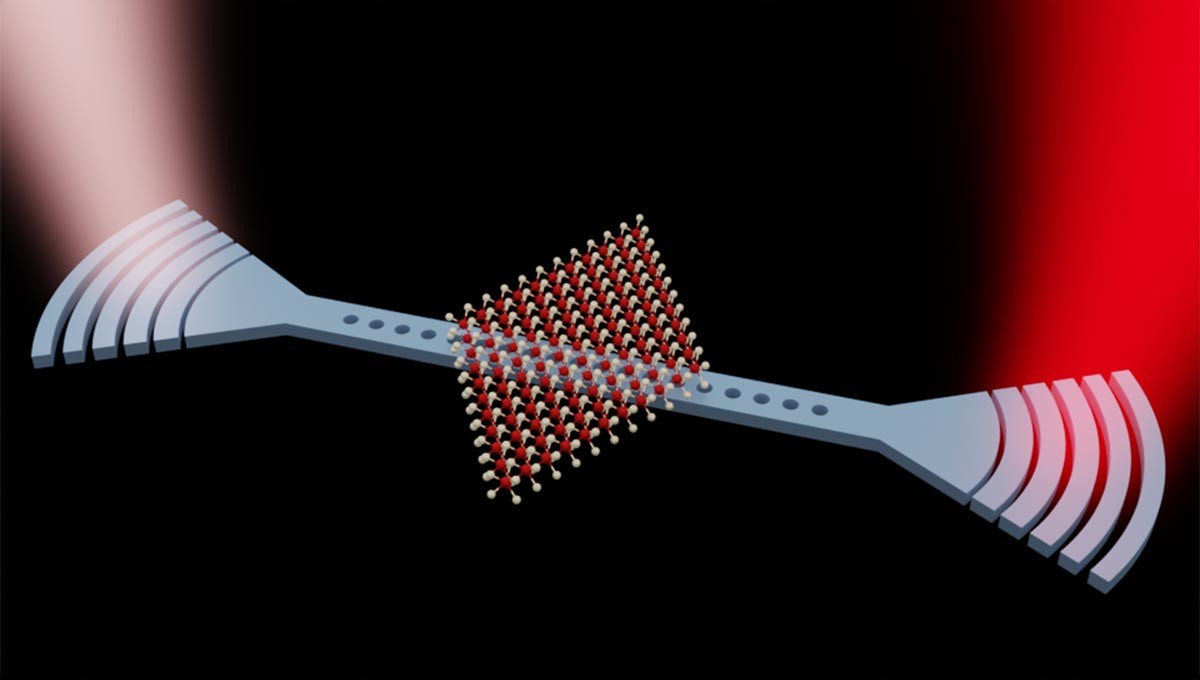
They created exciton-polaritons in an atomically thin semiconductor. Half light, half electron. A quasiparticle. The result? You keep the speed of light. But now it has weight. It interacts. It can switch signals. It can compute.
Most photonic chips today are cheating. They use light for the long haul, the data transfer parts. But the moment they hit a nonlinear step, like an activation function in neural nets, they convert the signal back into electricity. Convert. Calculate. Convert again.
That back-and-forth is slow. It eats power. It negates the benefits.
Zhen’s demo skipped the middleman. All-light switching. The energy cost? Four quadrillionths of a joules. That is practically nothing. Less energy than blinking a small LED.
No More Converting
If this scales, the implications are messy but promising. Future AI chips could eat data straight from camera sensors. No electrical translation required. Light in, light out, result ready.
It reduces the energy bill for massive AI systems. Maybe. If we can build the things at scale. There are whispers about supporting quantum computing functions too. Early days, obviously.
Who actually gets the chips first? The labs. Always the labs.
The paper, titled “Strongly Nonlinear Nanocavity…,” appeared in Physical Review Letters last April. Zhen holds the Jin K. Lee Professorship. He used to work with He, now an assistant prof at Montana State. Zhi Wang and Bumho Kim also helped.
Money came from the Navy Office and the Sloan Foundation. The work exists now. The engineering hurdles do too.
We might run on light soon. Or we might just burn out faster trying to force electrons to keep up. Either way, the current is shifting.