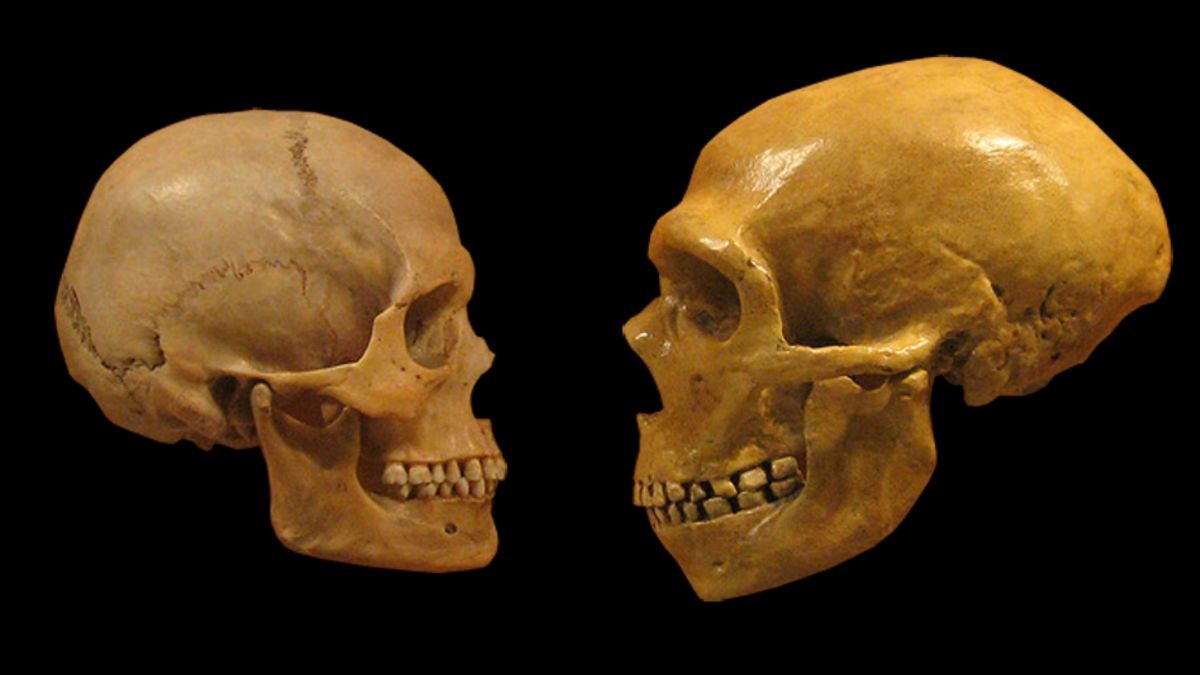
For over a century, the prevailing narrative of human history has been simple: Homo sapiens outsmarted and outmuscle our Neanderthal cousins, leading to their inevitable extinction. We were the clever survivors; they were the brutish losers.
But modern archaeology has dismantled this stereotype. We now know Neanderthals were sophisticated beings who created art, made fire, spun fibers, and hunted large game with coordinated strategy. If they were intelligent and capable, why did Homo sapiens survive while Neanderthals vanished from the face of the Earth more than 40,000 years ago?
A new study suggests the answer lies not in brains or brawn, but in social connectivity.
The Power of the Network
Researchers from the University of Montreal and the University of Cambridge argue that the key difference between the two species was how their populations were connected across the landscape.
Between 60,000 and 35,000 years ago, Europe underwent drastic climate shifts. As Homo sapiens migrated out of Africa, they encountered Neanderthals in a volatile environment. To understand how these two groups fared, the scientists built ecological models similar to those used in conservation biology to map suitable habitats. They integrated data on geography, climate variability, and archaeological findings to reconstruct the “social maps” of both species.
The results revealed a critical disparity:
- Homo sapiens occupied habitats that were well-connected, forming a robust network across regions.
- Neanderthal groups, particularly in Western and Southeastern Europe, lived in isolated pockets separated by large distances.
“These networks act as a safety net,” explains lead researcher Ariane Burke. “They allow for the exchange of information on resources and animal migrations, the forming of partnerships, and temporary access to other territories in the event of a crisis.”
In essence, when a local group of Homo sapiens faced a famine or a harsh winter, they could migrate, trade, or receive aid from neighboring groups. Neanderthals, living in smaller, more dispersed populations, lacked this buffer. A local disaster could wipe out an entire group with no hope of replenishment from elsewhere.
Debunking the Competition Myth
This finding challenges the long-held belief that Homo sapiens and Neanderthals were locked in a direct, zero-sum competition for the same resources. The models suggest that their most suitable habitats barely overlapped.
However, even a small overlap—estimated at up to 5 percent at any given time—could have had profound consequences. While direct competition may not have been the primary driver of extinction, the structural vulnerability of Neanderthal populations made them susceptible to demographic collapse.
Genomic evidence supports this view. Neanderthals likely had lower genetic diversity due to their small population sizes. Some scientists hypothesize that a crash in their numbers led to inbreeding and reduced resilience, accelerating their decline.
A Complex Legacy
The disappearance of Neanderthals was not a uniform event across Europe. The study suggests different dynamics played out in different regions:
- Western Europe: Where Homo sapiens and Neanderthal core regions overlapped more significantly, Homo sapiens may have played a more active role in the extinction or genetic assimilation of Neanderthals.
- The Balkans and Southern Italy: In areas where Neanderthal networks were distant and isolated, demographic vulnerabilities and environmental pressures likely explain their disappearance without significant direct conflict.
Today, the legacy of Neanderthals lives on in us. Non-African populations carry between 1 and 4 percent of Neanderthal DNA, a testament to the interbreeding that occurred before their final decline.
Conclusion
The survival of Homo sapiens was not just a triumph of individual intelligence, but of collective resilience. By maintaining strong social and geographical connections, early humans created a safety net that isolated Neanderthal groups lacked. In the harsh climate of prehistoric Europe, it was our ability to stay connected that ensured our lineage endured.