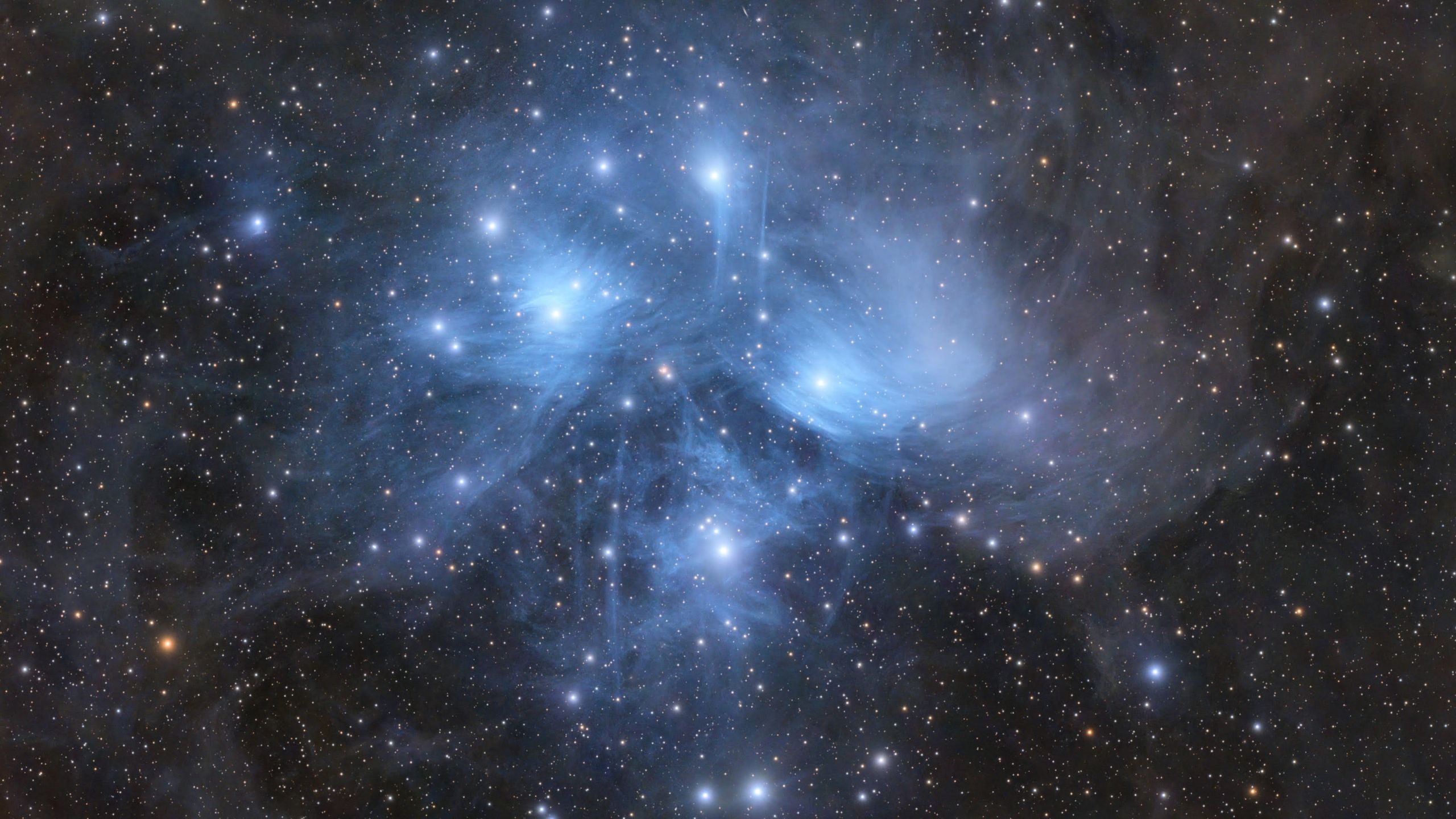
Astrophotographer Mark Germani has produced a stunning new image of the Pleiades star cluster, revealing the celestial formation surrounded by a delicate, ghostly blue haze. Located 445 light-years from Earth in the constellation Taurus, this open cluster is a favorite target for skywatchers and photographers alike. Germani’s work highlights not only the brilliance of the stars but also the subtle, often overlooked interstellar dust that surrounds them.
A Cluster of Blue-White Giants
The Pleiades, frequently referred to as the “Seven Sisters,” is a massive collection containing over 1,000 stars. However, its nickname derives from its seven brightest members: Alcyone, Asterope, Merope, Celaeno, Electra, Maia, and Taygete. These stars are predominantly blue-white in color, indicating they are young, hot, and massive compared to older, cooler stars like our Sun.
Germani’s photograph captures dozens of these stars, showcasing the cluster’s dense core. The image serves as a visual testament to the cluster’s youth; the Pleiades is relatively young in cosmic terms, estimated to be only about 100 million years old. This youth explains the prevalence of blue stars, which burn their fuel quickly and shine brightly before evolving into different stellar phases.
The Mystery of the Blue Nebula
One of the most striking features of Germani’s image is the vast cloud of reflection nebulas enveloping the stars. According to NASA, these clouds consist of dust and gas that preferentially reflect the blue light emitted by the nearby hot stars. This scattering effect is similar to why Earth’s sky appears blue during the day.
Why does this matter? For decades, astronomers debated the origin of this dust. Early theories suggested it was leftover material from the cluster’s formation. However, current consensus indicates that the Pleiades is simply moving through a random interstellar cloud. The stars are not carrying their birth remnants with them but are instead passing through a separate cosmic structure. Germani’s high-resolution imaging helps reinforce this understanding by revealing the faint, wispy details of the dust that might otherwise be washed out by light pollution or inferior equipment.
Technical Mastery Behind the Image
Capturing such fine detail required significant effort and specialized equipment. Germani spent over 18 hours imaging the cluster from Vancouver, Canada. His setup included an Askar SQA55 quintuplet refractor telescope and a ZWO astronomy camera.
A key decision in the process was the choice of filters. Germani noted that he had previously struggled with capturing M45 (the astronomical designation for the Pleiades). To improve the result, he abandoned his standard light pollution filter in favor of a UV/IR-cut filter. This specific filter blocks ultraviolet and infrared wavelengths, which do not contribute to visible color but can introduce noise and blur in digital sensors.
“I decided to take a different approach with this image, ditching my light pollution filter and swapping in a UV/IR-cut filter in an effort for better colour and more faint dusty detail,” Germani explained.
The imaging session was spread across seven nights in January, with additional hours captured in February. This long-exposure technique allows the camera to gather enough light to reveal the faintest structures in the nebulas, which are invisible to the naked eye.
The Changing Night Sky
For amateur astronomers, timing is everything. The Pleiades has been a dominant feature of the winter sky for months, soaring high above the horizon. However, as the seasons shift to spring, the cluster’s visibility is rapidly diminishing.
In late April, the Pleiades can only be seen low on the western horizon shortly after sunset. It sets less than two hours after the sun, making it increasingly difficult to observe as twilight deepens. Its departure marks the transition to a new set of celestial highlights, with spring constellations rising to reveal different deep-sky wonders, including distant galaxies and nebulae.
Conclusion
Mark