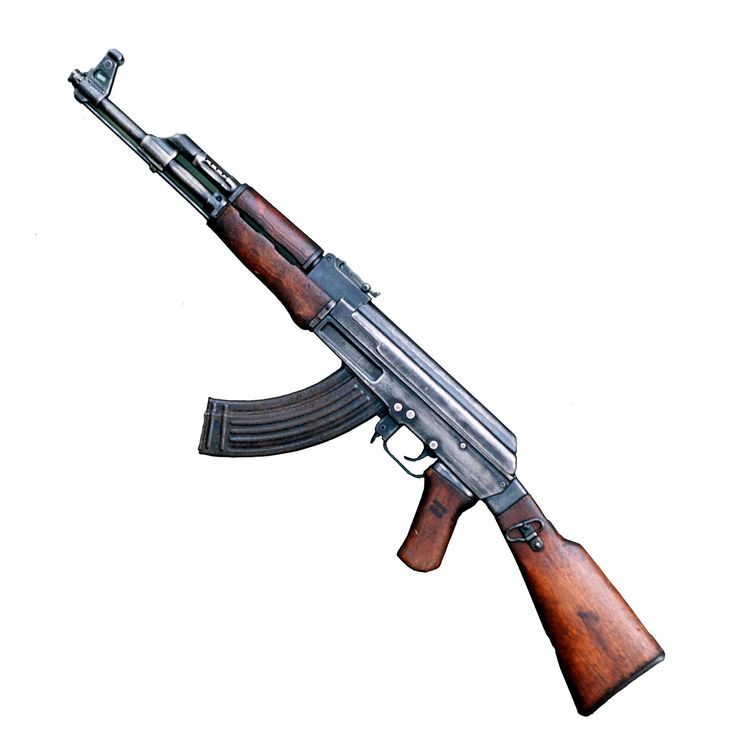
It is hard to overstate the cultural and military footprint of the AK-47. Designed by Mikhail T. Kalashnikov, the name is a direct abbreviation for “Automatic Kalashnikov 1947,” the year the weapon was adopted by the Soviet military. This Soviet assault rifle was built with a dual firing mode, allowing soldiers to switch between semiautomatic and fully automatic fire. It relied on an intermediate-power 7.62-mm round, a cartridge that offered a balance between the stopping power of full-sized rifle ammo and the controllability of lighter pistol rounds.
Manufacturing and Global Spread
The rifle was mass-produced in the former Soviet Union and across Soviet-bloc nations. But it did not stay behind the Iron Curtain. It became the standard shoulder weapon for virtually every communist army in the world. Beyond state militaries, it was picked up by guerrilla groups, nationalist movements, and insurgents. Its simplicity made it a favorite in conflicts where logistics were poor and maintenance was difficult. If a soldier could disassemble it blindfolded, they could put it back together in seconds. That reliability is a key reason why the AK-47 became so ubiquitous in asymmetric warfare.
Evolution and Successors
The original model was not the last word in Kalashnikov’s lineage. By the 1960s, the Soviet military began replacing the AK-47 with the AKM. This updated version used a lighter, cheaper stamped-metal receiver instead of milled steel, making it easier and less expensive to produce. The shift continued into the 1970s with the AK-74, which fired a new high-velocity 5.45-mm round. This smaller caliber allowed soldiers to carry more ammunition while maintaining accuracy at longer ranges compared to the bulky 7.62-mm rounds of its predecessor.
Context and Comparison
The AK-47 sits in a specific historical and technical context when viewed alongside other iconic weapons like the M16 rifle. While the M16 emphasized lightweight plastics and high-velocity small-caliber rounds, the AK series leaned into robustness and mechanical simplicity. This contrast defined the tactical doctrines of the Cold War. The AK-47 remains a symbol of this era, not just for its kill count, but for how it changed the way wars are fought by non-state actors. It proved that a well-designed, affordable weapon could shift the balance of power in the hands of those who usually lacked it.
The legacy of the AK-47 is not just in the numbers produced, but in the way it democratized firepower. It turned infantrymen into something closer to independent combatants. The designs it spawned are still in use today. And the questions about its impact on global politics continue to linger.