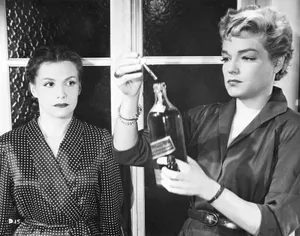
Born on March 25, 1921 in Wiesbaden, he was a German citizen, but later became a French icon. Simone Signoret spent her childhood in Neuilly-sur-Seine, a suburb of Paris. It was a sheltered middle class life. As a teenager, he frequented the Café de Flore. It was a center for leftist artists and intellectuals. There he met the writer Jacques Prévert and the director Yves Allègre.
He eventually married Allegrate.
But most importantly, he decided to become an actor.
Getting there is not easy.
His father is Jewish. This position prevented him from obtaining an official work permit during the Nazi occupation of France.
He couldn’t get the documents. So she took her mother’s maiden name. Signores. It became his professional identity. He worked as an extra in films for many years. The goal is survival, not stardom.
Then the war ended. Barriers have been broken. He quickly moved from behind-the-scenes roles to leading roles. His early role in Yves Allegret’s L’Auvelle (1945) proved this. The same goes for Macadam (1946). She plays a prostitute. A woman with a loose relationship. Characters on the fringes of society. The audience responded. He became a star in France with his leading role in Dédé d’Envers (1948). This movie is also known as ‘Dedi’. She plays another sympathetic prostitute. A fallen romantic heroine. This defined his early career.
His personal life matches his professional vicissitudes. She married Yves Montand. Their union is in disarray. They were both champions of left-wing causes. Politics makes them controversial. This gave them a bad reputation. Simone Signoret died on September 30, 1985 in Eure, France. However, her fierce and willful image in the film industry still remains.
The narrative of Simone Signoret’s career shifted dramatically in 1949. That year, she encountered Yves Montand. The chemistry was immediate, and the impact was permanent. She divorced her then-husband, Henri-Georges Allégret, to marry Montand in 1951. This union changed her professional rhythm. She began selecting projects with more care, prioritizing time with her new partner.
The films she chose during this period showcased her range. Jacques Becker’s Casque d’or (1952), known in English as Golden Marie, cast her as the title character. It was a romantic drama, but Signoret brought a specific sensitivity to the role. Her performance was warm. It was passionate. She did not just play a gangster’s moll; she played a woman with depth.
Then came Henri-Georges Clouzot’s Les Diaboliques (1955). The tone shifted entirely. Here, Signoret played a schoolteacher who was cool, calculating, and murderous. The film is a suspense classic, and her contribution was chilling. She proved she could switch from the warmth of Casque d’or to the ice of Les Diaboliques without missing a beat.
Her work in theatre also expanded during this era. She starred alongside Montand in Paris. The production was Arthur Miller’s The Crucible. They performed it in 1954 and 1955. The critical reception was strong. The play was later adapted into the 1957 film Les Sorcières du Salem, with Signoret reprising her role.
The Breakthrough in Room at the Top
International fame arrived in 1958 with Room at the Top. This was the project that secured her status as a global star. The role was complex: a jilted older woman. Signoret played her with intelligence and sensuality. The performance resonated deeply with audiences and critics alike.
The awards followed. She won the British Academy Award. She won the American Academy Award. These honors cemented her reputation.
Hollywood came calling after that success. She appeared in a few American films. But she found her footing elsewhere. She preferred working in France. The industry there allowed her more control and artistic freedom.
Aging as an Asset
In her later years, Signoret took on roles that reflected her own physical reality. Films like Le Chat (1971, or The Cat ) and La Vie devant soi (1977, released in English as Madame Rosa ) featured her as a survivor. These were women who had fought battles. Their struggles were visible in their faces.
Signoret’s face was often described as beautifully ravaged. She did not hide it. She did not try to glamorize her looks. This decision drew as much attention as her acting. Critics noted her sincerity. She brought the same warmth to these older characters that she had shown in her early days as a radiant beauty. But here, the authenticity was sharper.
She published her autobiography in 1976. The title, La Nostalgie n’est plus ce qu’elle était, translates to Nostalgia Isn’t What It Used to Be.