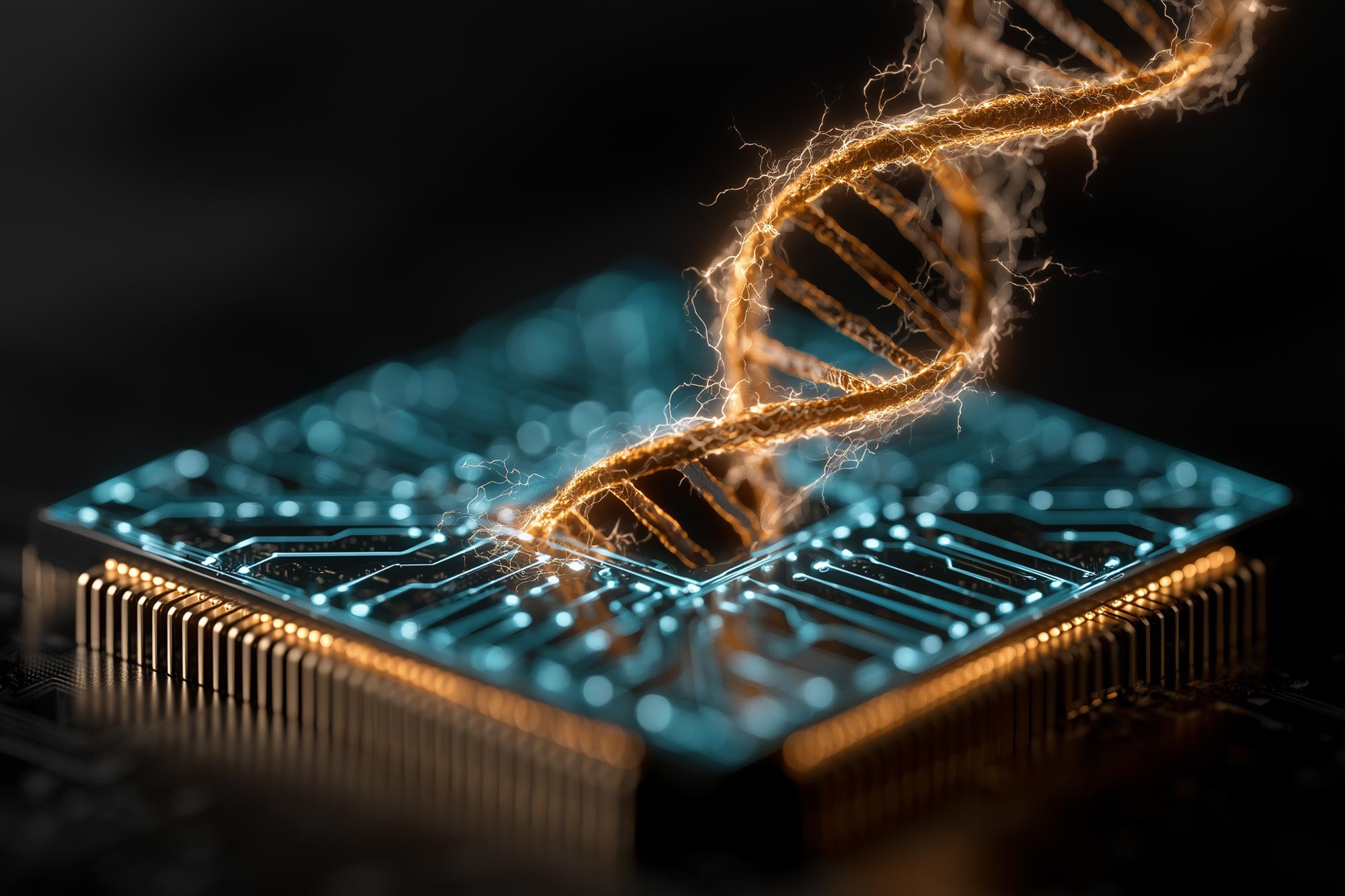
Harvard scientists just did something that feels like it belongs in a different era of computing. They turned a silicon chip into a DNA factory.
The setup is simple, almost elegant in its reversal. Instead of pumping hazardous organic solvents through a machine to build genetic code, they use water and electricity. The result? A cleaner, more precise method for manufacturing DNA that could change how we build the building blocks of life—and data.
This isn’t just another incremental update to biotech tools. It’s a fundamental shift in how we approach enzymatic DNA synthesis. And it starts with a chip originally designed for neuroscience.
Solvent-Free DNA Manufacturing
To understand why this matters, you have to look at how we make synthetic DNA today. It’s mostly done via phosphoramidite chemistry. That’s a mouthful, but the downsides are concrete. It relies on toxic organic solvents. It’s messy. And because of that chemistry, it usually happens in large, centralized facilities rather than small labs.
The alternative is enzymatic synthesis. It happens in water. It mimics how living cells naturally assemble DNA. It’s safer. It’s greener.
But it has a history problem. Until now, enzymatic methods lagged significantly behind conventional chemistry in speed and scale. Previous systems could only create about a dozen DNA sequences at once. That’s fine for research samples, but it doesn’t scale for industrial needs.
The Harvard team, led by Donhee Ham at the Paulson School of Engineering and Applied Sciences, changed that math. Their paper in Nature Electronics details a silicon chip that synthesizes 64 different DNA sequences simultaneously. Each sequence reaches up to 39 nucleotides in length.
That number—64—is a new benchmark for parallel enzymatic DNA synthesis in water. It’s a distinct jump from the dozen-sequence ceiling of the past.
How Precision Currents Control DNA Growth
The challenge isn’t just building one strand. It’s controlling 64 of them at once without them interfering with each other.
DNA grows one nucleotide at a time. But before a new piece can be added, a temporary blocking group must be removed from the previous one. This removal is called deprotection.
In this water-based system, deprotection requires a drop in pH—an acidic environment.
If you just dumped acid onto the whole chip, everything would react. Everything would grow at once. Chaos.
The Harvard chip solves this with electricity.
The surface features 64 distinct sites. Each site holds DNA strands at the center, surrounded by two concentric ring electrodes. The process is surgical:
- To add a nucleotide to a specific site, the chip sends current into the inner ring.
- This reaction produces protons, instantly lowering the pH around that specific DNA strand.
- Enzymatic growth begins.
- Simultaneously, the outer ring pulls current in the opposite direction, absorbing stray protons before they can drift.
This containment field prevents the acidity from bleeding into neighboring sites. By cycling current through different sites, the chip builds 64 separate sequences in parallel.
It’s precise current injection, adapted for molecules rather than neurons.
From Neurons to Nucleotides
The irony here is that this DNA factory wasn’t designed for biology first. It started in Ham’s lab as a tool for recording neural activity.
Former PhD student Jeffrey Abbott developed the silicon platform to capture signals from thousands of neurons. It mapped synaptic connections with high fidelity. The team even scaled it up to record tens of thousands of connections.
Then Ham had a thought.
The chip’s defining feature was its ability to inject current with extreme precision. They had used that to permeabilize neuronal membranes. Why not switch the target from cells to molecules?
“We wondered whether that same current control could be directed from cells to molecules,” Ham explained. “It worked.”
They replaced the neuron-facing electrodes with the ring-electrode pairs described above. The hardware stayed largely the same. The application flipped entirely.
DNA Data Storage and Environmental Impact
Beyond basic biotechnology, there’s a more ambitious use case lurking here: DNA data storage.
The researchers demonstrated this by encoding a 169-byte text string into their 64 DNA sequences. It’s a small-scale proof of concept. But the implications are huge.
Digital storage is running out of space. DNA is dense. A gram of DNA can theoretically hold all the data ever created by humanity. But storing data requires producing massive quantities of DNA.
Current solvent-based manufacturing can’t scale efficiently without creating massive amounts of chemical waste. Water-based enzymatic synthesis changes that equation.
“DNA data storage asks DNA synthesis to operate on a scale far beyond today’s needs,” says Woo-Bin Jung, co-first author and now a professor at POSTECH. “Enzymatic synthesis in water matters because it offers an environmentally friendly route toward writing DNA in very large volumes.”
If the parallelization scales beyond 64 sequences, the environmental benefits compound. Fewer solvents. Less waste. Cleaner biomanufacturing.
Where the Chemistry Breaks Down
The hardware works. The electricity localizes the pH perfectly. But the chemistry has a flaw.
When the team tried packing the synthesis sites closer together, the experiment failed. Not because the chip malfunctioned, but because the reaction itself was too messy.
Low pH doesn’t remove the blocking group directly. It generates intermediate molecules that do the job. These molecules are unstable. They drift.
They escape the controlled pH zones defined by the electrodes. They drift into neighboring sites and trigger reactions there. The “island” of acidity leaks. The precision fails.
“The chip did exactly what we asked it to do,” said Han Sae Jung, another co-first author. “The limitation is the deprotection chemistry.”
The solution isn’t better silicon. It’s better chemistry.
The field now needs an acid-driven deprotection method that doesn’t create drifting intermediates. A more direct chemical reaction that can keep pace with the electronic precision already built into the chip.
Until then, 64 sequences is the limit for dense packing. But the path forward is clear.
It’s no longer an electronics problem. It’s a chemical engineering one. And someone has to solve it next.
Reference: “Parallel enzymatic DNA synthesis using a semiconductor芯片” by Woo-Bin Jung, Han Sae J., Jun W., et al., Nature Electronics, June 17, 2026.