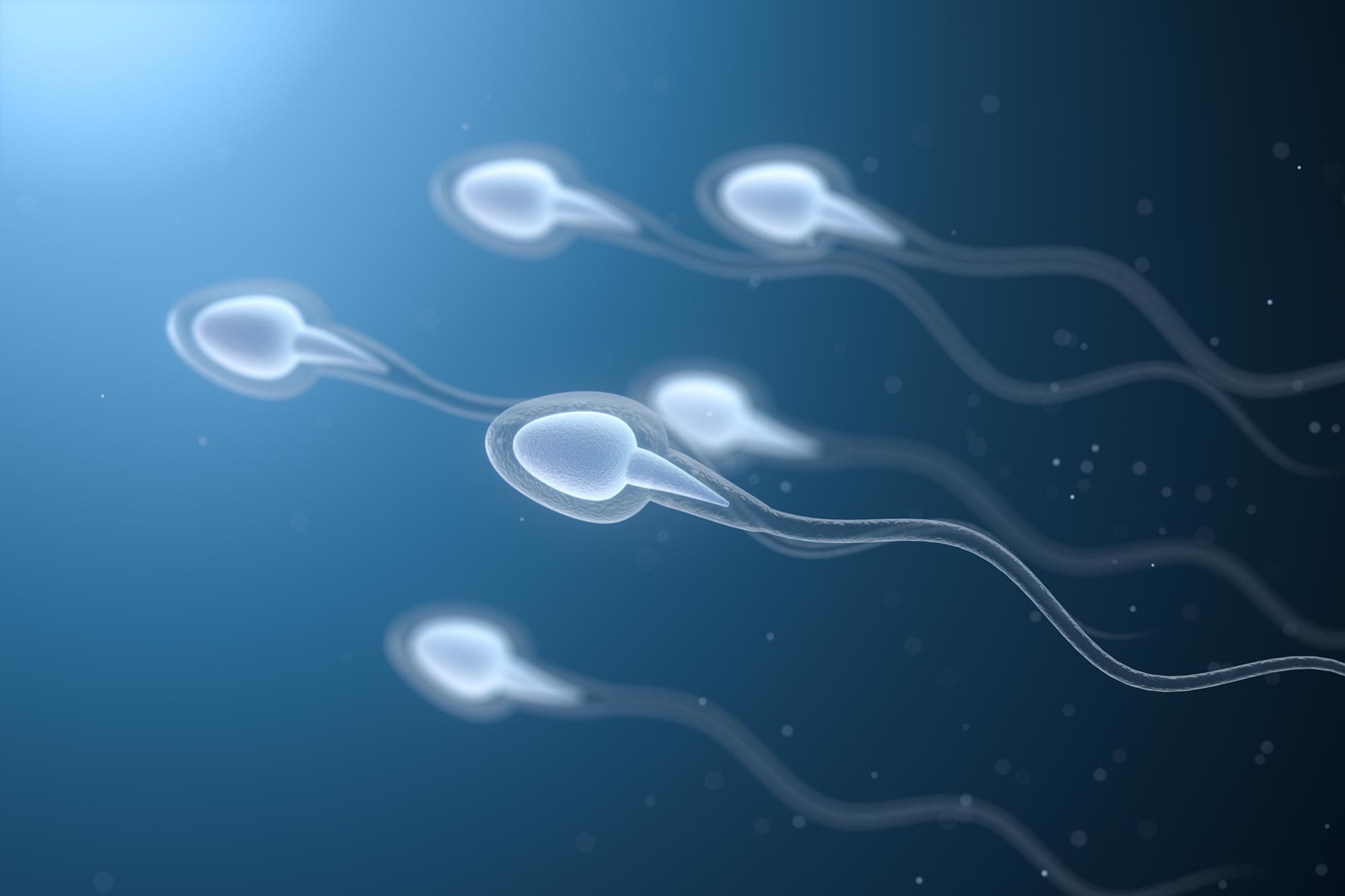
They should be stuck.
Fluids at the microscopic level aren’t like a pool you can dive into. They’re thick, resistant sludge. If you stop paddling, you stop moving instantly. There is no glide. No momentum.
So how does a sperm cell push through? It shouldn’t be able to.
A new study suggests they do it by breaking the usual rules. Not literally—physics still applies—but by exploiting a loophole in how we think about energy and motion.
The Newton Problem
Newton’s third law says action equals reaction. You push a marble, it pushes back. Simple. Symmetric.
Sperm are different. They are “active systems.” They pump their own energy into their motion constantly. They aren’t passive objects bobbing in a stream.
As the Kyoto University researchers write, “Newton’s third law may be violating… when we regard it as an open, with mechanical energy injected from microscopic active units.”
They aren’t breaking the universe. They’re just doing something the universe doesn’t expect passive objects to do.
“In other words, they reveal what happens when living systems pump their energy from within.”
Why Tiny Matters
For something so small, inertia doesn’t exist. Viscosity rules everything. This leads to a problem called the scallop theorem.
If you move forward, then move back exactly the same way, you end up right where you started. In thick fluid, symmetry kills motion. To go anywhere, you have to break the symmetry. Your forward stroke must be different from your backward one.
Sperm use flagella. Thin, waving tails.
Most things that wave, like a rubber spring, just snap back. Sperm tails are powered by internal motors. Those motors add energy into the tail itself. The tail becomes an active material. Not passive. Not static. Alive with energy.
The “Odd” Part
This brings us to “odd elasticity.”
In normal materials, force is reciprocal. You push, it pushes back equally. Odd elasticity breaks that mirror image. Because of internal energy, the material responds differently than the force applied. It’s non-reciprocal.
It helps sustain waves even when the fluid is trying to dampen them.
The researchers created a math framework for this called odd elastohydrodynamics. It sounds heavy, but it basically lets scientists separate what the fluid is doing from what the tail is doing internally. Drag masks the mechanics. This framework uncovers it.
What They Found
They tested the model on human sperm and a green alga called Chlamydomonas.
The results were clear. In sperm, internal activity creates the wave, while passive elasticity just stabilizes it. In the alga, the odd elasticity directly powers the beat.
It means the tail isn’t just a whip. It’s a complex energy-consuming engine. It uses non-reciprocal forces to move in a world where regular back-and-forth motion fails.
Why does this matter?
It explains how life moves at the smallest scale. It might also help build microscopic robots. Machines that don’t get stuck in the viscous sludge of the human body, but swim through it with the same cunning efficiency as a sperm cell.
We thought we knew the rules. We just forgot that life writes its own.
Reference: “Odd Elastohydrodynamics: Non-Reciprocal Living Material, Kenta Ishimoto et al., PRX Life.