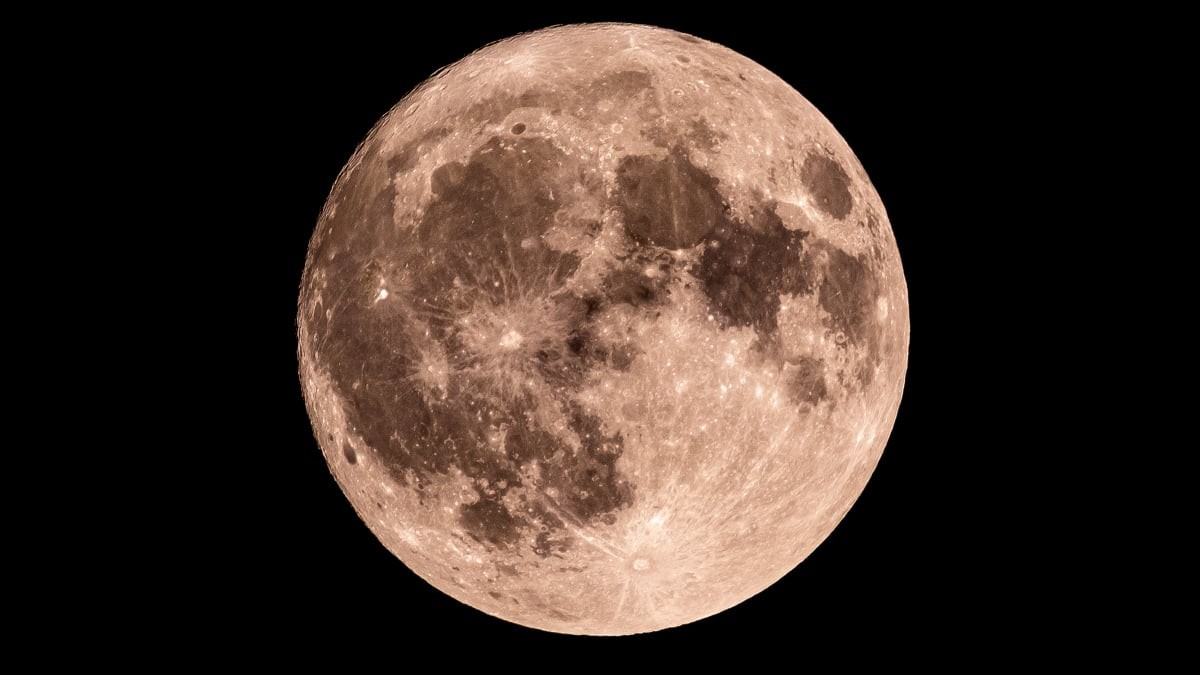
The lunar cycle has officially begun its upward climb. Following the recent New Moon, the Moon is entering a period of gradual brightening that will continue over the coming weeks. For observers on April 18, 2026, this transition marks the very beginning of a new visible phase.
Today’s Lunar Status: The Waxing Crescent
As of Saturday, April 18, the Moon is in its Waxing Crescent phase. According to data from NASA, only about 1% of the lunar surface is currently illuminated from our perspective on Earth.
Because the illumination is so minimal, the Moon remains extremely difficult to spot with the naked eye. However, this “sliver” of light is the first step in a predictable brightening process. Each night, a slightly larger portion of the Moon’s sunlit side will become visible to us, a process known as “waxing.”
Looking Ahead: The Road to the Full Moon
The Moon is currently on a trajectory toward its next peak brightness. Observers can look forward to the next Full Moon on May 1, 2026. Interestingly, this will be the first of two Full Moons occurring in the month of May, a phenomenon often referred to as a “Blue Moon” when it occurs in a single calendar month.
How Lunar Phases Work
To understand why the Moon changes shape, it is helpful to look at its relationship with the Earth and the Sun. While the Moon takes approximately 29.5 days to complete one orbit around our planet, we do not see the entire surface lit at once.
Because the Moon orbits the Earth, our viewing angle of its sunlit side constantly shifts. This creates the eight distinct phases that define the lunar cycle:
The Waxing Phases (Increasing Light)
- New Moon: The Moon is positioned between the Earth and the Sun, leaving the side facing us in darkness.
- Waxing Crescent: A thin sliver of light appears on the right side (in the Northern Hemisphere).
- First Quarter: Exactly half of the Moon appears illuminated.
- Waxing Gibbous: Most of the Moon is lit, but it has not yet reached a full circle.
The Full and Waning Phases (Decreasing Light)
- Full Moon: The entire face of the Moon is illuminated by the Sun.
- Waning Gibbous: The illumination begins to shrink from the right side.
- Third Quarter: The opposite half of the Moon (the left side in the Northern Hemisphere) is lit.
- Waning Crescent: A final, thin sliver of light remains before the cycle resets to a New Moon.
Why this matters: Understanding these phases is more than just a celestial observation; it tracks the rhythmic cycle of light and darkness that has influenced human calendars, tides, and navigation for millennia.
Summary
While the Moon is nearly invisible tonight with only 1% illumination, it is beginning a predictable cycle of brightening that will culminate in a Full Moon on May 1.