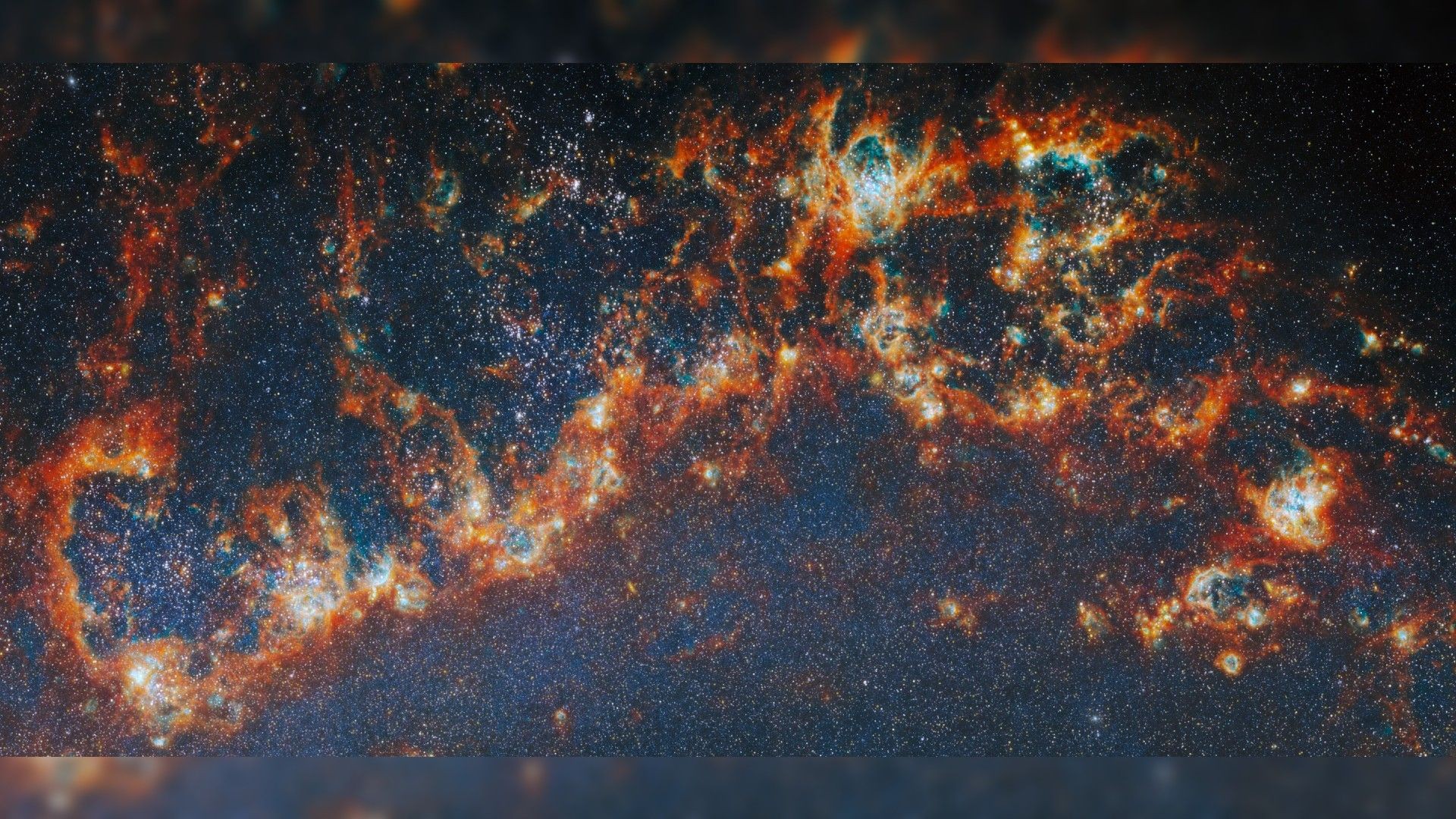
The James Webb Space Telescope (JWST) has released a stunning new portrait of the Whirlpool Galaxy (M51), offering astronomers and space enthusiasts a glimpse into the galaxy’s dynamic interior. Captured by the telescope’s Near-Infrared Camera (NIRCam), this image highlights the intricate dance of gas, dust, and newborn stars within one of the universe’s most recognizable spiral structures.
Seeing the Invisible: The Power of Infrared
While the Whirlpool Galaxy has long been a favorite subject for amateur astronomers and Hubble Space Telescope operators, this latest image provides a fundamentally different perspective. The key lies in the technology used: NIRCam observes in near-infrared light, a part of the electromagnetic spectrum invisible to the human eye.
This capability is not merely aesthetic; it is scientific. Infrared light penetrates thick clouds of cosmic dust that often obscure visible-light observations. By cutting through these veils, JWST reveals the raw materials of star formation—compressed hydrogen gas and dust clouds—that are currently condensing into new stellar bodies. This transforms the image from a simple snapshot into a map of active galactic evolution.
Cosmic Scale and Proximity
The image displays only a fraction of the galaxy’s vast structure, yet it underscores the immense scale of M51.
- Size: The full diameter of the Whirlpool Galaxy spans approximately 76,900 light-years. For context, our own Milky Way is larger, measuring over 100,000 light-years across.
- Distance: Located in the constellation Canes Venatici, M51 sits roughly 31 million light-years from Earth.
Despite this astronomical distance, the Whirlpool Galaxy remains one of our closest galactic neighbors. Its relative proximity and bright apparent magnitude of +8.4 make it accessible to skywatchers with modest equipment, such as small telescopes or high-quality binoculars. This accessibility has made it a staple of amateur astronomy, allowing the public to witness spiral structures that are often theoretical to beginners.
Why This Matters
This release is more than a visual update; it reinforces the critical role of multi-wavelength astronomy. By combining historical visible-light data with JWST’s infrared capabilities, scientists can better understand the lifecycle of stars within spiral arms. The image serves as a reminder that galaxies are not static paintings but living, breathing entities where matter constantly collapses to ignite new suns.
The Whirlpool Galaxy stands as a testament to the universe’s creative power, where dust and gas converge to birth stars in structures visible from millions of light-years away.
As JWST continues to probe the cosmos, images like this bridge the gap between complex astrophysical processes and public appreciation, reminding us that even distant galaxies are composed of the same fundamental materials as our own.