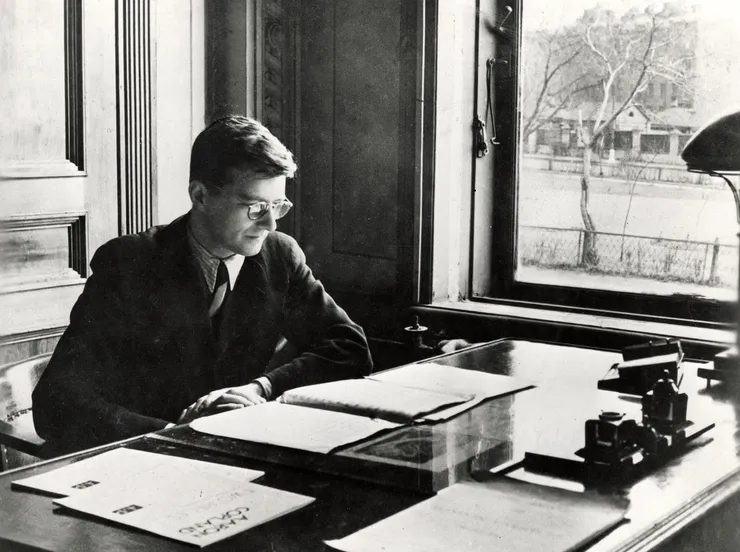
Dmitri Shostakovich wasn’t just a composer. He was a survivor. Born in St. Petersburg on September 25, 1906, the future titan of Russian music grew up under the shadow of revolution and political terror. His parents were intellectuals, a detail that would ultimately be both a blessing and a death sentence in Stalin’s USSR. By age 13, he had already breezed into the St. Petersburg Conservatory. Most 13-year-olds are worried about algebra. Shostakovich was worried about making a mark.
His debut, Symphony No. 1, dropped between 1924 and 1925. It didn’t just arrive; it conquered. Critics were stunned by his ability to handle large orchestral forces with a maturity that belied his youth. The work swung wildly between unaffected lyricism and biting satire. It was grand. It was heroic. It made him an international name almost overnight.
But fame in the Soviet Union came with a catch. You had to please the state. Shostakovich tried. He dipped his toes into avant-garde waters with his next few symphonies and theatre pieces. The opera Lady Macbeth of Mtsensk (1932) was one of his biggest bets. He later revised it as Katerina Izmaylova, but the damage was done. In 1936, Soviet authorities denounced the work. It was a public humiliation. The government wanted clear, accessible propaganda. They didn’t want ambiguity.
Shostakovich pivoted. Hard.
For the next few years, his music turned serious. Elegiac. Direct. He stripped away the experimental layers to give the public exactly what they were told to want. This shift paid off in a major way during World War II. Symphony No. 7, composed in 1941, became known as the “Leningrad Symphony.” Whether it explicitly portrayed the German invasion or just felt like one to listeners, it became a potent symbol of patriotism. It was played across the Allied world. It was a morale booster that transcended borders.
Then came 1948.
If 1936 was a slap, 1948 was a knockout. The government denounced his music again. He was devastated. The pressure broke something in him, or perhaps it forced him deeper underground. He stopped trying to write for the masses and started writing for his soul. He turned to chamber music. The result? 15 string quartets. These works are remarkably personal. They are dark, complex, and deeply human. They were his way of screaming in a room where shouting was forbidden.
The Cold War “thaw” of the late 1950s allowed him to breathe again. The political climate shifted slightly, just enough for him to compose two outspokenly personal late symphonies. The 13th, completed in 1962, is a standout. It’s raw. It’s unapologetic. He died in Moscow on August 9, 1975, leaving behind a catalog that is as much a historical document as it is art.
Historians and musicians often rank him as the greatest Russian composer to follow Igor Str