Something weird happened near Šurany, Slovakia. Archaeologists stumbled upon a massive Roman military camp. It’s huge. Eighteen point two acres. That’s about seven hectares.
The site is extremely rare. Why? Because it holds the remains of Marcus Aurelius’ troops. And they didn’t die with honor in open fields. Many were dumped in wells. Haphazardly. Hastily.
“We have a unique opportunity to explore practically an entire Roman marching camp, which is extremely rare in the European context,” says Matej Ruttkay. He runs the Institute of Archaeology at the Slovakian Academy of Sciences. They found the camp near Šurany. Southwest Slovakia. The excavation is a joint effort between MH Invest and SAS.
It’s not just another ruin. It’s a snapshot of chaos.
The Marcomannic War Context
To understand why these men are here, you have to go back to the late second century. Specifically, 166 to 180 AD. This was the Marcomannic Wars.
Rome was fighting Germanic tribes. The Marcomanni lived north of the Danube. In what is now Slovakia and the Czech Republic today. The Roman emperor was Marcus Aurelius. He ruled from 161 to 168. His goal was simple: defend the border. Secure the empire against invasion.
But the war didn’t end with a grand parade. It ended because Aurelius died. His son, Commodus, negotiated peace. That’s what the third-century historian Cassius Dio wrote.
Ruttkay puts it bluntly: “We are clearly investigating a place that disappeared Immediately after the military conflict between the Romans and Germans.”
The place vanished. But the bones stayed.
Defenses and Dead Bodies
The Šurany site has clear defensive lines. Five gates. Fortifications. A curved ditch and rampart system. It looks like a standard marching or legionary camp. In fact, it’s only the second such installation ever found in western Slovakia.
The first one was found in 2024. Some believe Marcus Aurelius wrote part of his Meditations there. But Šurany is different. It’s darker.
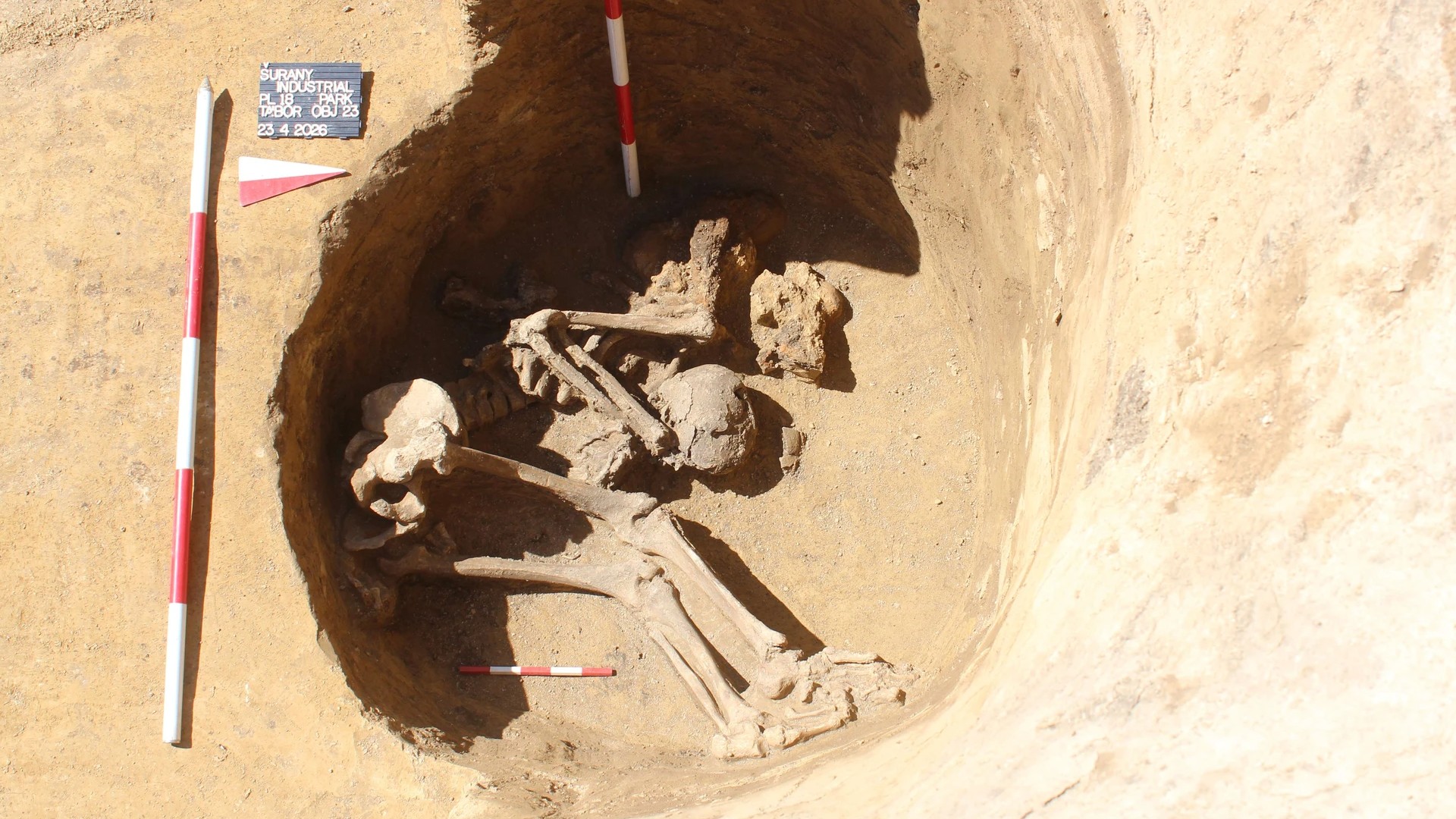
Archaeologists found skeletons everywhere.
Not just in graves. In ditches. In wells. In hastily dug shallow pits. Parts of skeletons. Numerous bodies.
“Our preliminary findings indicate that in most cases these are Roman soldiers,” said Marek Vojteček.
He’s an archaeologist with SAS. The equipment found with the remains proves it. Spears. Arrowheads. Helmet parts. Segmented armor. Scale armor. Legionary brooches. Coins. And footwear.
The Miracle in the Clay
Here’s the kicker. They found caligae. The classic Roman military sandals. Iron nails in the soles survived. How?
X-ray analysis of clay blocks revealed them. Intact.
“Laboratory analyses and further genetic and anthropological research may provide answers,” says Michal Cheben. He’s another archaeologist at SAS.
The nails are now stored in SAS’s specialized lab. Cheben called it “a miracle.” To see original footwear. To even determine the soldier’s size from a sandal. It’s tangible proof of their existence.
But why were they thrown into wells? Why weren’t the bodies looted? Combat injuries? Disease? The camp’s sudden abandonment raises questions that standard archaeology might miss.
A Long-Term Investigation
This isn’t a weekend dig. The camp is large. The artifacts are numerous.
International experts are coming in. They’ll use carbon dating. Soil analysis. Isotopic analysis. Ancient DNA studies. It’s going to take years.
“Long-term process,” Ruttkay says. “Many results will only become known in the coming years.”
So, what actually happened here? Did the Romans retreat in panic? Did the soldiers mutiny? Did plague sweep through the ranks before the well-dumping began?
We might know soon. Or maybe we’ll just have more questions. The clay holds the secrets. The wells hold the dead. And the history books might need a rewrite.
Who knows. Time will tell.