


Short nights in June might make deep-sky astronomers groan. The sky doesn’t stay dark long enough for serious observation. But the celestial theater is putting on a show worth waking up for.
Look up. The Milky Way is glowing with unusual intensity right now. It’s not just a faint band of stars. It’s a vivid, textured ribbon stretching across the heavens. This visibility isn’t accidental. It’s a result of Earth’s position relative to the galactic center during these summer months.
Saturn stands alone
Saturn is currently in opposition. That means the planet is directly opposite the sun from Earth’s perspective. It rises at sunset. It reaches its highest point around midnight. It sets at sunrise. It’s visible all night long.
This alignment has two major benefits. First, Saturn appears at its brightest and largest. Second, the sun’s light doesn’t wash it out during the day. You can spot it with the naked eye if you know where to look. A telescope reveals its rings clearly. No atmospheric distortion interferes. The view is sharp.
For those tracking planetary movements, opposition is a key event. It marks the best time for observation. It doesn’t happen every month. Saturn’s orbit takes about 29 years. Each opposition shifts the date slightly. This year, the geometry favors northern hemisphere viewers. The rings are tilted toward us. We see more of the upper hemisphere.
The June solstice and light
The longest day of the year falls on June 21st. This is the summer solstice for the northern hemisphere. The sun reaches its northernmost point in the sky. Daylight stretches for hours.
This extra light is a double-edged sword for stargazers. It pushes back twilight. It delays the start of astronomical darkness. Yet, the increased sunlight also highlights dust and debris in the upper atmosphere. This can sometimes enhance the visibility of certain celestial objects.
The solstice marks a turning point. Days will begin to shorten soon. The nights will grow longer. That means better opportunities for stargazing later in the year. But for now, the short nights are what we have. Make use of them.
Mini-full moon and lunar details
A mini-full moon is occurring. The moon is at apogee. This is the point in its orbit farthest from Earth. It appears slightly smaller. It looks a bit dimmer. Some call it a “micromoon.”
It’s not as dramatic as a supermoon. But it’s still a full moon. The phase is complete. The entire face is illuminated. This makes it easier to observe surface features. Craters are more distinct. Shadows are longer near the terminator.
The combination of a full moon and short nights creates a challenging sky. Bright moonlight washes out faint stars. Planets remain visible. Saturn shines brightly despite the lunar glare. The Milky Way is harder to see. But its core still stands out near the horizon in the early evening.
Why this matters
Observing these events isn’t just about checking boxes. It’s about connecting with the mechanics of our solar system. Saturn’s opposition is a reminder of orbital dynamics. The solstice is a marker of Earth’s tilt. The moon’s phases are a constant cycle.
Understanding these patterns helps predict future events. It builds a mental
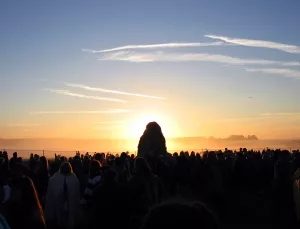
The night is losing its grip in June. It doesn’t just retreat; it gets pushed aside by the sun, which hangs around well past midnight. On June 21, things hit their peak. We are looking at the summer solstice, the single longest day of the year. The sun stays up for more than sixteen hours, reaching a height in the sky it never achieves again until next year.
North of the Arctic Circle, the rules change completely. The sun doesn’t just delay its exit; it doesn’t go down at all. For twenty-four days straight, it remains above the horizon. Daylight is absolute.
Here in Central Europe, the compromise is less stark but still noticeable. The twilight stretches out, dragging on long after the sun dips below the line. It can take up to three hours for true darkness to settle in after sunset. Meanwhile, the first glimmer of dawn arrives shortly after midnight. The result? Northern Germany never gets properly dark. A faint residual glow lingers all night. Even in the south, where things are a bit darker, the pitch-black period lasts no more than two hours.
The Geometry of Light
Why does this happen? It comes down to the tilt of the Earth’s axis. We are currently leaning toward the sun. This angle means the northern hemisphere gets more direct sunlight and the sun traces a higher, longer arc across the sky. The higher the sun climbs, the longer it stays above the horizon. It’s simple geometry, but the effect on our circadian rhythms is anything but simple.
This extended twilight isn’t just a visual curiosity. It affects how we sleep, how we feel, and even how we perceive time. The lack of deep darkness disrupts the production of melatonin, the hormone that signals to your body that it’s time to rest. You might find yourself lying in bed, staring at the faint blue light creeping through the curtains, wondering why you can’t quite drift off.
Living with the Midnight Sun Effect
For those living further north, the summer solstice means a complete break from the usual day-night cycle. People adapt, of course. They go out later. They eat dinner at ten. They take evening swims. But the body knows the difference. Sleep quality often suffers.
In southern Germany, the effect is subtler but still present. You get those two hours of true darkness, but they are sandwiched between hours of lingering twilight. It’s a liminal space. Not day. Not night. Just a long, soft gray.
This phenomenon highlights a disconnect between our internal clocks and the environment. We evolved in a world with distinct days and nights. Now, we live in a world where the boundaries are blurred by tilt and atmosphere. The sun doesn’t care about our schedules. It follows its path, high and steady, demanding our attention long into the evening.
So, what do you do with an extra three hours of light? You burn it. Or you try to ignore it. Either way, the night is shorter. And the darkness is thinner.
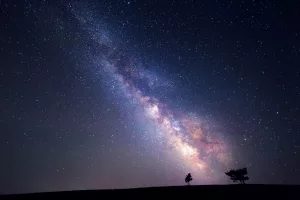

The nights are short. The days are long. But if you look up, you’re looking at our home.
Right now, the Milky Way is putting on its best show. It’s not a trick of the eye. In summer, the densest, most beautiful part of our galaxy—the galactic center—sits directly overhead. It forms a bright band of stars stretching high into the sky. The geometry works in our favor. The Milky Way stands almost perpendicular to the horizon in summer. That vertical angle makes it far easier to spot than when it lies flat.
The Moon Problem
Early June brings a complication. The moon.
During the first half of the month, lunar brightness washes out the star band. You won’t see it. Not really. But wait until the second half of June. The moon sets earlier. The sky darkens. The Milky Way emerges above the southern horizon. You can see it from dusk onward. It’s a shift. A subtle change in timing that unlocks the view.
The Light Pollution Wall
There is a catch.
If you live in a city, you might be staring at a blank sky. Not because the stars aren’t there. Because of the lamps.
Light pollution is brutal. Streetlights, office buildings, neon signs. They create a haze of scattered light. This glow turns the night sky gray. It drowns out the faint structure of the galaxy. In major urban centers, the Milky Way has all but vanished. The contrast is gone. You need dark skies. You need to get away from the concrete jungle.
Where to Look
The galactic center is the prize. It’s the core. The bulge. It’s where millions of stars crowd together. To see it, you need to face south. Look for that vertical streak. It’s thicker in the middle. Fainter at the edges. It’s not just a smudge. It’s a landscape.
But can you see it from your backyard? Probably not. Not if you’re in a city. The light pollution is too strong. You need to drive. Or hike. Away from the glow.
The Milky Way is still there. It’s just hiding. From the noise. From the light.
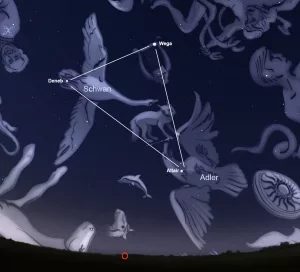

Why the Summer Triangle dominates the night sky right now
Look up. Right now, the Milky Way isn’t just a faint smudge. It’s a bright, chaotic river of starlight stretching overhead, and cutting straight through it are two heavy hitters: the Eagle and the Swan. They’re moving toward each other in a cosmic dance, though you won’t notice the motion if you blink. One heads northeast. The other counters it.
The stars that make up these constellations are arranged in shapes that feel almost too on-the-nose. A cross. A bird with wings spread wide. But the real magic happens when you zoom out.
The brightest stars in these two groups—Deneb in Cygnus and Altair in Aquila—are the anchors of a larger pattern. They form two corners of the Summer Triangle. The third point? Vega. A dazzling blue-white star sitting in Lyra, the Harp.
This isn’t an official constellation. Astronomers don’t list it on the charts. It’s an asterism. A loose pattern stitched together from stars that might be light-years apart, floating in different directions, sharing only the accident of their alignment from our vantage point on Earth.
How the Summer Triangle helps you navigate
You might wonder why this matters. Why should you care that three specific stars form a giant, glowing triangle? Because it’s the sky’s most reliable signpost.
When you’re out in the dark, away from city lights, the Summer Triangle acts as a celestial map. Find Vega first—it’s incredibly bright. Follow the line down to Deneb. Then jump to Altair. You’ve got your bearings. The Milky Way runs right through this triangle, giving you a direct line to the center of our galaxy if the sky is clear and dark enough.
It’s not just pretty. It’s practical. For centuries, travelers used these stars to find north and south, to estimate the time of night, to know when to plant or harvest. Today, it’s still the easiest way to identify the season. See the triangle? It’s summer. Miss it? You’re likely looking at winter.
Vega, Deneb, and Altair: A trio of superstars
These three stars aren’t just bright. They’re distant behemoths.
Vega, in Lyra, is about 25 light-years away. It’s a relatively young star, spinning so fast it’s bulging at the equator. It’s bright because it’s close and active.
Deneb, in Cygnus, is vastly different. It’s over 2,600 light-years away. You can see it with the naked eye because it’s emitting more than 100,000 times the light of our Sun. It’s a blue supergiant, nearing the end of its life. If you could replace our Sun with Deneb, Earth would be scorched instantly.
Altair, in Aquila, sits in between. About 16 light-years away. It’s also spinning rapidly, completing a rotation in less than 10 hours. It’s a main-sequence star, stable, reliable. The kind of star that keeps the galaxy turning.
Together, they form a triangle that spans nearly 100 degrees of sky. That’s huge. It covers more


