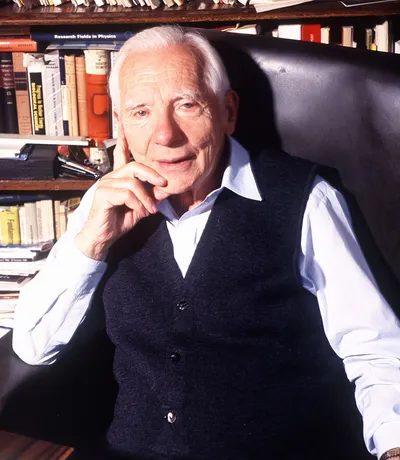
Joseph Rotblat changed the course of his life in 1944.
He was working on the Manhattan Project at Los Alamos, New Mexico. The goal was simple: build the first atomic bombs before the Nazis did. It was high stakes. High risk. And for Rotblat, the most dangerous part wasn’t the radiation. It was the realization that the threat he was racing against didn’t exist.
Nazi Germany wasn’t building an atomic bomb.
Rotblat quit the project immediately. He returned to Britain. He walked away from the very weapon that defined an era.
Most physicists who worked on the bomb stayed. They stayed because the work was groundbreaking. They stayed for the prestige, the funding, the sheer scale of the challenge. Rotblat left because the moral calculus had changed. The enemy wasn’t just across the ocean anymore. The enemy was the potential for global annihilation by any nation.
This wasn’t a moment of weakness. It was the beginning of a lifetime campaign against nuclear weaponry.
A Physics Degree That Led to Peace
Rotblat’s path to Los Alamos started in Warsaw. Born in 1908, he studied at the Free University of Poland and later the University of Warsaw, earning his PhD in physics in 1938. The war in Europe disrupted everything. By 1939, he had secured a fellowship at the University of Liverpool in England.
He stayed there until 1944.
When he moved to Los Alamos, he was part of a massive, secret enterprise. But his departure that same year set him on a different trajectory. After the war, he didn’t return to nuclear physics. He shifted to medical physics. He became a professor at St. Bartholomew’s Hospital Medical College at the University of London in 1950.
He spent decades applying physics to medicine. But the shadow of 1944 never left him.
The Russell-Einstein Manifesto
In 1955, the world was in the grip of the Cold War. Nuclear arsenals were growing. The threat of mutual destruction was no longer theoretical. It was policy.
A handful of prominent scientists signed a manifesto written by philosopher Bertrand Russell. Albert Einstein was among them, though he died weeks later. The document criticized the proliferation of nuclear arms. It warned that science had created a tool that could end human civilization.
Rotblat was one of those signatures.
That manifesto wasn’t just words. It led directly to the Pugwash Conferences on Science and World Affairs. The conference was named for Pugwash, Nova Scotia, the home of industrialist Cyrus Eaton, who funded the first meeting.
The inaugural meeting took place in 1957.
It brought together scientists from rival nations. Specifically, it created a space for American and Soviet scientists to talk when their governments refused to. This wasn’t a diplomatic summit. There were no politicians. Just researchers who understood the physics of destruction and wanted to prevent it.
Leading the Charge
Rotblat didn’t just attend. He led.
He became a founding member of the Pugwash Conferences in 1957. He served as secretary-general from 1957 to 1973. Later, he was president from 1988 to 1997.
The organization sought solutions to national development and