


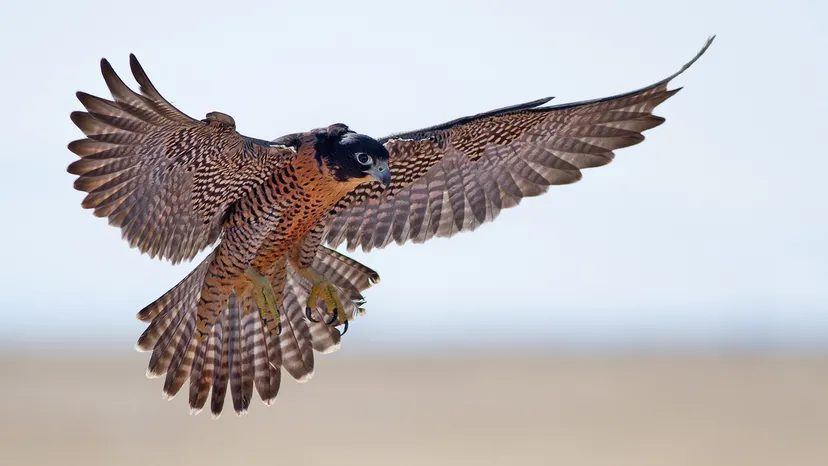
A shadow sweeps across the sky. It’s fast. It’s high. You squint against the sun, trying to catch a glimpse of wings, but the blur is gone in a second. Your friend swears it was a peregrine falcon. The guy next to her is adamant it was a red-tailed hawk.
You’re left standing in the grass, guessing.
It’s a common problem. Both are raptors. Both love the open sky. Both will look you dead in the eye with terrifying intelligence before deciding whether you’re a threat or just scenery. But mixing them up is a rookie mistake. If you want to stop guessing and start identifying, you need to look past the size and focus on the mechanics.
The difference isn’t just in the name. It’s in the physics of their flight and the architecture of their wings.
The Anatomy of a Hawk: Built for Gliding
When people say “hawk,” they are usually talking about birds in the family Accipitridae. This is a sprawling, confusing family that also includes buzzards, eagles, harriers, and kites. Some of these guys share names with falcons, which is why birdwatchers often throw their hands up in frustration.
But if you want to narrow it down to the “true” hawks, you’re looking at the genus Accipiter. This group includes the Cooper’s hawk and the sharp-shinned hawk. There are about 50 species here. They are named Accipiter because they specialize in eating other birds. They also take small mammals when the mood strikes.
Look at their shape.
True hawks have rounded wings. They have broad tails. This body plan is designed for agility in tight spaces, like forests, but it also allows them to glide effortlessly on thermal updrafts. They are the cruisers of the sky.
Then there are the “buzzard hawks,” or the genus Buteo. This is where you find the red-tailed hawk, the ferruginous hawk, and the red-shouldered hawk. The red-tailed hawk is the most common hawk in North America. If you see a big bird sitting on a telephone pole in the middle of nowhere, it’s probably a Buteo.
Size varies wildly. The northern goshawk can stretch to 2 feet long. The tiny sparrowhawk is barely 8 inches. But they all share that broad, rounded wing silhouette.
How Hawks Actually Hunt
Hawks don’t rely on raw speed in the way falcons do. They rely on patience and precision.
Their eyesight is monstrous. They can spot a mouse from hundreds of feet up. But they don’t usually chase it for miles.
Scott Barnes, an expert with New Jersey Audubon, explains that red-tailed hawks typically use two methods: “hover-hunting” or “perch hunting.”
Hover-hunting means flapping in place, suspended in the air, scanning the ground below. When they spot movement, they dive. It’s a short, sharp burst.
Perch hunting is exactly what it sounds like. Sit still. Watch. Wait for the perfect moment to drop. It’s an ambush strategy. They don’t need to be the fastest animal alive. They just need to be the most accurate.
Where You’ll Find Them
Hawks are everywhere. Literally. Every continent except Antarctica has some species of hawk. They prefer open spaces with high perches. A cliff edge. A lone tree in a field. A telephone pole. They need a vantage point to execute their ambush tactics.
The Anatomy of a Falcon: Built for Velocity
Falcons are different. They belong to the family Falconidae. There are nearly 60 species, but the most famous is undoubtedly the peregrine falcon. It is the fastest animal on the planet. When it dives, it hits speeds over 200 mph.
If you want to distinguish a falcon from a hawk in mid-air, look at the wingtips.
Falcons have long, pointed wings. This is not a subtle difference. It is a fundamental architectural choice. Pointed wings are for high-speed flight. They cut through the air with minimal drag. Hawks have rounded wings for lift and maneuverability. Falcons have pointy wings for velocity.
The “True” Falcons
The genus Falco contains about 35 species. The peregrine falcon. The prairie falcon. The merlin. The American kestrel.
In these birds, the females are larger than the males. This is common in raptors, but it’s a consistent trait here.
There are other genera in the Falconidae family, like Microhierax (falconets) and Polihierax (pygmy falcons), but when people talk about falcons, they are usually thinking of the Falco group.
How Falcons Hunt
Falcons don’t hover. They don’t really perch for long periods waiting for a snack. They are active hunters.
Rick Schwartz, a San Diego Zoo Global Ambassador, notes that hunting peregrines catch prey in the air. They use rapid dives. They use impressive aerial maneuvers. They don’t wait for the prey to make a mistake. They force the mistake with speed and aggression.
They have incredible eyesight, yes. But they pair it with intense, explosive flight.
When they catch a bird in mid-air, they might dismember it while still flying. Or they will land in a secure spot, pluck the feathers, and eat. But there is one critical tool they use that hawks do not.
The Notched Beak
This is the detail that trips people up.
Falcons have a sharp, tooth-like notch on the upper mandible of their beak. It looks like a tiny serration. They use this “tomial tooth” to sever the spinal cord of their prey. It’s a quick kill.
Hawks don’t have this. They kill with their talons. They crush or suffocate. Falcons have a specialized knife; hawks have specialized clamps.
Where Falcons Live
Falcons are also global. The peregrine falcon, for instance, lives on every continent except Antarctica. They are adaptable. Schwartz notes they prefer wide-open spaces but do well near coasts where shorebirds are abundant. They can be found in the tundra, in the desert, and even in forests.
Some migrate. Some stay put. But they all share that desire for open sightlines. They need to see the hunt coming from a mile away.
The Verdict
So, back to the sky.
If you see a bird gliding, riding the thermals, with wings that look like a fan at the tips — that’s a hawk. It’s likely a red-tail or a Cooper’s. It’s patient. It’s broad.
If you see a bird slicing through the air, wings stiff and pointed, moving with a purpose that feels almost mechanical — that’s a falcon. It’s built for war. It has the tooth. It has the speed.
The debate isn’t about which is better. It’s about recognizing the different tools in the toolbox of nature. One waits. One strikes. And if you’re watching closely, you’ll see them both, doing exactly what evolution designed them to do.
But the sky is big. And the next bird you see might just change your mind.
Reading the Silhouette and the Sky
You can tell a lot about a bird before you even hear it. The National Audubon Society suggests starting with the basics: size and wing shape. It is a visual game.
Hawks in the genus Accipiter are the compact ones. They have narrow tails and a built-for-speed look. Then you have the buzzard hawks, or Buteo. These are the heavyweights. Broad wings. Short tails. They look like they were built for thermal soaring. Falcons (Falco ) are a different story entirely. Slender bodies. Pointed wings. They look like arrows meant to pierce the wind.
Once you have the shape, look for the colors. Markings are the fingerprint of the species. Take the red-tailed hawk. The name isn’t poetic; it is literal. That distinctive rust-red tail is hard to miss if you are looking up.
But the flight pattern? That is the tell. Falcons flap rapidly. Their wings beat fast against the air, driving them forward with intense energy. Hawks? They glide. Or they beat their broad wings with a slow, heavy rhythm. One is a sprinter. The other is a marathon runner.
The real trick isn’t just memorizing these categories. It is learning which specific falcon or hawk lives where you do. Context matters. A peregrine in the city is a different observer experience than a red-tail in the open fields.
Where They Live and How They Kill
Habitat isn’t just background noise. It dictates behavior.
Hawks generally prefer open spaces with high vantage points. Cliffs. Tall trees. They need that perch to spot a mouse in the grass from three hundred feet up. They are everywhere, too. Every continent except Antarctica has a hawk species calling it home.
Falcons are also open-air lovers, but their playgrounds are more varied. You will find them near coasts, in tundras, across deserts, and in forests. Some migrate. Some stay. It depends on the species and the season.
The difference in hunting style is where the biology gets violent.
Hawks rely on eyesight. They spot prey from a distance. Then they dive or hover and grab it with sharp talons. It is a grab-and-hold strategy. Precision. Strength.
Falcons do not usually stop to hover. They chase. They pursue prey in midair. They accelerate. The kill is often brutal and fast. Many falcons use a “tooth” on their beak to sever the prey’s neck instantly. No struggling. No long chase. Just speed and impact.
Which method do you prefer watching? The slow, calculated stalk of the hawk, or the supersonic dive of the falcon? Neither is better. They just evolved for different kinds of air.


