


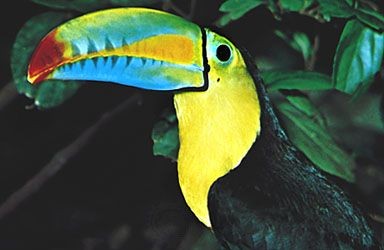
Most people think that bright colors are meant to stand out. They are not. Standing out in the wild is a calculated risk, often the difference between life and death. This practice is known as advertising coloration, a biological strategy in which animals use bright patterns to stand out rather than blend in.
The goal is simple. It’s about making it impossible to ignore yourself. By contrasting sharply with the background, this creature communicates specific information about its location, identity, and movements to those nearby. But why do animals want to be found? The answer lies in the messages their colors convey.
Nature’s warning signs
The most common reason for this visibility is danger. This particular type of advertising coloration is often called a aposematic coloration. It is a common warning sign of predators. Predators don’t find flashes of bright yellow and black “pretty”. It thinks “poison.”
Consider wasps and bees. Stripes are not random decorations. They are biological billboards. The high contrast between black and yellow signals that the insect is unpalatable or poses a physical threat, such as a sting. Predators quickly learn to associate these bright colors with bad experiences. In this case, it is difficult to understand what the real disadvantages are. If a wasp blended into the green leaves, a hungry bird might bite, realize too late that it made a mistake, and the wasp would be dead. Wasps completely prevent attacks by advertising their venom in advance.
Attraction Over Camouflage
Not all bright colors scream “stay away!” Some serve as invitations. Advertising colors can also be used to attract individuals of the same species for breeding purposes. Courtship displays are often based on a striking pattern that indicates health, fitness and readiness to mate. Here visibility is a feature, not a bug. This way, potential partners can easily identify the creature’s location and status.
So what strategy does a particular species use? It depends on evolutionary pressures. If the cost of being eaten is high, bright warnings is a wise investment. If the cost of not reproducing is higher, vivid attraction signals take precedence. The common thread is clarity. Whether the message is “I am dangerous” or “I am a mate,” the underlying mechanism are the same. In other words, it uses biological colors to drown out the noise of nature.
This ability to communicate visually has changed the way we understand animal behavior. It challenges the old notion that survival requires hiding. Sometimes the best way to survive is to make sure everyone knows exactly who you are. What happens when a predator learns to ignore warnings? The evolution of mimicry takes over and creates a complex web of deception that keeps the life cycle going.


