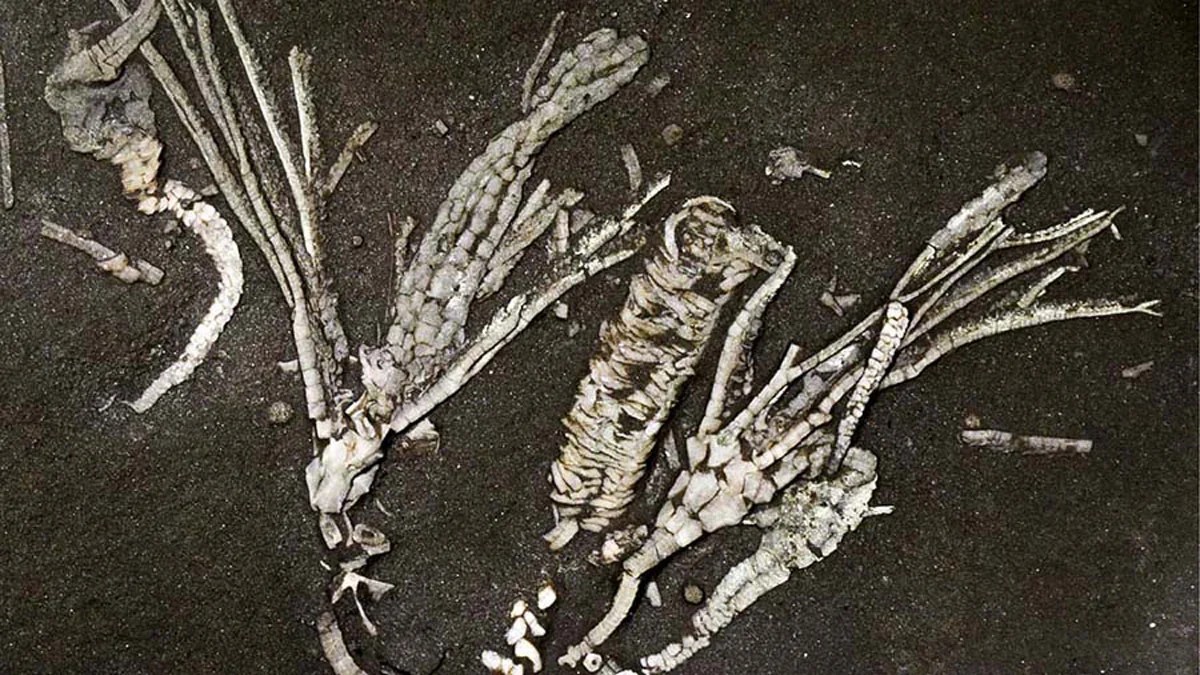
One in a million. That’s the odds of finding this.
Most fossils are just skeletons. Hard plates. Teeth. Shells. The rest—the skin, the gut, the delicate mechanics of feeding—rot away before the first grain of sand can bury them. Or so we thought.
A 450-million-year-old crinoid has just changed that story. It’s old. Older than forests. Older than dinosaurs. Way older. But the real surprise isn’t its age. It’s the tube feet.
These aren’t just rocks shaped like legs. They’re preserved soft tissue. Actually intact.
The Odds Are Long
Soft tissue decays. It rots. It vanishes. To survive half a billion years requires a perfect storm of bad luck for the bacteria and good luck for the scientist. You need anoxic mud. Rapid burial. Cold depths. A natural vacuum seal that snaps shut the moment life stops.
“After an animal dies… soft tissues… are the first things to decay.”
— Dr. Lena Cole, OU Paleontologist
Cole isn’t speaking hypothetically. She’s looking at Dendrocrinus simcoensis. It is only the second time anyone has ever seen a crinoid’s soft parts. In millions of specimens found globally.
The math is staggering.
These tissues predate the first dinosaur by over 200 million years. Put it in perspective: by the time T. rex roamed the Earth, this specific type of soft-tissue preservation was already dust. Mostly. Except here. In this rock.
Feeding Fossils
Why care about tube feet? Because they ate.
Think of tube feet like mammal teeth. You look at teeth and you know what an animal ate. Plant matter? Bone? Small fish? Now apply that to arms. Crinoids are like underwater flowers. They wave their branches in the current. Tube feet trap particles. Move them to the mouth. Simple. Or was it?
The fossil tells a different tale.
The arrangement of these ancient tube feet doesn’t match modern crinoids. The pattern is different. The spacing. The angle.
“Anatomy of this ancient species was very different.”
— Dr. Cole
This means the ecological role they played 450 million ago is extinct. We can’t find it in today’s oceans. We lost a version of “reef animal” that no longer exists.
Evolution isn’t a straight line. It’s a branching bush with burned-off branches. Most of the ways life solved the problem of “how do I get lunch?” died with the creatures that used them. Until now. We were blind to it.
Dust on the Shelves
Here’s the twist. No one dug this up recently.
It was already sitting in a drawer. In Montreal. At a small museum funded by donations. Community-supported. Quiet. Forgotten, effectively.
Lena Cole and David Wright are specialists. They know crinoids. They went to visit. They looked closer than most. What others might have dismissed as a wrinkle in the rock or a bubble in the stone, they saw as biology.
This is the unsexy reality of science.
Fieldwork is dramatic. Dynamite. Dust. Sweat. But collections are where the slow work happens. Specimens sit. They wait. A new question arrives. A specialist looks. Suddenly, the “ordinary” rock speaks.
“There’s more than a lifetime’s worth waiting to be found.”
— Dr. Wright
One million invertebrates. In Oklahoma. Many unstudied.
The fossil wasn’t lost. It was just waiting for the right eyes.
Does this change how we view the Ordovician reefs? Maybe. It suggests they were more complex. More specialized. Perhaps more fragile than the bones suggest.
We usually think we know what life looked like in the deep past because we have the shells. But shells are armor. They hide the machine underneath.
For once. We saw the machine.