Astronomers have detected the most distant and powerful hydroxyl megamaser ever recorded, originating from a merging galaxy system 8 billion light-years away. This event, occurring when the universe was roughly half its current age, offers a rare glimpse into the conditions of the early cosmos and provides valuable data for understanding galaxy evolution.
The Discovery: A Cosmic Laser Across Billions of Years
The megamaser – a naturally occurring “laser” emitting in radio waves rather than visible light – was observed by the MeerKAT radio telescope in South Africa. The source, designated HATLAS J142935.3–002836, is a system where two galaxies are colliding. This collision creates dense clouds of hydroxyl molecules (hydrogen and oxygen), which amplify radio emission, resulting in the exceptionally bright signal.
The extreme distance means the light from this event traveled for 8 billion years to reach Earth. Without a critical phenomenon called gravitational lensing, the signal would have been too faint to detect.
Gravitational Lensing: A Natural Telescope
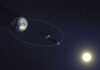
Gravitational lensing occurs when the gravity of massive objects, like galaxy clusters, warps the fabric of spacetime. This warping bends the path of light, acting like a natural magnifying glass. Einstein predicted this effect in his theory of general relativity over a century ago. The effect isn’t just a quirk of physics; it’s how astronomers can study objects that would otherwise be too dim or distant to observe.
This magnification is what made the already-bright megamaser visible to researchers, allowing them to analyze a system that would otherwise have remained hidden.
Why This Matters: Understanding the Early Universe
Megamasers are rare, typically found in galaxies undergoing intense star formation due to mergers. The fact that this megamaser originates from such a distant collision provides insights into how galaxies evolved in the early universe. The extreme distance means we’re observing the system as it existed billions of years ago, offering a snapshot of conditions when galaxies were younger and more active.
“This megamaser is unusual because it is located at a very large distance… This combination makes it one of the most distant and powerful hydroxyl megamasers known,” said Thato Manamela of the University of Pretoria, leader of the discovery team.
By studying the emission lines from the megamaser, scientists can determine gas kinematics, physical conditions, and star formation processes within the merging galaxies. Furthermore, such events often host dual active galactic nuclei – pairs of supermassive black holes – which are expected to emit detectable gravitational waves.
Future Implications: Mapping the Early Cosmos
This discovery not only reveals a distant megamaser but also highlights the power of gravitational lensing as a tool for astronomical observation. The findings will help determine how common megamasers were in the early universe and how they relate to galaxy evolution and star formation. This will refine our understanding of the conditions that shaped the cosmos as we know it today.
The study of distant megamasers offers a unique window into the early universe, allowing astronomers to test theoretical models and refine their understanding of galactic formation and the distribution of matter across cosmic time.