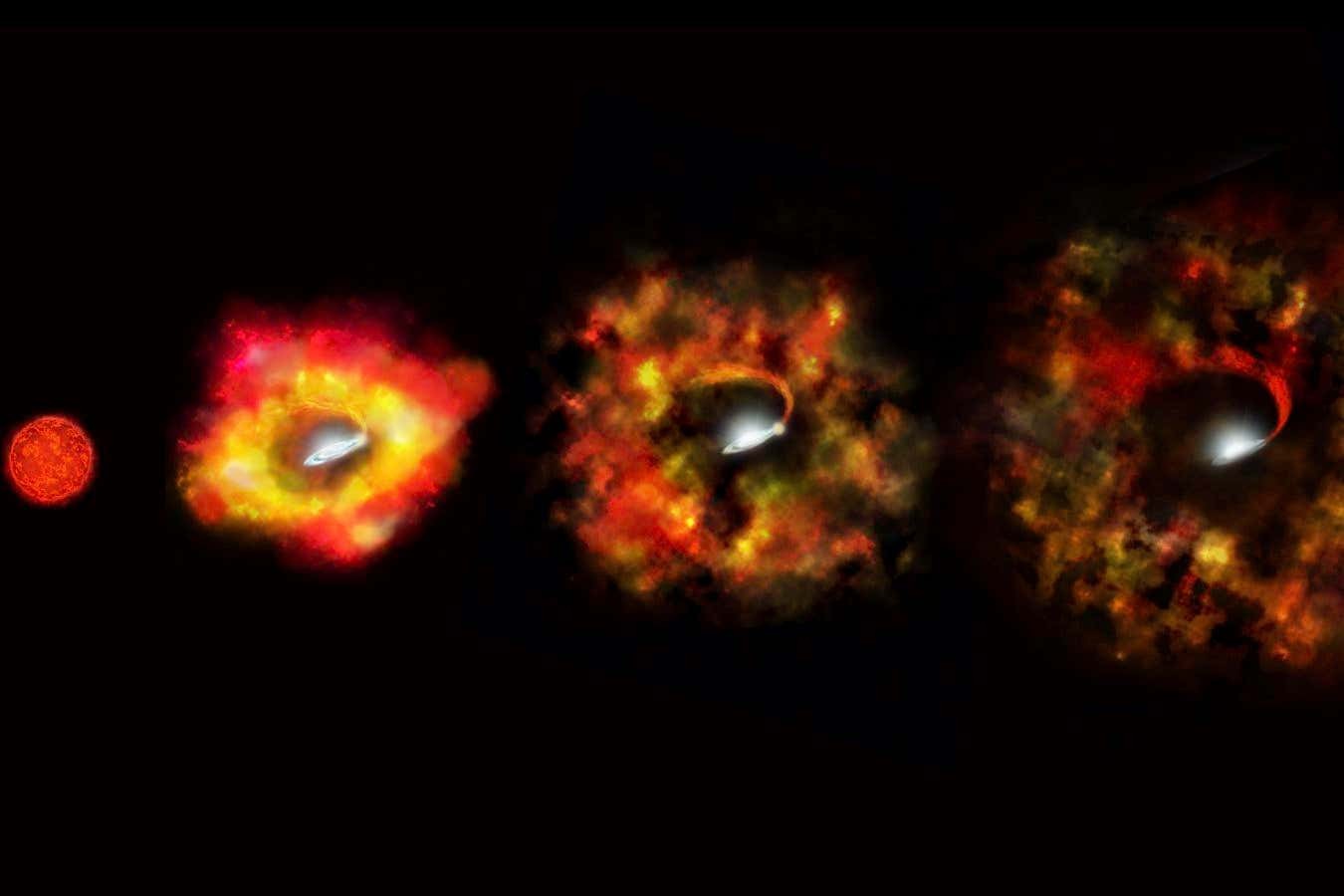
A massive star in the Andromeda galaxy has seemingly vanished, not in a spectacular supernova explosion as expected, but through a direct collapse into a black hole. This is a rare and significant observation because most black holes form after stars detonate, making this potential “failed supernova” an unusual cosmic event.
The Vanishing Star
In 2014, astronomers observed a star called M31-2014-DS1, roughly 20 times the mass of our sun. It briefly brightened before dimming dramatically between 2017 and 2020. The initial hypothesis was that this fading indicated a failed supernova: a star collapsing directly into a black hole without the usual explosive finale. However, no expected X-ray radiation was detected, casting doubt on this theory.
New Evidence From James Webb Telescope
Recent observations from the James Webb Space Telescope (JWST) and the Chandra X-ray Observatory confirm the star’s disappearance. Where M31-2014-DS1 once shone, there’s now only a faint, red object, about 8% as bright as the original star, surrounded by rapidly expanding dust. This aligns with the predicted aftermath of a failed supernova.
Alternative Explanations: Stellar Mergers
While the failed supernova scenario is compelling, another possibility exists: the star didn’t collapse alone. It may have merged with another star, producing a similar dimming and dust cloud. Both events are rare, but the observational data doesn’t definitively favor one over the other.
“The predictions for what a failed supernova looks like overlap quite significantly with what we might expect from two stars colliding and producing loads of dust,” says Emma Beasor of Liverpool John Moores University.
Why This Matters
The disappearance of massive stars is poorly understood. For decades, searches yielded ambiguous results. The power of modern telescopes is now allowing astronomers to make progress. Confirming the mechanism behind this event will reveal one of the final fates of massive stars. The absence of X-ray radiation makes it difficult to confirm the black hole’s existence, but continued study will provide definitive answers.
The ability to study such faded stars with telescopes like JWST is key. It’s a “Cheshire cat way to go,” meaning the star disappears leaving only traces behind. Ultimately, this observation highlights the dynamic and sometimes unpredictable nature of stellar evolution.