For decades, geoscientists have puzzled over a striking discrepancy: Earth appears to be deficient in lighter elements like hydrogen, carbon, nitrogen, sulfur, and noble gases compared to the Sun and certain meteorites. In some cases, the shortage is extreme – over 99% less than expected. While some loss occurred during planetary formation, the full explanation remained elusive… until now.
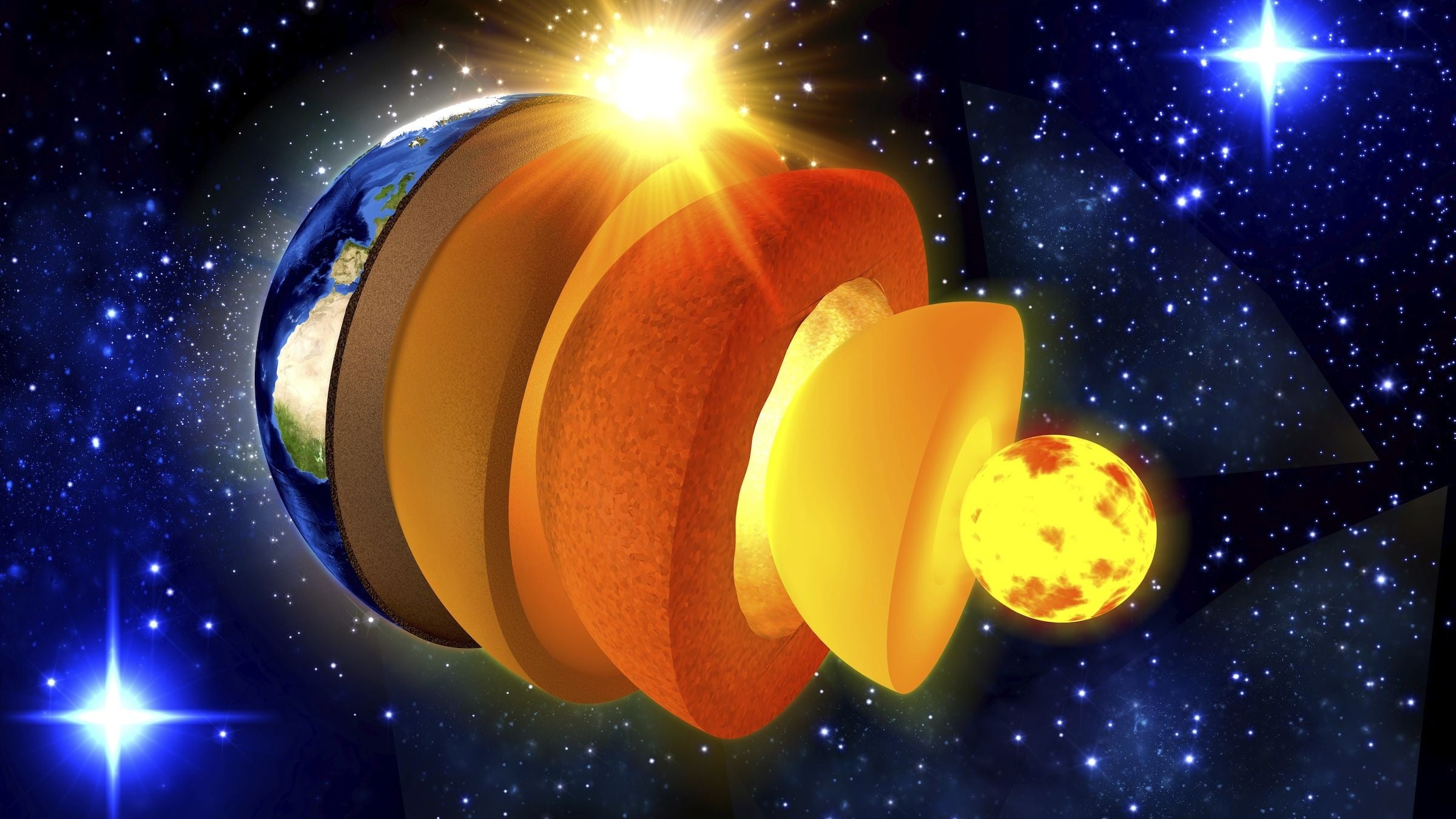
Recent research suggests these missing elements may be sequestered deep within Earth’s solid inner core. Under immense pressure – 3.6 million times atmospheric pressure – iron behaves in an unusual way, transforming into an “electride.” This little-known metallic state can absorb lighter elements by trapping them in unique electron pockets.
The Electride Mechanism: A New Form of Metallic Bonding
Electrides differ from ordinary metals in how their electrons behave. Instead of freely moving between atoms, electrons become localized at “non-nuclear attractor” sites – spaces between atoms where they are essentially trapped. This phenomenon arises from the extreme compression within Earth’s core, forcing electrons into these stable positions. The trapped electrons then stabilize lighter elements, effectively hiding them within the iron structure.
This discovery helps explain why seismic waves suggest the inner core is 5-8% less dense than expected if it were solely metallic iron. The absorbed light elements lower the overall density. Researchers estimate this process could have occurred over billions of years and may still be ongoing.
Beyond Planetary Mysteries: Electrides as Catalysts and Energy Savers
The implications extend far beyond understanding Earth’s composition. Electrides are emerging as a promising material in diverse applications, particularly as catalysts. Their unique electron-rich structure allows them to accelerate chemical reactions by donating electrons, making them ideal for processes that traditionally require high energy input.
One notable example is ammonia production. The conventional Haber-Bosch process, responsible for 2% of global energy consumption, is highly energy-intensive. Electride-based catalysts, specifically using mayenite (a calcium aluminate oxide) as a support for ruthenium nanoparticles, reduce energy usage by 20%. Tsubame BHB, a Japanese company, has already commercialized this technology, opening pilot plants in Japan and Brazil to replace fossil-fuel-based fertilizer production.
Other potential applications include more efficient CO2 conversion, safer nuclear waste immobilization, and even low-temperature satellite propulsion systems. Mayenite’s cage-like structure can trap radioactive ions, while its heated electrons can generate thrust in a vacuum.
The Search for New Electrides: From Room Temperature to AI Prediction
Researchers are actively exploring new electrides, including organic complexes discovered through “mechanical chemistry” (high-energy milling). These materials exhibit similar catalytic properties but often suffer from air and water sensitivity. Scientists are working to stabilize them for industrial use, particularly in pharmaceutical synthesis where palladium catalysts are often costly and inefficient.
Predicting electride formation remains a challenge. Current models rely on quantum theory simulations and, increasingly, artificial intelligence. By training algorithms on existing data, researchers hope to identify new materials with the right electron configurations for electride behavior. This field is still nascent, but the potential for discovering materials with unique properties is enormous.
The discovery of electrides provides a new lens through which to understand not only the composition of our planet but also the future of energy-efficient chemistry and materials science.