


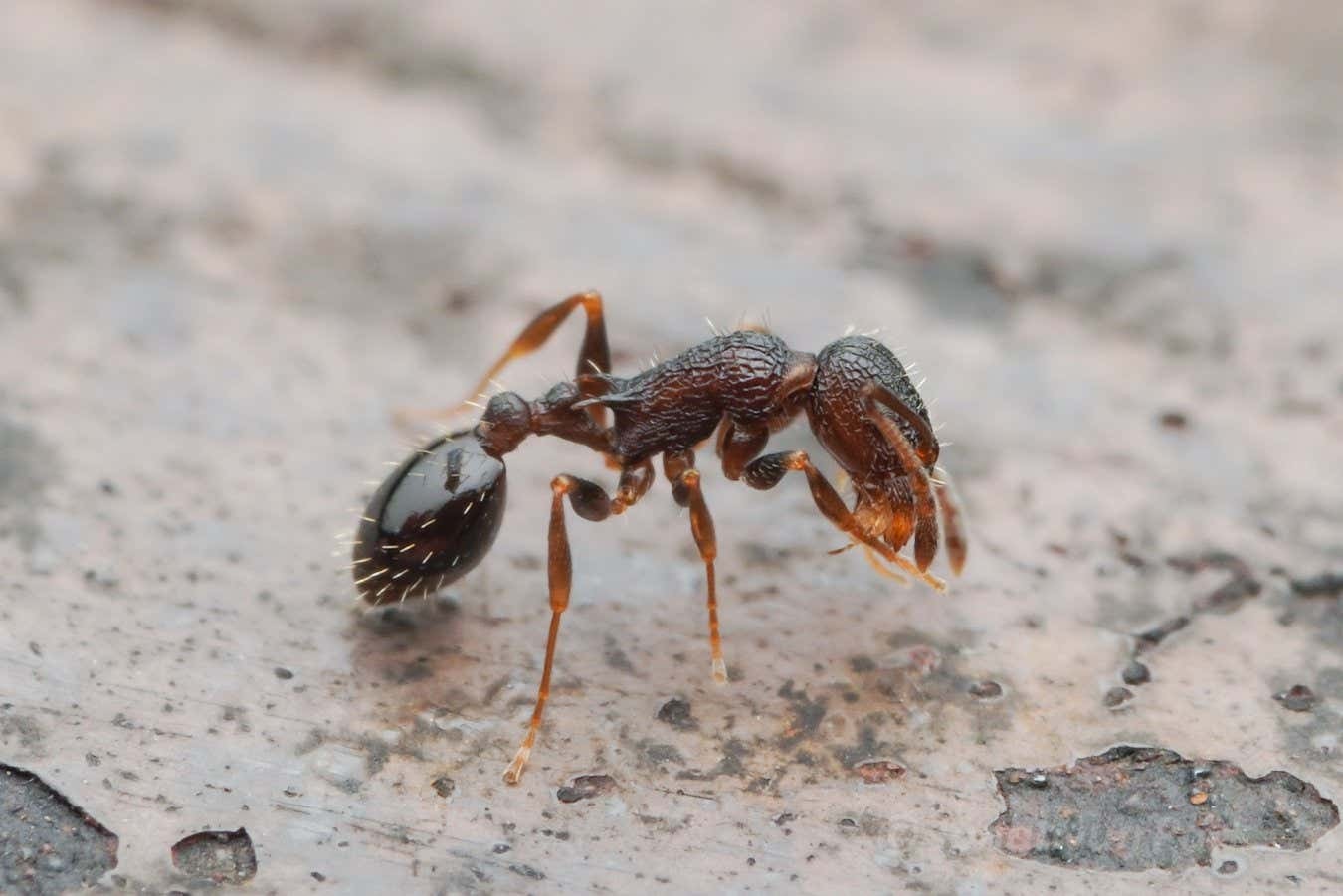
A unique species of ant in Japan, Temnothorax kinomurai, has been confirmed to consist entirely of queens with no males or worker castes. This marks the first known instance of such a social structure in the ant world, where colonies typically include a queen, female workers, and short-lived males.
The Parasitic Lifestyle of T. kinomurai
For decades, scientists suspected this rare parasitic ant only produced queens, but recent lab studies have definitively confirmed this. T. kinomurai queens invade the nests of a related species, Temnothorax makora, killing the host queen and workers via stings. Once in control, they reproduce asexually through parthenogenesis—cloning daughters without mating. Crucially, T. makora workers unwittingly raise these invading queens’ offspring.
Confirmed Reproduction in the Lab
Researchers at the University of Regensburg, Germany, reared six T. kinomurai colonies in artificial nests. Over time, they bred 43 queen offspring, and detailed inspection confirmed the absence of males. These queens were then allowed to invade T. makora colonies; seven successfully took over, producing another 57 all-female queen offspring.
Evolutionary Significance: Why All Queens?
This all-queen system is a high-risk strategy, as many invasion attempts fail. However, having only reproductive individuals drastically increases the odds of establishing new colonies. As Jürgen Heinze explains, if queens reproduce parthenogenetically, they can produce a large number of daughters without needing males, thereby maximizing the potential for colony foundation.
“This species may be considered the final step in the evolution of social parasitism, highlighting the enormous flexibility in the life histories of social insects.”
The discovery provides compelling evidence that extreme social flexibility exists in ants. The evolution of this all-queen structure underscores how natural selection favors reproductive efficiency, even at the expense of conventional worker castes. The success rate for queens is inherently higher when every offspring can potentially start a new colony.


