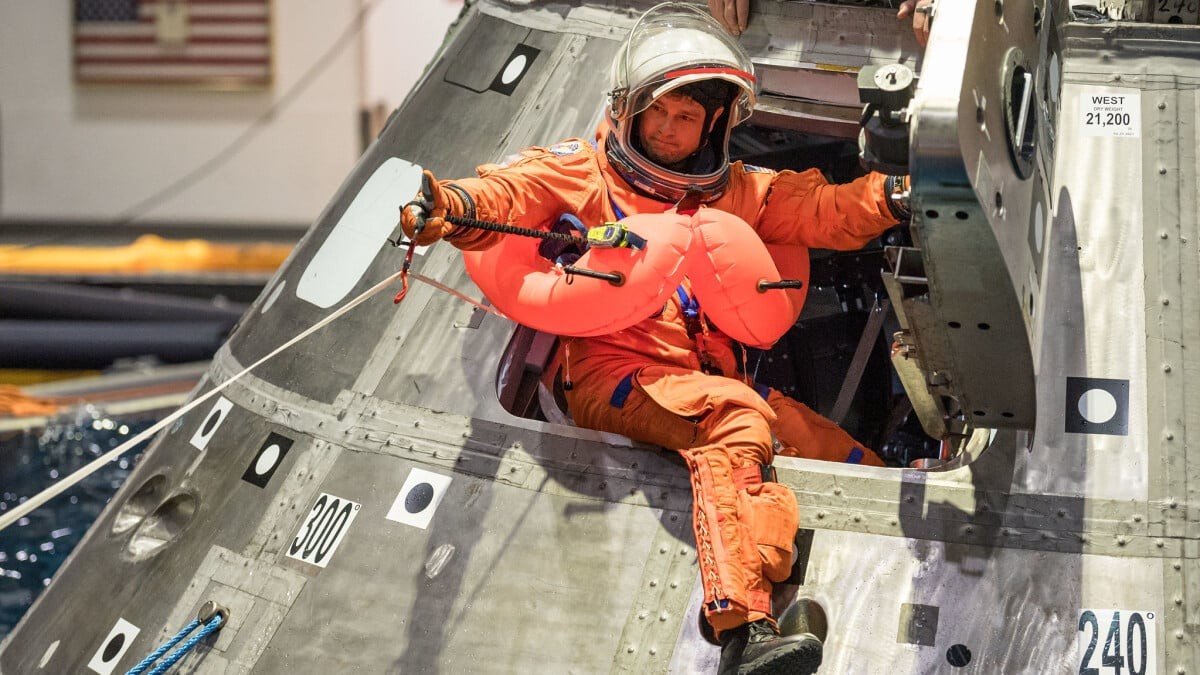
Immediately following the splashdown of the Artemis II mission, NASA’s crew—Commander Reid Wiseman, Christina Koch, Victor Glover, and Jeremy Hansen—will face a grueling physical gauntlet. Rather than resting after their descent through Earth’s atmosphere, the astronauts will be thrust into a series of intensive physiological tests designed to answer a critical question: How quickly can humans regain the strength and coordination required for lunar exploration after returning from space?
The Challenge of Re-entry and Gravity
When astronauts spend extended periods in microgravity, their bodies undergo significant changes. Muscles atrophy, aerobic fitness declines, and the vestibular system—the inner ear mechanism responsible for balance—becomes desynchronized from Earth’s gravity.
While long-duration missions on the International Space Station (ISS) are well-documented, the Artemis II mission provides a unique data set for shorter, high-intensity lunar transit. NASA scientists are particularly concerned about the “transition period” between weightlessness and the heavy physical demands of moonwalks or Mars exploration.
“We don’t want to put the astronauts in a position where they’re going to be stranded in a spacesuit, asking them to do tasks that are probably above what their physiologic capabilities are going to be in,” warns Jason Norcross, a senior scientist leading the research.
Simulating the Moon with ARGOS
To bridge the gap between Earth and the Moon, researchers at NASA’s Johnson Space Center will utilize the Active Response Gravity Offload System (ARGOS). This specialized robotic crane can lift a portion of an astronaut’s weight, effectively simulating different gravitational environments.
For this study, the system will be calibrated to lunar gravity (one-sixth of Earth’s pull). The testing will be divided into two primary phases:
1. The Emergency Escape Drill
Within hours of landing, the crew will perform a mock capsule escape. This involves:
– Sitting up from a supine position.
– Deploying and climbing a ladder.
– Shouldering a heavy pack and walking a set distance.
This phase tests whether a crew can perform life-saving maneuvers immediately after the disorientation of reentry.
2. The Simulated Lunar EVA (Extravehicular Activity)
The following day, the astronauts will don heavy-duty EVA spacesuits and liquid cooling garments. Attached to the ARGOS crane, they will navigate a 40-minute obstacle course designed to mimic the rigors of a moonwalk:
– Navigation: Climbing down ladders and traversing unstable, rocky terrain.
– Technical Tasks: Bending, squatting, and performing precision movements to mimic connecting electrical and fluid lines.
– Physical Labor: Carrying 30-pound bags across uneven ground and using tools to chip rock samples.
– Endurance: A final half-mile trek on a treadmill with extreme inclines (exceeding 20%) to test cardiovascular recovery.
Why This Research Matters
The data gathered from these tests is more than just academic; it is mission-critical intelligence. By tracking heart rates, energy expenditure, and task completion times, NASA can build a predictive model for astronaut performance.
Understanding the “recovery curve”—the time it takes for a body to stabilize after gravity shifts—will allow mission planners to:
– Determine the safety of immediate lunar excursions.
– Schedule high-intensity tasks for when astronauts are most physically capable.
– Design better protocols for future Mars missions, where the stakes of physical exhaustion are even higher.
Conclusion
By pushing the Artemis II crew through these simulated lunar environments, NASA is gathering the essential data needed to ensure that the next generation of explorers can move safely and effectively on the surfaces of other worlds.