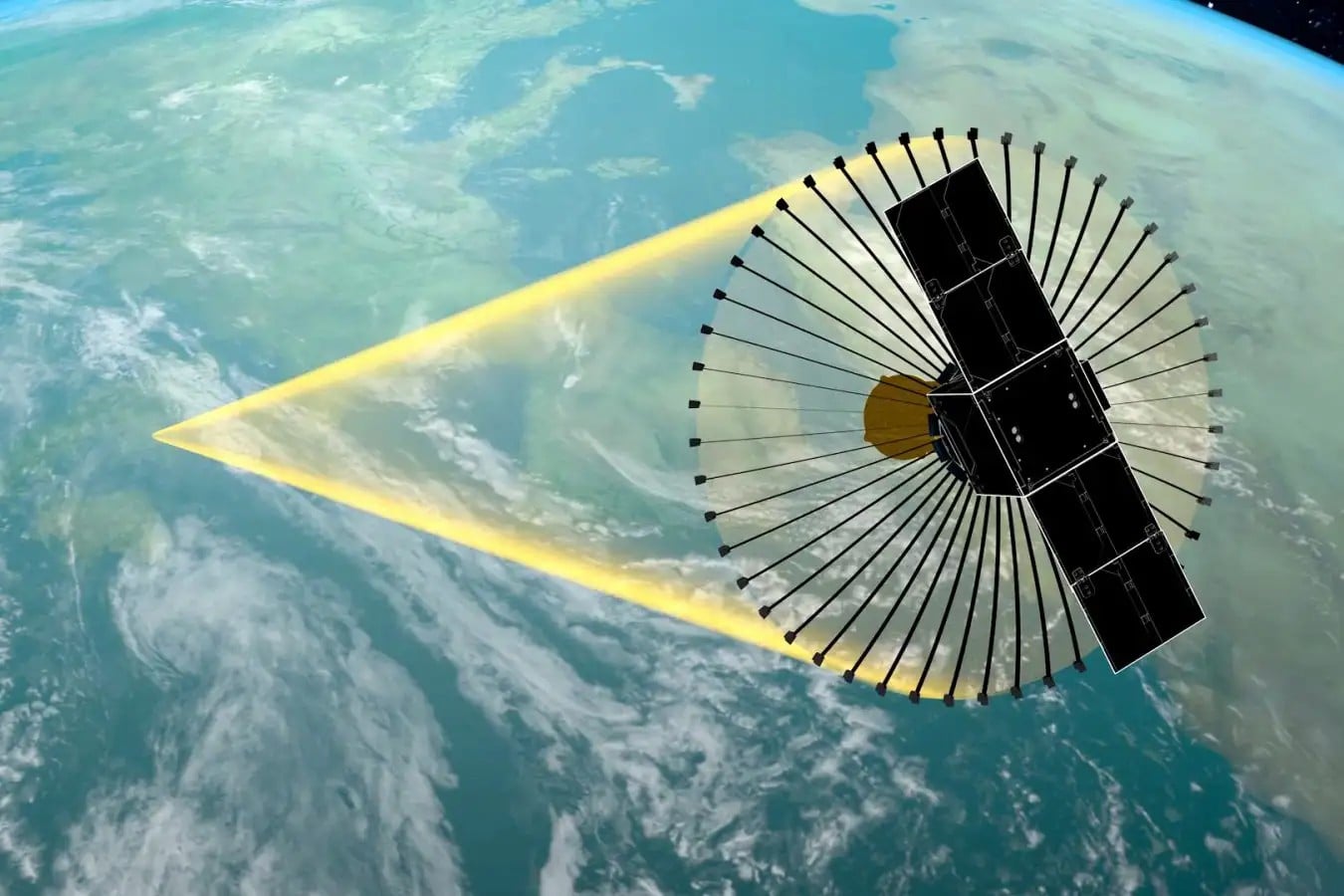
The United Kingdom is set to launch a novel satellite, CarbSAR, this Sunday, featuring a radar antenna constructed using a modified knitting machine. This unusual approach, pioneered by Oxford Space Systems (OSS) and Surrey Satellite Technology Limited (SSTL), represents a significant step forward in compacting high-resolution radar technology for Earth observation.
Innovative Design: From Jumpers to Space Radar
Traditionally, satellite radar antennas are bulky and expensive to deploy. OSS has circumvented this issue by adapting standard industrial knitting machinery to weave ultra-fine tungsten wire coated in gold into a mesh fabric. This fabric is then cut, sewn, and stretched over a carbon-fiber rib structure.
The key to the design is its collapsibility: the ribs are wound radially like tape measures, allowing the entire structure to compress to 75cm in diameter for launch. Once in orbit, stored energy in the carbon fiber causes the ribs to snap into position, forming a precise parabolic dish for radar imaging. This innovative approach dramatically reduces launch volume without sacrificing performance.
Military Applications and Reasserting UK Space Leadership
While the technology has broad applications, including environmental monitoring and disaster response, its potential for military surveillance is undeniable. Radar’s all-weather, day-and-night imaging capabilities have proven invaluable in conflicts like the Russia-Ukraine war.
The UK, once a leader in space radar development in the 1990s, has since lagged behind international competitors. CarbSAR, and the planned follow-up constellation Oberon (part of the broader ISTARI program for the Ministry of Defence), aim to reverse this trend. The success of this technology could reestablish the UK as a key player in space-based intelligence.
Technical Capabilities and Future Prospects
CarbSAR is expected to resolve objects down to 50cm in size, sufficient for identifying tanks and aircraft. UK Space Command, overseen by the Royal Air Force, will closely monitor the deployment, which is scheduled two days after launch.
Foreign governments have already expressed interest in acquiring this radar concept, according to SSTL’s managing director. The deployment of CarbSAR will serve as a crucial proof of concept, paving the way for wider adoption and potentially reshaping the landscape of Earth observation.
“CarbSAR is a testament to the innovation and collaboration of one of the UK’s most forward‑thinking space companies,” says Major General Paul Tedman, commander of UK Space Command.
This launch signals a strategic move by the UK to reclaim its position in the competitive space sector, leveraging unconventional engineering to deliver advanced surveillance and observation capabilities.