Two centuries of physics built on shaky ground.
For over 200 years, thermodynamics has explained why engines run and refrigerators cool. It connects to everyday life because it started as an engineering tool. People wanted to maximize heat efficiency. Simple. But the math underneath was never quite rigorous.
Now that changes.
Bryan Roberts from the London School of Economics is rebuilding the theory. He’s ditching traditional methods. Instead he uses the heavy machinery of quantum field theory. It’s a departure. A bold one.
There’s kind of two levels to thermynamics,” he says.
Roberts splits the world into accessible and inaccessible. Think of an engine piston. You can grab it. Move it. That’s work. Real, tangible manipulation. Then there is heat. Lost energy. Heat is hard to pin down. You can’t hold it like a wrench. Roberts calls this hidden energy.
Standard textbooks treat work and heat as equals. Just sum them up. Roberts disagrees. He sees hierarchy.
Enter gauge theory.
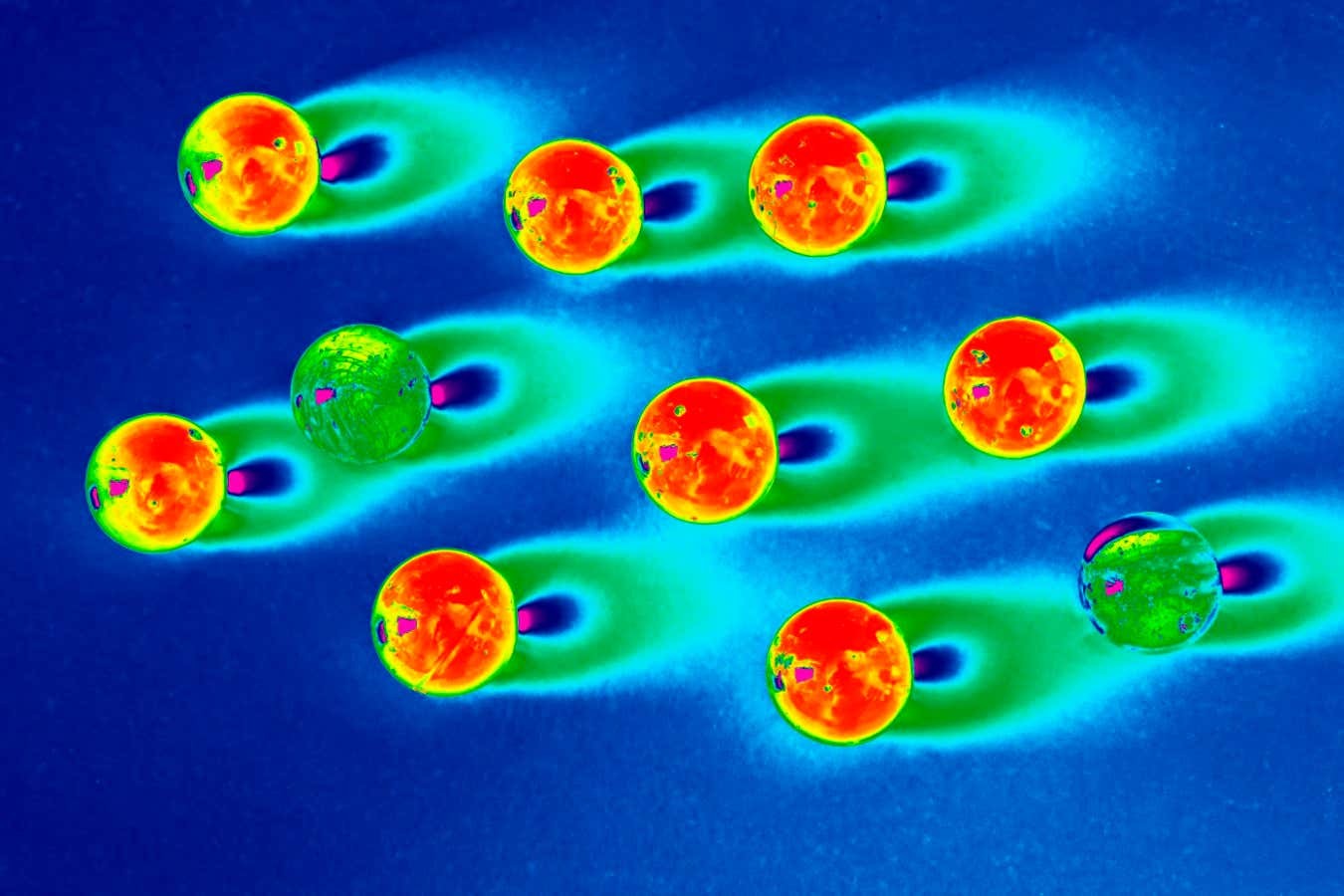
Imagine marbles rolling on a floor. They look identical. Identical white shells. But deep inside, each marble holds a unique color. You can’t see the color. You can only watch the roll.
Roberts maps thermodynamics exactly this way. The visible motion? That’s the observable space. The hidden colors? The bundle space. One projects onto the other. Like a shadow revealing the shape of the object casting it.
This matters.
Temperature and entropy? They’re no longer vague concepts. Roberts defines them through this geometric projection. It works for car engines. It even works for black holes. A smoother application of rules where none existed before.
Does this sound like pure abstract math?
Maybe not for long. Experiments with molecular junctions already hint at it. They suggest a thermodynamic version of the Aharonov-Bohm effect. In quantum mechanics, charged particles sense hidden magnetic fields they shouldn’t theoretically interact with. Heat might do something similar. Hidden variables showing up in physical reality.
Roberts presented this at a conference in Irvine on June 16. The reaction was positive. Lucas Céleri from the Federal University of Goiás in Brazil thinks the idea is beautiful.
He worries about quantum thermodynamics. The definitions are messy. Too many versions of “work” and “heat” floating around. Gauge theory might finally impose order. Céleri and his team are already seeing results. Standard quantum outcomes match the new model.
The real test remains.
Special relativity. Einstein’s rules. Merging them with thermodynamics is notoriously difficult. Classical math struggles. Céleri suspects gauge structures handle the job better. The math fits the physics.
Or it doesn’t.
Time will tell if shadows can explain the light.