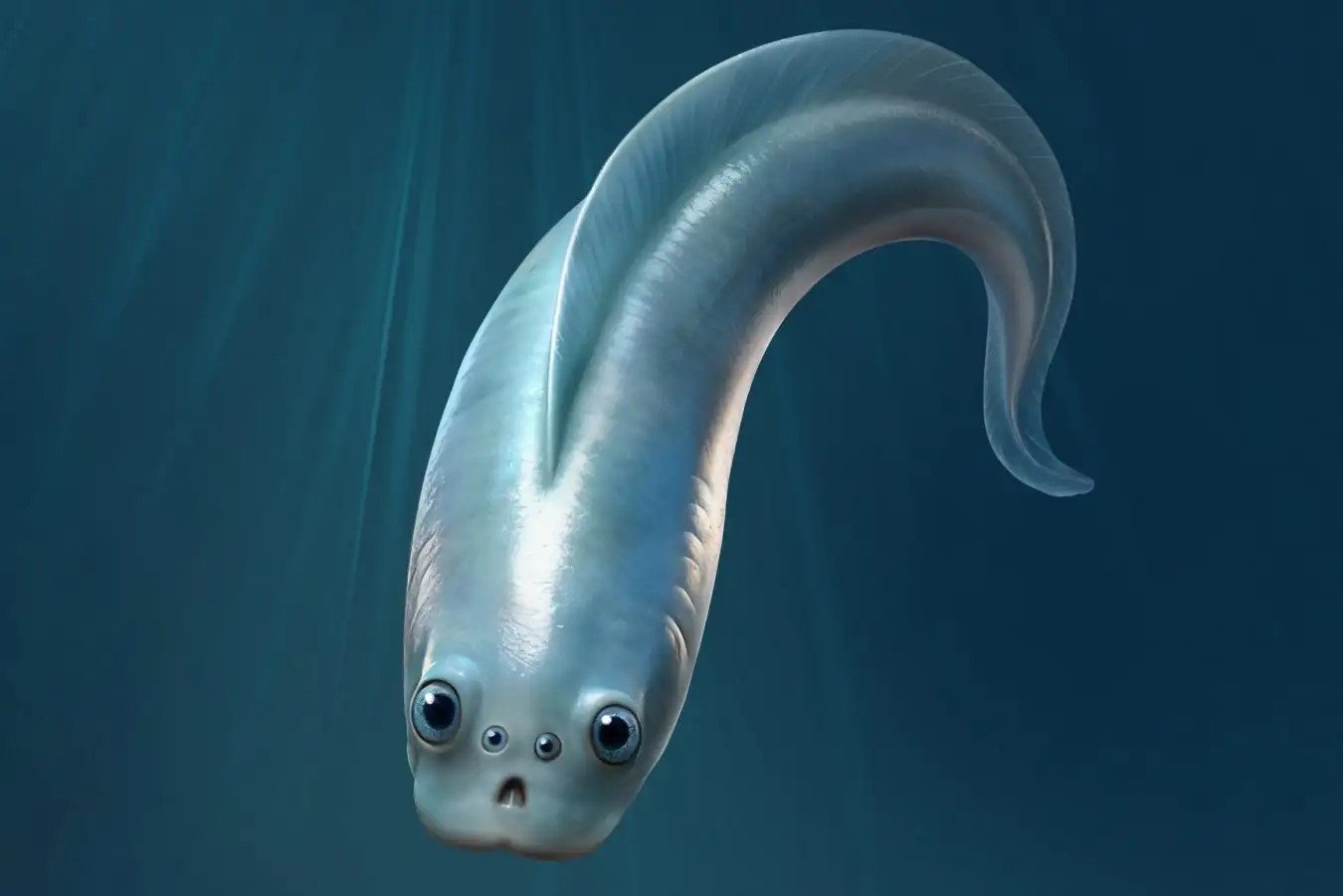
New fossil discoveries reveal that some of the earliest vertebrates, dating back over 518 million years, likely possessed two pairs of camera-type eyes. The remarkable find, based on exceptionally preserved fossils from the Chengjiang biota in China, challenges conventional understanding of early vertebrate anatomy and evolution.
The Discovery
Researchers led by Peiyun Cong from Yunnan University examined fossils of myllokunmingids, a group of ancient jawless fish. Using electron microscopy, the team identified not only the expected pair of well-developed eyes on the sides of the head but also a smaller, second pair positioned centrally. These smaller eyes contained preserved melanin structures and clear impressions of lenses, suggesting they were fully functional visual organs.
Why This Matters
This is significant because it rewrites what we thought we knew about the origins of vertebrate vision. The Cambrian period was a time of rapid diversification, and this discovery shows just how experimental early animal designs were. The presence of four eyes suggests that early vertebrates may have evolved a different way to perceive their environment—potentially better for both high-resolution vision and detecting approaching threats.
From Four Eyes to the Pineal Gland
The extra pair of eyes didn’t last. Over evolutionary time, these structures appear to have transformed into the pineal complex—an organ now primarily associated with sleep-wake cycles in mammals. In some reptiles, a remnant of this ancient vision system remains as a parietal eye, a light-sensitive organ on the top of the head. This means that humans may still carry genetic traces of this four-eyed ancestor.
Debate and Questions Remain
While the evidence is compelling, not all researchers are fully convinced. One key question is where the nose was located if both sets of eyes were prominent features on the head. Some suggest that the “eyes” may be misidentified structures, formed through the chemistry of fossilization. Further detailed analysis of the fossil bodies will be needed to confirm the findings.
“The Cambrian is a bit of a weird time when you see animals doing strange things for the first time in an evolutionary sense,” says John Paterson, University of New England, Australia.
Ultimately, this discovery adds another layer of complexity to our understanding of early vertebrate evolution. The idea that these ancient fish used four eyes to see the world—perhaps even in a wide-angle, IMAX-style view—is a remarkable insight into the diversity of life in Earth’s deep past.