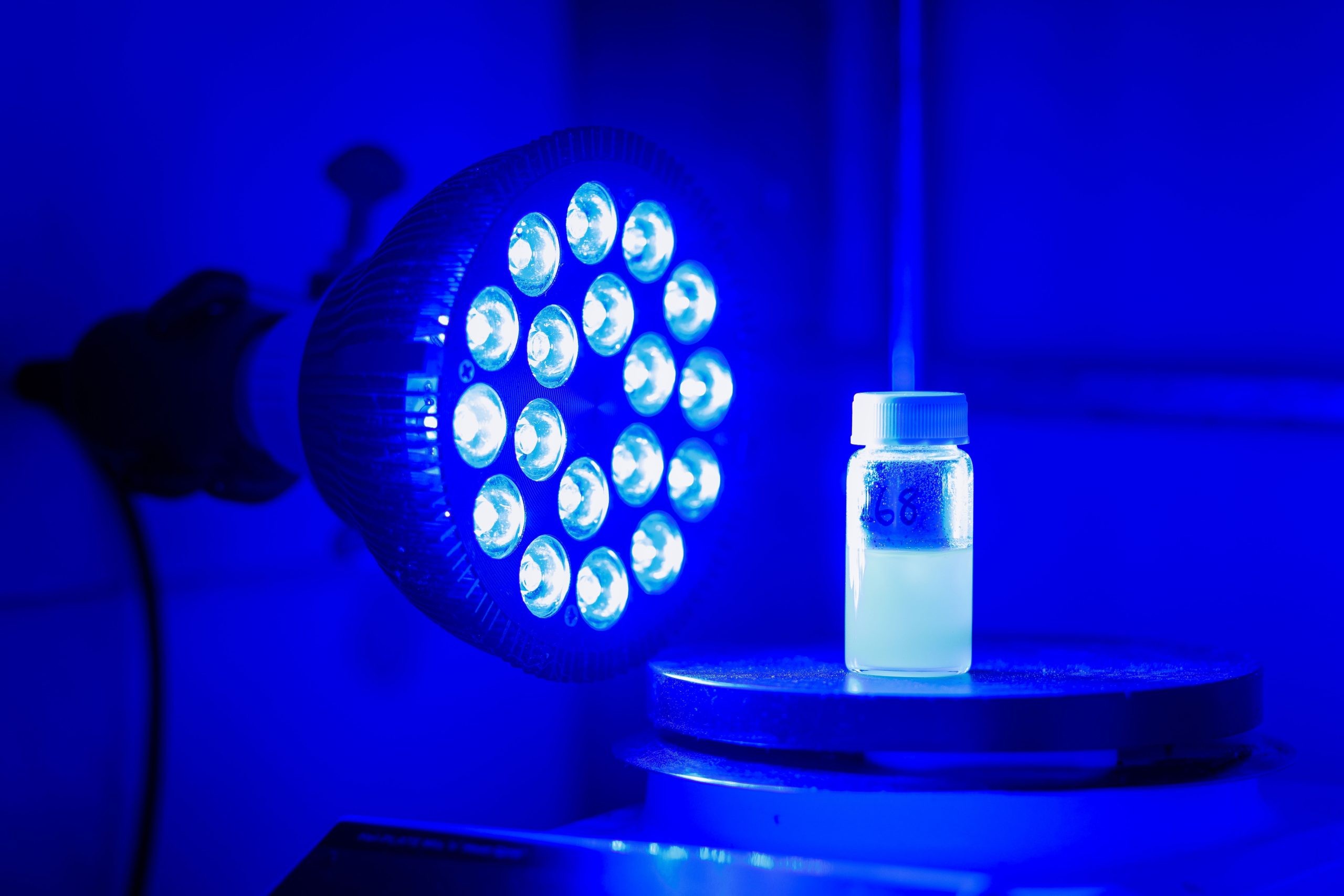
Blue LEDs. The same cheap bulbs used in fish tanks and grow lights. Now they’re helping chemists build complex drugs in fewer steps.
It’s not just a novelty. It’s a workaround for a messy problem in medicine development: making molecules complex enough to work, without burning through weeks of lab time and materials.
How blue light drives faster drug synthesis
Most small-molecule drugs are built on carbon. The shape of that carbon skeleton matters. A flat, simple molecule might drift past a target. A 3D one can lock on tighter.
Getting that 3D structure usually means adding reactions. Step. Purify. Add another group. Repeat.
Every step costs time. Every step risks low yield. Every step adds noise.
A team from the University at Buffalo (UB) and Binghamton University flipped the script. They published a method in Science that tweaks two neighboring carbon atoms at once. Just one reaction.
“We’ve used the relatively mild conditions… to expand what chemists can do…”
It uses visible blue light. No heat. No harsh chemicals. Just a light-sensitive catalyst and common carbon-halogen bonds—the stuff every chemist learns in undergrad.
Why modifying two carbons matters
Standard chemistry hits the carbon attached to the halogen. Done.
The new trick reaches the next carbon over too.
Think about the math. Two changes instead of one? That means half the steps. Fewer intermediate compounds to isolate. Less purification. Fewer chances for things to fall apart.
Jennifer Hirschi of Binghamton University put it plainly: “The advantage is getting two modifications… More changes in fewer steps…”
This isn’t just speed. It’s accessibility. Complex targets often need complex drugs. If the route to that drug is a twenty-step maze, you might never finish it. Shortening the maze matters.
The “Buffalo boxes” and UV alternatives
The reaction doesn’t need a cleanroom or a supercooled reactor.
It needs “Buffalo boxes.”
Patricia Z. Musacchio lines her shelves with them. They’re just compartments with blue LEDs. Vials sit inside. The light hits the catalyst. The reaction starts.
Why not just use UV light? Older methods tried that.
UV carries high energy. Too much. It zaps the very molecules you’re trying to build. Decomposition. Side reactions. A mess.
Blue light is gentle. It excites the photocatalyst. The catalyst transfers that energy precisely. The molecule wakes up, just enough to rearrange. Then it settles down.
Mild conditions. Specific results.
What happens next in the lab
The study shows the chemistry works on the bench.
The next step? Scale and partnership. The team plans to talk with pharmaceutical companies. Can this method handle real drug candidates? Can it adapt to specific therapeutic targets?
Musacchio wants more than just faster drugs. She wants harder-to-make drugs. Targets that were previously out of reach because the chemistry was too painful.
If light can replace heat, and single steps can replace double… the landscape changes.
Chemists might start looking at carbon-halogen bonds differently. Not just as handles for simple swaps. But as entry points for complexity.
The bulbs are already in the shop. The question is how far they’ll push it.