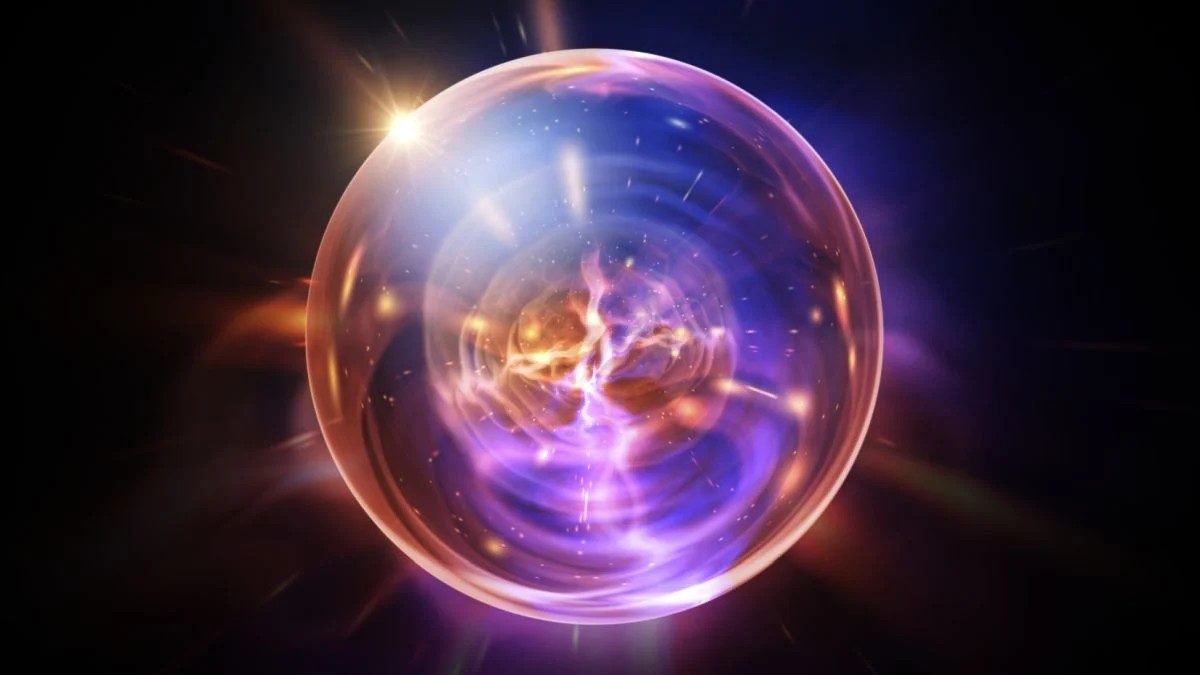
While our universe appears stable, it may actually be resting in a state of “false calm.” A terrifying theoretical concept known as false vacuum decay suggests that our entire reality could, in an instant, be overwritten by a more stable state of physics.
Recently, a team of physicists led by Tsinghua University in China successfully simulated this catastrophic process in a laboratory setting. While the experiment doesn’t threaten our existence, it provides a vital new way to study one of the most profound mysteries in physics.
The Concept: A Universe in Transition
To understand false vacuum decay, one must first understand what a “vacuum” is in the context of quantum physics. In classical terms, a vacuum is empty space. In quantum field theory, however, a vacuum is simply the lowest possible energy state of a quantum field.
The danger arises if our current vacuum is not the absolute lowest energy state, but merely a “local minimum”—a temporary resting point.
The “Lake” Analogy
Imagine a landscape containing several lakes at different elevations.
– A false vacuum is like a lake sitting in a high basin.
– A true vacuum is like a much deeper basin further down the mountain.
If a “tunnel” were to open at the bottom of the high lake, the water would drain into the deeper basin. In our universe, if a small pocket of space were to “tunnel” into a lower energy state, it would create a bubble of true vacuum. This bubble would expand at nearly the speed of light, consuming everything in its path and instantly rewriting the laws of physics as it moves.
The Scientific Prize: Bridging Two Worlds
Why would scientists spend resources simulating a cosmic catastrophe? The answer lies in the fundamental conflict in modern physics: the struggle to unify General Relativity and Quantum Field Theory.
- General Relativity is our master key for the “macro” world—explaining gravity, stars, and the large-scale structure of the universe.
- Quantum Field Theory governs the “micro” world—the behavior of atoms and subatomic particles.
Currently, these two frameworks do not play well together; they are mathematically irreconcilable. However, false vacuum decay sits exactly at their intersection. The initial “trigger” (the tunneling into a lower state) is a quantum process, but the resulting expansion is a relativistic event that affects the entire cosmos. By studying this overlap, physicists hope to find a unified theory that explains how both realms work as one.
The Experiment: Using Rydberg Atoms as a Proxy
Since we cannot risk poking a hole in the fabric of space, the researchers used a sophisticated proxy: Rydberg atoms.
Rydberg atoms are highly energized atoms where the electrons are pushed far from the nucleus, making them “puffed up” and extremely sensitive to external forces. This sensitivity makes them perfect for simulating complex quantum behaviors.
How the simulation worked:
- The Setup: Researchers arranged an even number of repulsive Rydberg atoms in a ring, creating a symmetrical pattern of alternating “spins.”
- Breaking Symmetry: Using lasers, the team broke this symmetry, forcing the ring into a state where it could exist in two different energy patterns.
- The Decay: One pattern represented the “false vacuum,” and the other the “true vacuum.” The researchers observed the ring “decaying” from the unstable state to the preferred ground state.
Conclusion
The experiment did not discover a new way to destroy the universe, but it did something arguably more important: it validated theoretical models using a controllable laboratory system. By proving that Rydberg atoms can accurately mimic the mechanics of vacuum decay, scientists have gained a new “playground” to explore the chaotic boundary where quantum mechanics and relativity collide.
This breakthrough provides a crucial tool for physicists attempting to solve the greatest puzzle in science: the unification of the very small and the very large.