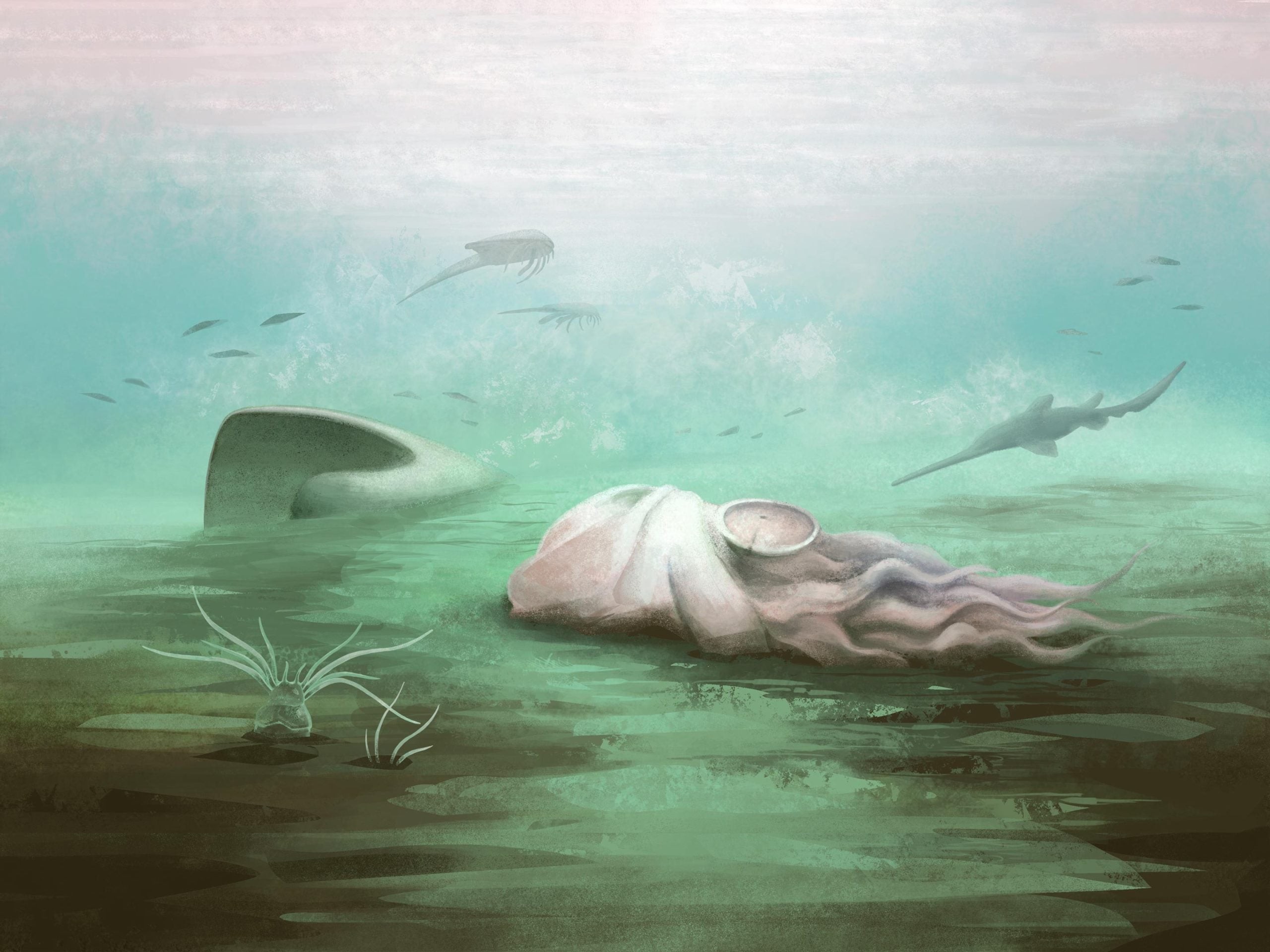
A fossil long celebrated as the world’s oldest octopus has been revealed to be a different marine animal entirely. The 300-million-year-old specimen, which once held a place in the Guinness Book of Records, was misidentified due to post-mortem changes that occurred before the creature was buried.
New research using advanced imaging techniques has shown that the fossil, known as Pohlsepia mazonensis, was not an octopus. Instead, it belonged to a group of shelled sea creatures related to the modern Nautilus. This discovery resolves a decades-long scientific debate and pushes back the record for preserved nautiloid soft tissue by hundreds of millions of years.
Hidden Teeth Solve a Decades-Long Mystery
The fossil was originally discovered in Illinois, USA, and described in a 2000 study. Researchers initially identified it as an octopus based on what appeared to be eight arms and fins. This identification suggested that octopuses existed roughly 150 million years earlier than previously thought, a claim that sparked both excitement and skepticism within the paleontological community.
While some scientists questioned the identification for years, there was no reliable way to verify the fossil’s internal structures until recently. The breakthrough came when researchers used synchrotron imaging, a technique that utilizes beams of light brighter than the sun to penetrate rock and reveal hidden details.
Dr. Thomas Clements, lead author of the study from the University of Reading, explained the significance of the new findings:
“It turns out the world’s most famous octopus fossil was never an octopus at all. It was a nautilus relative that had been decomposing for weeks before it became buried and later preserved in rock, and that decomposition is what made it look so convincingly octopus-like.”
Forensic Science on Ancient Fossils
The synchrotron scans acted like a modern forensic investigation on a 300-million-year-old crime scene. The technology allowed scientists to detect a radula —a ribbon-like feeding structure lined with rows of teeth unique to mollusks—hidden inside the fossilized rock.
The specific arrangement of these teeth provided the definitive proof needed to reclassify the specimen:
- Octopus Teeth: Typically have seven or nine teeth per row.
- Nautiloid Teeth: Typically have 13 teeth per row.
- Pohlsepia Teeth: The fossil showed at least 11 tooth-like structures per row, closely matching Paleocadmus pohli, a known nautiloid species from the same Illinois site.
This dental evidence immediately ruled out an octopus classification. Instead, it pointed to a nautiloid that had partially decomposed before fossilization. The decay process likely caused the tentacles to separate and arrange in a way that mimicked the eight arms of an octopus, leading to the initial misidentification.
Rewriting the Evolutionary Timeline
The reclassification of Pohlsepia mazonensis has significant implications for our understanding of marine evolution.
First, the fossil now holds a different record: it represents the oldest known preservation of nautiloid soft tissue in the fossil record. This surpasses the previous record by approximately 220 million years, offering unprecedented insight into ancient marine life. The Nautilus, often called a “living fossil” due to its ancient lineage, now has a much deeper historical footprint in the fossil record.
Second, the discovery corrects the timeline for octopus evolution. With this “oldest octopus” removed from the record, current evidence suggests that octopuses appeared later, during the Jurassic period. Furthermore, researchers now believe the evolutionary split between octopuses and their ten-armed relatives, such as squids, occurred during the Mesozoic era, rather than hundreds of millions of years earlier.
A New Chapter in Paleontology
The study, published in Proceedings of the Royal Society B, highlights how new technologies can overturn long-held scientific beliefs. What was once considered a cornerstone of octopus evolutionary history is now understood as a remarkable example of nautiloid preservation.
Dr. Clements noted the profound impact of such small details: “It’s amazing to think a row of tiny hidden teeth, hidden in the rock for 300 million years, have fundamentally changed what we know about when and how octopuses evolved.”
Conclusion
The reclassification of Pohlsepia mazonensis from octopus to nautiloid corrects a major error in the fossil record and refines our understanding of cephalopod evolution. By revealing that the creature was a decomposing nautilus relative, scientists have pushed the confirmed origin of octopuses to a later period while simultaneously uncovering the oldest known soft tissue of a nautiloid, showcasing the power of modern imaging in unraveling ancient mysteries.