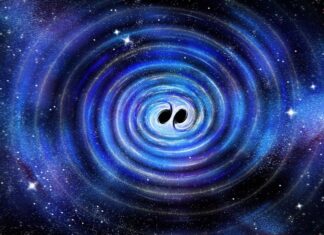
Astronomers have observed the brightest fast blue optical transient (FBOT) ever recorded, dubbed AT 2024wpp, which confirms that these extreme events are driven by black holes tearing apart entire stars. The new observations rule out traditional stellar explosions as the cause, revealing that a black hole up to 100 times the mass of our Sun consumed a massive companion star, converting a significant portion of its mass directly into energy.
What Are Fast Blue Optical Transients?
FBOTs are short-lived, intensely bright outbursts visible across billions of light-years. First detected in 2014, they puzzled scientists because their energy output defies conventional explanations like supernovae. The first well-studied case, AT 2018cow (nicknamed “the Cow”), led to a series of playfully named successors: the Koala, the Tasmanian Devil, and the Finch. Now, AT 2024wpp — possibly “the Wasp” — has shattered previous records.
Extreme Energy Release
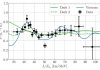
The energy released by AT 2024wpp is 100 times greater than that of a typical supernova. To produce this luminosity, about 10% of the Sun’s mass would need to be converted into energy within weeks. Crucially, observations from the Gemini South telescope revealed an excess of near-infrared light, a signature observed previously only in AT 2018cow — and absent in standard stellar explosions. This finding establishes near-infrared emissions as a hallmark of FBOTs, though the underlying mechanism remains unexplained.
“The sheer amount of radiated energy from these bursts is so large that you can’t power them with a core collapse stellar explosion — or any other type of normal stellar explosion,” said Natalie LeBaron, a graduate student at the University of California, Berkeley.
The Black Hole’s Long-Term Feeding
Scientists believe that the black hole had been slowly stripping material from its companion for an extended period, building up a halo of gas around itself. When the companion star ventured too close, it was shredded, and the resulting material crashed into the black hole’s accretion disk. This collision generated intense X-ray, ultraviolet, and blue light. Some gas was also ejected in powerful jets traveling at 40% of the speed of light, creating detectable radio waves.
The shredded companion star was likely a massive Wolf-Rayet star, already depleted of much of its hydrogen, which would explain the faint hydrogen emission observed in AT 2024wpp. The event occurred in a star-forming galaxy, where such massive stars are common, at a distance of 1.1 billion light-years. AT 2024wpp is 5 to 10 times brighter than the previous record holder, AT 2018cow.
These findings, published in two papers in The Astrophysical Journal Letters, provide new insights into the violent interactions between black holes and stars, and challenge existing models of extreme cosmic events.
The discovery confirms that FBOTs are not simply exploding stars but the result of a black hole’s brutal and energetic feast.