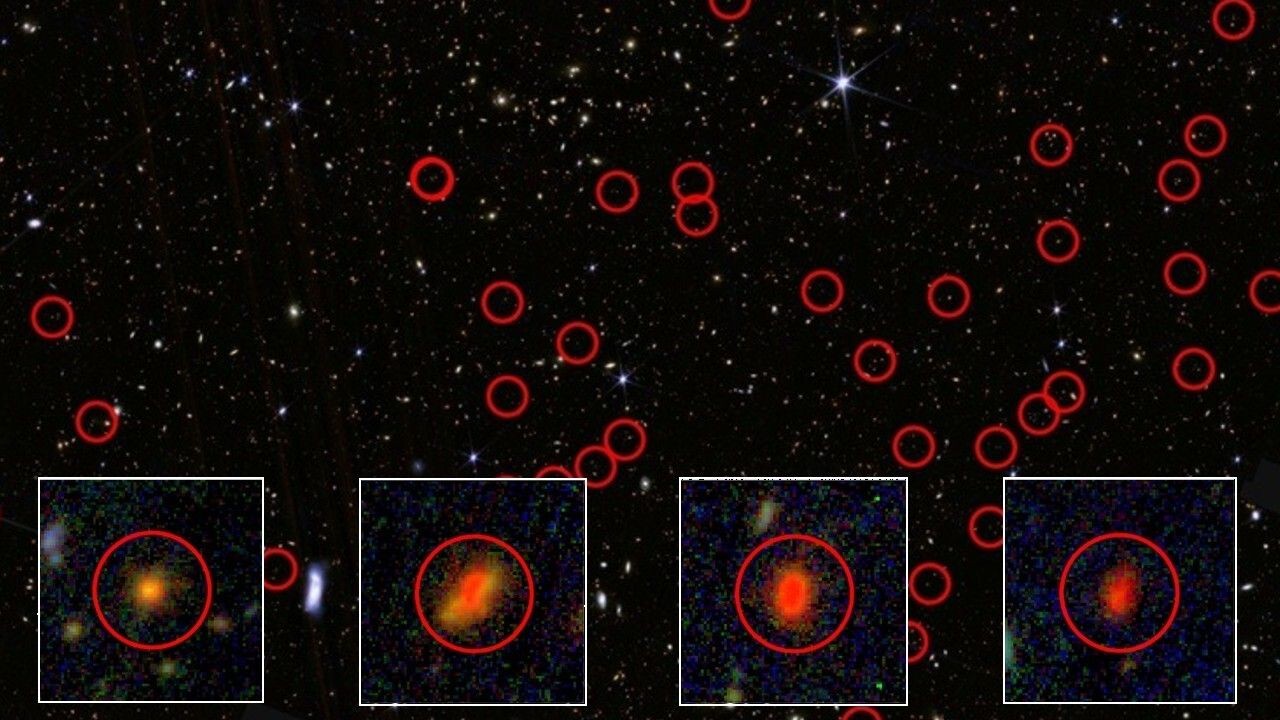
The James Webb Space Telescope (JWST) has revealed enigmatic “little red dots” in the early universe, prompting debate over their origin. Initial theories suggested these objects were rapidly growing black holes, but new research indicates they could instead be massive stars nearing collapse, the potential ancestors of the first supermassive black holes. This discovery re-frames our understanding of early galactic evolution and how black holes first formed.
The Mystery of the Red Dots
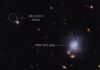
These compact, reddish objects emerged within the first 2 billion years after the Big Bang, surprising astronomers with their small size and lack of expected X-ray emissions, typically associated with actively feeding black holes. Their spectra also lack the metal signatures common around black holes, suggesting a chemically pristine environment. This ambiguity led Devesh Nandal and Avi Loeb of Harvard and Smithsonian Center for Astrophysics to explore an alternative: these dots might be supermassive stars in their final moments.
Supermassive Stars as a Possible Explanation
The research team developed a model of primordial supermassive stars—the first generation of stars (Population III), potentially reaching thousands of times the sun’s mass. These stars, formed from hydrogen and helium, are predicted to collapse into supermassive black holes upon death.
Their simulations matched observed brightness levels and spectral features of two specific red dots (MoM-BH*-1 and The Cliff), including a distinctive “V-shaped” dip in their spectra. This dip, initially attributed to dust absorption, now appears to originate from the star’s atmosphere itself. If such stars existed, they would naturally produce the observed characteristics.
A Short-Lived Phenomenon
These hypothetical stars would burn brightly for only about 10,000 years (for the most massive) or up to a million years (for stars with 10,000–100,000 solar masses), making detection difficult. The short lifespan raises questions about why hundreds of these objects have already been discovered.
The team suggests that not all red dots can be explained by this model, meaning some may still be black holes. A key test will be detecting X-ray emissions, which would confirm black hole activity. Variability in brightness would also favor the black hole hypothesis, as stars emit light more steadily.
The Next Steps in Confirmation
Decisive proof lies in detailed spectroscopic measurements of the gas surrounding these dots. The presence of nitrogen would support the supermassive star theory, while strong neon lines would indicate a black hole. Radio observations from facilities like the Square Kilometre Array could also detect emissions from black holes that might otherwise be obscured by dust.
If these objects are black holes, radio waves will escape and be detected. If they are stars, we should see consistent, steady emission.
Ultimately, whether these “little red dots” represent the final moments of dying stars or the birthplaces of black holes remains to be seen. Further observations will be critical to resolving this cosmic mystery.