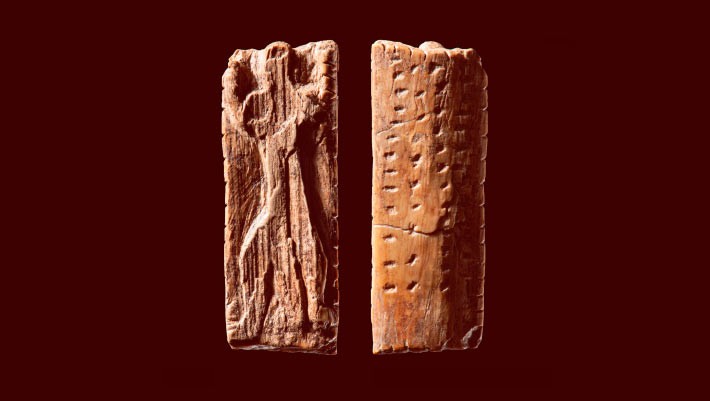
Forty thousand years ago, before the advent of writing, early Homo sapiens in Europe developed a deliberate system of geometric markings. A new study published in the Proceedings of the National Academy of Sciences reveals that these markings weren’t random decorations but a conventional way to store and transmit information visually. This discovery pushes back the timeline for organized symbolic thought by tens of millennia.
The Aurignacian Sign System
Researchers analyzed over 260 artifacts from cave sites in the Swabian Jura region of southwestern Germany. These objects, dated between 43,000 and 34,000 years ago, included tools, beads, musical instruments, and figurines carved from ivory, bone, and antler. Many were engraved with repeated sequences of dots, lines, and crosses.
The scientists applied quantitative linguistics and information theory to over 3,000 signs, revealing a striking pattern: the system was stable over roughly 10,000 years. While not writing in the modern sense (it did not encode spoken language), it closely resembled early accounting marks like protocuneiform from Mesopotamia, which emerged 5,500 years ago.
Why This Matters
The stability and repetition of these symbols suggest shared rules passed down through generations. The context of the markings also mattered: denser sequences appeared on figurines, particularly those carved from ivory, while certain symbols were consistently used for specific subjects. For example, dots were common on human and feline figures, while crosses appeared on animals like mammoths and horses. This shows a deliberate structure, not arbitrary scribbling.
Implications for Human Cognition
This finding challenges the assumption that symbolic communication suddenly appeared with writing. Instead, the evidence suggests a gradual evolution of systems designed to record numbers, events, or social knowledge. Researchers theorize that these signs may have tracked seasonal cycles, hunting information, or ritual concepts.
“Paleolithic hunter-gatherers developed a system of symbols that has an information density statistically comparable to the earliest protocuneiform tablets,” said Dr. Christian Bentz, one of the study’s authors.
This suggests that Stone Age humans possessed cognitive abilities comparable to modern humans, including the capacity for abstract thought and the need to coordinate complex tasks. The portability of the objects further underscores their importance; many fit in the palm of the hand, similar to ancient Mesopotamian tablets.
The evidence shows that organized symbolic thought was not a sudden invention but an evolutionary process stretching back at least 40,000 years. This system of signs provides a glimpse into the cognitive lives of early humans, demonstrating their capacity for structured communication long before the emergence of written language.