Researchers in China have achieved a significant step forward in fusion energy development, successfully exceeding a long-held density limit in experimental reactors. The breakthrough at the Experimental Advanced Superconducting Tokamak (EAST) demonstrates that the traditional constraints on plasma density – a critical factor in fusion efficiency – can be circumvented through precise control of reactor conditions. This matters because increasing plasma density is directly linked to higher energy output, a key challenge in making fusion power viable.
The Greenwald Limit and Why It Matters
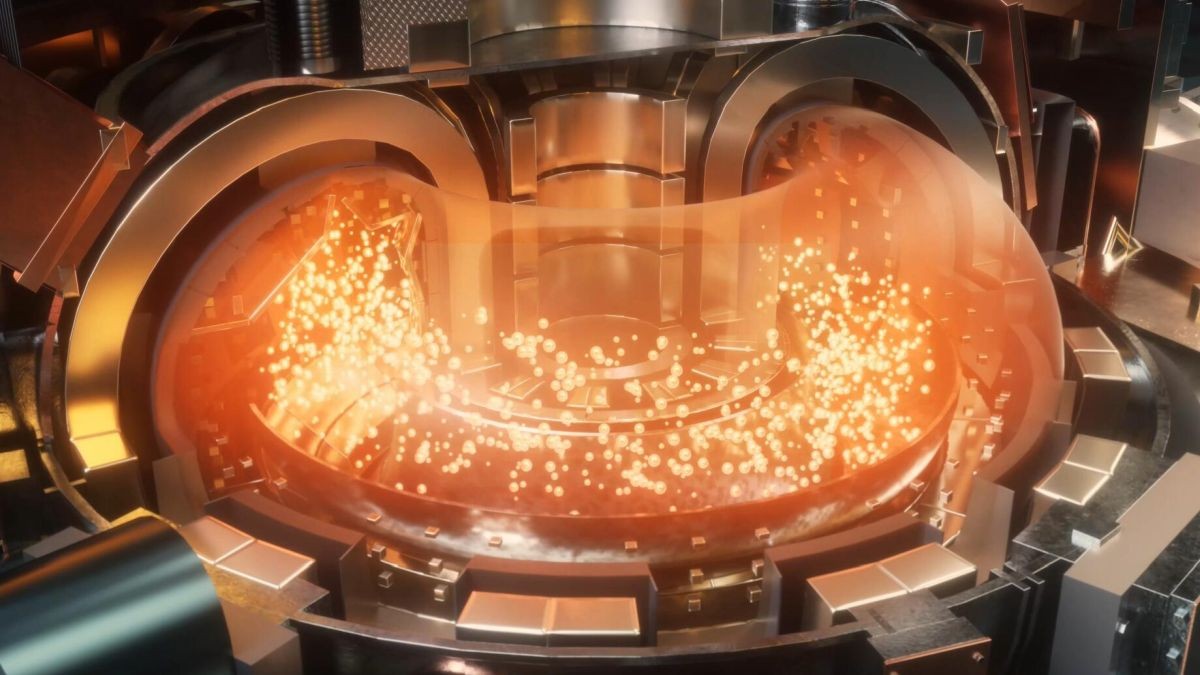
For decades, fusion physicists have operated under what’s known as the Greenwald limit: a practical boundary beyond which superheated plasma tends to become unstable, potentially damaging reactor components. This wasn’t considered a hard law of physics, but rather an observed phenomenon that dictated how far plasma density could be pushed within a tokamak (a donut-shaped magnetic confinement device) before collapsing.
The problem? The more atoms packed into the plasma, the more fusion reactions occur, and thus the higher the energy output. But as density increases, the plasma radiates energy, cools at its boundary, and pulls impurities from the reactor walls. These impurities accelerate cooling, releasing more impurities in a destructive feedback loop that degrades magnetic confinement and shuts down the reaction.
The Density-Free Regime: A New Approach
Recent theoretical work suggested a way around this limit: controlling plasma-wall interactions during reactor startup to prevent impurity buildup. A team led by Ping Zhu and Ning Yan tested this theory at EAST, carefully adjusting fuel gas pressure and applying electron cyclotron resonance heating.
The result? They achieved plasma densities 65% higher than the Greenwald limit, by dramatically reducing the entry of wall impurities into the plasma. This isn’t a complete elimination of density limits, but it proves that the traditional barrier is not absolute.
Implications for Future Fusion Reactors
This finding suggests that fusion reactors can be designed and operated more efficiently than previously thought. By tweaking operational processes, future devices may be able to sustain higher-density, higher-energy reactions. The researchers are continuing to refine their methods to see how EAST performs under these improved conditions.
“The findings suggest a practical and scalable pathway for extending density limits in tokamaks and next-generation burning plasma fusion devices,” says Zhu.
This breakthrough is significant because it removes a key roadblock on the path to sustainable fusion energy, bringing us closer to a clean, virtually limitless power source.